

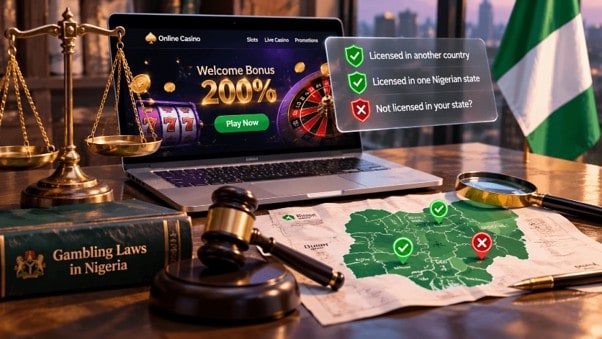

A casino site opens fine in Lagos. You can browse the slots, make an account and see deposit options in naira, and nothing hints at a problem. But does being able to open a casino mean it’s legally allowed to operate?
Not always. Who regulates online gambling in Nigeria depends on the state you’re in, and the license a casino shows might not cover you at all. A site can be fully licensed abroad, or in one Nigerian state, and still have no permission to take players from another. That’s worth knowing before you believe a badge on a homepage.
Why Casino Laws Depend on Location
There’s no single license that covers a gambling operator across all of Nigeria. In November 2024 the Supreme Court ruled that lotteries and games of chance are mostly a matter for the individual states to regulate, while the Federal Capital Territory has its own arrangements. In practice, that makes your location the first thing that counts.
Take Lagos. The Lagos State Lotteries and Gaming Authority regulates gambling there, online casino games included, and other states set their own rules. So whether an operator is legal depends on three things: which rules apply where you are, what kind of gambling it offers and who gave it the license.
Where the Law Is Still Being Sorted Out
The Supreme Court ruling didn’t leave Nigeria with one new system. It left a patchwork. More than 20 states have joined the Federation of State Gaming Regulators of Nigeria, and in May 2025 the group introduced a framework that lets an online operator apply once for a certificate covering all member states. Other states are going their own way, and nine Muslim-majority states in the north prohibit gambling under Sharia law.
Online gambling is the part that’s still disputed. Federal lawmakers have proposed a Central Gaming Bill 2025 to regulate online and remote gaming nationwide, arguing that the Supreme Court never addressed online gambling.
State regulators say the ruling covers it and have pushed back hard. Because the rules in your state could change, check the current position with your state regulator instead of relying on any article, this one included.

What Different Licence Claims Actually Tell You
Casino sites love to show regulatory badges but rarely explain what they mean. One may name a Nigerian authority, another an overseas regulator, and a third gives you nothing you can verify.
That matters when you’re looking at legal online casinos. The table shows how to read the most common claims without treating any single badge as proof.
| Licence claim | What it tells you | What still needs checking |
| Nigerian state licence | Operator claims local authorisation | State, activity and validity |
| Foreign gaming licence | Operator claims overseas regulation | Permission to serve local players |
| Licence number | A potentially verifiable identifier | Match with regulator’s records |
| Licensed casino badge | Marketing claim | Issuing authority and company name |
| No licence information | Legal status is unclear | Operator identity and authorisation |
A badge is only a claim. A license number you can look up on the regulator’s own site is evidence.
Why a Casino List Isn’t a Legal Guarantee
Landing on an online casino list says very little about whether an operator is properly licensed. Those ratings usually come down to the game selection, the bonuses, and how smooth the payments are, and nobody has necessarily checked the legal side.
Player reviews have the same blind spot. A player who says “I got my money out” has told you that one withdrawal went through, which is nice, but it isn’t proof the casino meets local licensing rules. For that, you have to ask the regulator.
A Short Check Before Opening an Account
Say a casino advertises hundreds of games and takes Nigerian bank transfers. The site mentions a license, but you’ve never heard of the regulator. Don’t assume it’s fine. Before you sign up, find out:
- who operates the casino, and under what registered company name
- who issued the license, and in which jurisdiction
- whether the license is current, according to the official records
- whether it covers casino games, since sports betting can need separate permission
- where you can report a dispute
If you can’t answer most of these from the site itself, take that seriously before you deposit.
Legal Doesn’t Mean Risk-Free
A properly licensed casino can still cost you money. A license covers the operator’s permission to run certain activities and its duties to the regulator. It isn’t a promise that you’ll win, or that every dispute ends in your favor.
That’s especially true for games of chance. As Wikipedia’s overview of the house edge explains, casino games have a mathematical advantage built into their rules, and regulation doesn’t remove it. Legal or not, set a spending limit and learn how the games work.
Conclusion
You can’t tell whether an online casino is legal in Nigeria by checking if the site loads, takes naira, or shows a license badge. It depends on who regulates the state you’re in, where the operator is licensed, whether the license is valid, and what kind of gambling it covers. With the rules still shifting, that picture can change.
Official license registers are a better starting point than promo claims or ratings. Check the operating company and its authorization before you deposit, and remember that a legal casino can still lose you money. Legal and safe for your wallet aren’t the same thing.