

CAF held a two-day workshop in Cairo on 29 and 30 October 2026 for clubs entering the group stages of the 2026/27 Champions League and Confederation Cup. Announced by the governing body on 28 October, the programme covered competition rules, refereeing, VAR procedures, television production and match operations.
The timing was important. Sixteen clubs in each competition had just learned their group-stage opponents, and CAF was trying to establish common procedures before matches began. For viewers following live games or comparing football betting odds on BizBet, consistent VAR communication also matters because an unconfirmed goal can temporarily affect score feeds and live markets.
CAF’s announcement referred to VAR. It did not say that semi-automated offside technology would be used throughout either competition. The systems are connected, but they should not be treated as the same thing.
VAR is a review process run by match officials
The video assistant referee system allows designated officials to review certain match-changing incidents using broadcast and dedicated camera footage. These include goals, penalties, direct red cards and cases of mistaken identity.
VAR is the person and the review process, not a particular offside camera system.
Under the protocol published by the International Football Association Board, the referee must still make an initial decision on the field. The VAR can recommend a review or provide factual information, but the referee retains responsibility for the final decision.
A conventional VAR offside check may require officials to choose the relevant frame, establish when the ball was played and position virtual lines. That process can take time, particularly when the incident is close or several players are involved.

SAOT sends positional information to the VAR team
Semi-automated offside technology, or SAOT, adds player and ball tracking to the VAR process. It is designed to identify potential offside positions more quickly and provide the video officials with a proposed result.
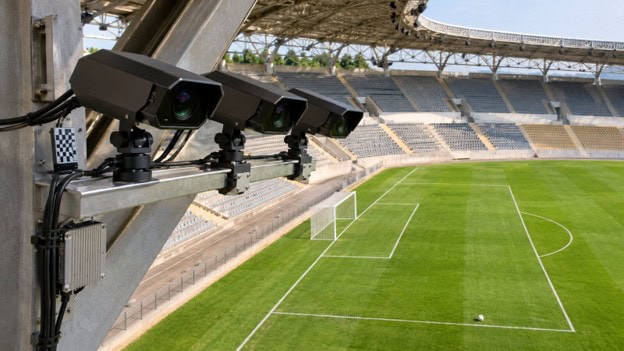
FIFA’s current technical description refers to a system using 16 cameras inside the stadium. The cameras usually record the ball and 29 body points for every player 50 times per second. Optical ball tracking is used, with data from a connected ball added when that technology is available.
The figure is not identical for every generation of the system. At the 2022 World Cup, FIFA described a configuration with 12 tracking cameras and a connected ball transmitting data 500 times per second. Technical specifications should therefore be linked to the tournament and version being discussed.
With standard SAOT, an automated alert goes to the VAR team in the video operation room. The officials review the proposed kick point and offside position before communicating the decision to the referee.
| System | Main function | Where the alert goes | Who confirms the decision |
| VAR | Reviews match-changing incidents | Video officials | Referee |
| SAOT | Detects possible positional offsides | VAR team | VAR and referee |
| Advanced SAOT | Detects clear positional offsides faster | VAR and on-field officials | Match officials |
The technology reduces the manual work needed to establish position. It does not take control of the match away from the officials.
Advanced SAOT can alert officials on the field
Advanced SAOT uses the same tracking process but adds a direct audio signal for clear positional offsides. Instead of waiting for the information to pass only through the video room, the assistant referee can receive an immediate alert.
FIFA tested the system at the 2025 Club World Cup and used it again at the 2025 Intercontinental Cup. Its account of the latter tournament says the setup used 16 optical cameras, 29 tracking points per player and connected-ball data to help identify the moment of contact.
The direct alert is intended for straightforward positional cases. Incidents involving interference with an opponent or another subjective element still need interpretation.
This difference is central:
- VAR provides the broader review framework;
- SAOT proposes offside information for the video officials;
- advanced SAOT can also send clear positional alerts directly to the on-field team.
Calling all three “automated VAR” hides how the decision actually travels.
Delayed flags remain part of the protocol
Assistant referees may delay raising the flag when there is a clear attacking situation and an immediate chance of a goal. The purpose is to avoid stopping an attack that a later review might show was onside.
According to the IFAB protocol, delayed flags are permitted only in clearly defined attacking situations, not as a general instruction to ignore possible offsides.
Advanced SAOT may shorten that delay in clear positional cases. A close incident or one involving possible interference can still require a completed attack and a VAR review.
For live data services, the result is familiar: a goal may appear, change to “under review” and then disappear. Betting markets can remain suspended until the official decision is known. The first notification on a phone is provisional; the referee’s decision determines the recorded event.
CAF’s immediate task is consistent VAR operation
The Cairo workshop was not an announcement that advanced SAOT had been adopted across African club football. Its confirmed purpose was more practical: preparing clubs for VAR procedures, refereeing requirements, television production and match organisation.
Those areas depend on one another. Camera placement affects the available angles. Communication links connect the referee with the video room. Broadcasters need the correct replay, while clubs must understand what happens when equipment fails or a review delays the restart.
Faster tracking may eventually reduce waiting time in African competitions. CAF’s October workshop addressed the more immediate requirement: ensuring that clubs and officials enter the group stages with a shared understanding of how the existing VAR process should operate.