

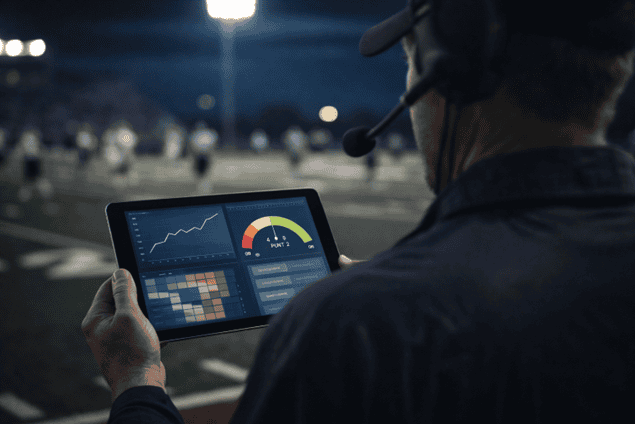
On a cold sideline, it can still look like the old world: laminated play sheets, shouted reminders, a coordinator pointing at space only he can see. But the modern game now unfolds on the second plane. Data and analytics haven’t turned coaches into robots. They’ve turned the job into something closer to navigation: reading the weather, watching the tide, and choosing the safest route while the waves argue back.
The most important shift is not that coaches “use analytics.” It’s that analytics have moved from postgame autopsy to live decision-making. They influence what gets practiced on Tuesday, who gets saved on Friday, and what a coach dares to do on fourth-and-short when the crowd is begging for a punt.
The numbers moved to the headset
A decade ago, analytics were often treated like a specialty: a small group of staffers building slides for the head coach to glance at between meetings. Now, the infrastructure is bigger, and the questions are sharper. Coaches want answers that arrive in time to matter, and they want those answers to live inside football language.
The biggest change is rhythm. What used to be a weekly cycle (review, plan, install) is now layered with constant measurement: practice speed, rep counts, sprint distance, recovery signals, and opponent tendencies updated after every snap. If you’ve ever heard a coach talk about “earning the right” to call something, data has become one way to define what that right looks like.
Fourth down is now a calculated risk
Fourth down used to be a kind of cultural test. Conservative choices sounded “smart,” and aggressive ones sounded “reckless,” even when the math disagreed. That’s why the new decision tools matter: they translate chaos into options, and they do it without pretending the game is simple.
The NFL’s Next Gen Stats Decision Guide is an example of this shift. The league has described it as a live decision-support tool for fourth downs and two-point conversions, built on machine-learning models and framed around win probability and conversion probability. It doesn’t call the play for a coach, but it does force a question to be answered honestly: what’s the cost of playing it safe?
Independent models and analytics groups have pushed the same idea for years. When an AP explainer cites EdjSports’ win-probability view of game management, it’s pointing at a larger trend: coaches are being judged by the quality of their decisions, not just the beauty of the outcome. A stopped fourth-and-1 may still look ugly, but the process can be defensible.

Turning “effort” into coordinates
Coaches have always loved film because film shows intent. Tracking data adds something film can’t: it measures the space between intent and execution. In the NFL, Next Gen Stats uses RFID tags in shoulder pads, plus tags on officials and even the ball, to capture player movement across the field. When you can quantify separation, acceleration, pursuit angles, and spacing, you can coach details that used to be argued about forever.
This is not an NFL-only story. Basketball’s tracking ecosystem has been building for years, and the NBA G League’s partnership with Second Spectrum was described as a leaguewide deployment of optical tracking that serves players, coaches, and broadcasters. The technical point matters less than the coaching consequence: spacing is no longer a feeling. It’s a shape you can measure.
The practical effect is subtle but real. A coach can ask why a defensive call keeps bleeding yards to the same concept, and the answer might lie in the half-step a linebacker loses on his third long run of the night. Data helps find the half-step.
Workload data is changing a lot
The harshest lesson of a season is that talent doesn’t matter much if it’s unavailable. That’s why athlete monitoring has become one of analytics’ most immediate coaching tools. Wearables can track speed, distance, acceleration, and overall workload. Companies like Catapult describe how teams use these metrics to tailor training and manage fatigue, with the explicit aim of reducing injury risk.

For coaches, this changes the meaning of “toughness.” A staff can still demand intensity, but it can also plan intensity like a resource. It becomes easier to justify a lighter day when the data shows a player’s load spiking beyond a safe baseline. It becomes easier to keep a rotation honest when the numbers show who is actually carrying the hidden work.
The deeper influence is cultural. Players are more likely to buy into a plan when the plan is explained with evidence rather than tradition. “We’re easing you today” lands differently when it’s tied to a workload trend rather than a hunch.
Betting markets as a mirror
There’s a reason fans talk about probabilities now. Analytics language has seeped into the way people watch games, and the rise of live models makes every drive feel like a shifting forecast. On MelBet, injury reports, pace, and matchup tendencies also shape how odds move from kickoff to the final minutes. Some fans translate those probabilities into pari sportif, treating it as a structured entertainment layer rather than a substitute for understanding the sport. The key is discipline: set limits before the game, keep stakes modest, and accept that even the best model loses to a bounced ball.
What numbers still struggle to capture
Analytics can illuminate patterns, but it can also seduce people into thinking a pattern is destiny. Context still matters. A conversion probability doesn’t know the emotional weather of a rivalry game. A workload chart doesn’t understand that a veteran can self-regulate in ways a freshman can’t.
Data also inherits the biases of what gets measured. Tracking can tell you where a player went, but not always why he chose that route. Models can optimize for “average” situations and still fail in the weird ones. Coaches earn their salaries in the weird ones.
The coach of 2026
The future isn’t a headset barking orders while an algorithm runs the team. It’s a coach who can translate numbers into belief and belief into habits. Analytics will keep pushing game management toward aggression when the math supports it. Tracking will keep turning “effort” into measurable movement. Wearables will keep reshaping practice so that availability is treated like a skill, not a prayer.
But the last decision will still belong to a human being, standing in front of 60,000 opinions and choosing what kind of season he wants to live with. Data won’t remove pressure. It will clarify it.