

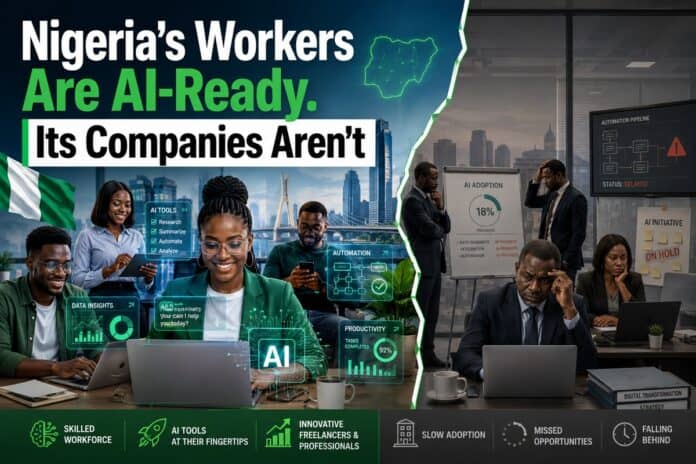

Nigerian workers have taught themselves to use artificial intelligence faster than Nigerian businesses have figured out how to deploy it. That is the standout finding for Nigeria in the newly published 2026 Global Outsourcing AI Readiness Index, and it captures a tension anyone working in Lagos, Abuja, or Port Harcourt will recognize: the talent is ready, the institutions are lagging.
The index, produced by Ataraxis, ranks the world’s top 25 outsourcing destinations across four dimensions: workforce, AI literacy, population, AI adoption, enterprise AI adoption, and the AI education pipeline. Nigeria’s overall score is 49.15 out of 100, placing it 17th. But that single number hides the most interesting story in the country’s data: a 32-point gap between how skilled its workers are and how little its companies use those skills.
The 32-point gap
Nigeria’s strongest dimension by a wide margin is workforce AI literacy, with a score of 66 and a rank of 6th in the world among outsourcing destinations. Its weakest is enterprise AI adoption, where it scores just 34 and ranks 19th out of 25.
That 32-point spread is the widest workforce-to-enterprise gap among destinations in the index. In plain terms: Nigerian professionals are experimenting with ChatGPT, Claude, Midjourney, and a growing stack of AI tools on their own initiative, often to serve foreign clients or make their own work faster. Their employers, meanwhile, have been slow to build AI into how their organizations actually run.
This is not a talent problem. It is an adoption problem, and the two are very different things to fix.
Sixth in the world for AI skills
It is worth pausing on the workforce number, because it is genuinely impressive. A score of 66 puts Nigeria behind only five destinations globally: India (89), Brazil and the Philippines (both 76), Poland (70), and Malaysia (68).
That means Nigeria’s workforce AI literacy outranks every outsourcing destination in Europe outside Poland, every destination in Latin America outside Brazil, and every other country in Africa.

For a market often discussed in terms of what it lacks, stable power, cheap bandwidth, and patient capital, this is a rare case of Nigeria leading rather than catching up.
Much of that has been driven from the bottom up. Freelancers, remote workers, students, and small studios have adopted AI tools because the tools lower the cost of competing for international work. When a designer in Yaba or a developer in Enugu can deliver faster by using AI, they do – no boardroom sign-off required.
Where the companies fall behind
The contrast on the enterprise side is stark. Nigeria’s enterprise AI adoption score of 34 sits ahead of only six destinations in the entire index: Ghana (31), Pakistan and Bangladesh (both 25), Nepal (19), and Uganda and Ethiopia (14 each). Among serious outsourcing contenders, Nigerian enterprises are near the back of the pack.
Several familiar forces are likely at work here. Deploying AI across an organization costs money and demands reliable infrastructure, power, and connectivity that many Nigerian firms still cannot take for granted. It also requires management confidence and internal expertise, which are easier to find in an individual freelancer than in a mid-sized company’s leadership.

There is a subtler factor, too. Nigeria’s most AI-fluent workers are often the ones least tied to local enterprises; they work remotely for firms abroad, freelance across borders, or build their own products.
The skills exist in the labor pool, but they do not always flow into the domestic companies the index measures. The talent is Nigerian; the deployment is happening somewhere else.
The other anchor: the education pipeline
Enterprise adoption is not the only weight dragging Nigeria’s composite score down. The AI education pipeline also ranks 19th, with a score of 41. Together, these two dimensions are what separate Nigeria’s 6th-place workforce from its 17th-place overall standing.
That pipeline number matters for the future. Today’s strong workforce score reflects self-directed learning, people picking up AI tools on YouTube, in WhatsApp groups, through trial and error.
That grassroots energy is real, but it is not the same as a formal system producing AI-ready graduates at scale. If universities, polytechnics, and training institutions do not build AI into their curricula, the current advantage could plateau just as competitors formalize theirs.
Third in Africa, but only just
Regionally, Nigeria ranks as Africa’s 3rd most AI-ready outsourcing destination, behind South Africa (66.5) and Egypt (49.35), and ahead of Kenya (47.6), Morocco (43.35), Ghana (42.25), Uganda (25.1), and Ethiopia (24.2).
The Egypt comparison is instructive. Nigeria trails Egypt overall by a razor-thin 0.20 points despite having a dramatically stronger workforce (66 versus 50). Egypt pulls ahead precisely where Nigeria is weakest: population AI adoption (53 to Nigeria’s 49), enterprise adoption (42 to 34), and the education pipeline (53 to 41). In other words, Egypt is more balanced, whereas Nigeria is carried almost entirely by a single exceptional dimension.
The lesson writes itself. If Nigeria closed even part of its enterprise and education gaps, it would not just edge past Egypt, it would pull clear of the African pack and start challenging destinations well above it.
The opportunity in the gap
A 32-point gap is a warning, but it is also an invitation. The hardest thing is to manufacture a workforce that actually wants to use AI and has taught itself how to do so, as Nigeria already has. What remains is the more tractable work of getting businesses to deploy those skills and getting institutions to teach them formally.
For outsourcing firms, that is a competitive opening. The companies that move first to build AI into their delivery will be drawing from one of the most AI-literate labor pools outside India.
For policymakers and educators, it is a signal about where to focus. And for the many Nigerians already fluent in these tools, it is a quiet confirmation of something they have known for a while: they were ready before the system was.
You can explore the full index and methodology at the 2026 Global Outsourcing AI Readiness Index.