

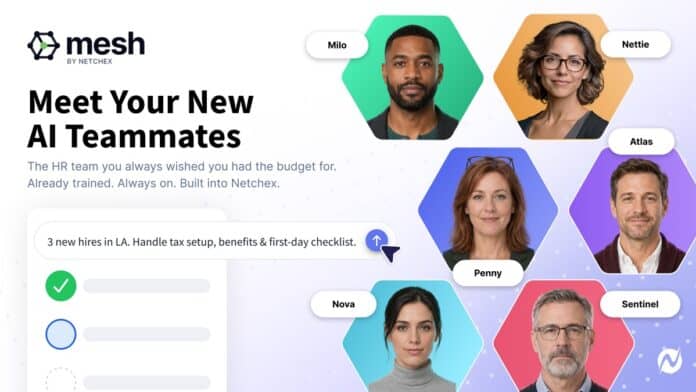
When Netchex launched Mesh in July 2026, it did not ship one AI assistant. It shipped six, each with a name, a job title, and a specific slice of HR work it owns from start to finish.
That structure is the whole point. Instead of a single chatbot that answers whatever you type, Mesh splits HR operations the way a real department would. Someone on payroll, someone on people ops, someone watching for problems, someone on reporting, someone looking after employees, and someone answering the admin’s questions.
Netchex calls them teammates. They share one underlying data model, which is what lets them hand work off to each other.
Here is what each of the six actually does, what you can ask them, and how much they are trusted to do on their own.
Quick reference: the six Mesh AI agents
| Agent | Role | Built for | Owns |
|---|---|---|---|
| Penny | Payroll and Time Teammate | Admins | The pay cycle end-to-end |
| Atlas | People Operations Teammate | Admins | The employee lifecycle |
| Sentinel | Anomaly Teammate | Admins | 24/7 monitoring and alerts |
| Nova | Insights and Analytics Teammate | Admins | Reporting and analysis |
| Milo | HR and Employee Teammate | Employees | Self-service HR requests |
| Nettie | Service Partner Teammate | Admins | Product support and troubleshooting |
Netchex also describes Sentinel as a “compliance and risk analyst” and Nova as both a “workforce analyst”.
Penny: the payroll and time teammate
Penny owns the pay cycle from one end to the other. She approves timecards, plans schedules, processes PTO, runs payroll, and catches paycheck discrepancies before the money moves, the stated goal being to flag problems before they hit anyone’s bank account.
She is also the agent doing the least glamorous and most time-consuming job in any lean HR operation: chasing the missing timecards that hold up a payroll run.

What you can ask Penny:
- Run payroll for the last two weeks and flag anything unusual
- Approve all clean timecards and show only the exceptions
- Build next week’s schedule with the same coverage as last week
In Netchex’s own before-and-after scenario, Penny approves a pending overtime entry without a manager needing to log in, and flags the open items ahead of a payroll cutoff so nothing is missed.
Atlas: the people operations teammate
Atlas carries the employee lifecycle. It onboards new hires, processes promotions and compensation changes, transfers people between departments and locations, and keeps performance records current.
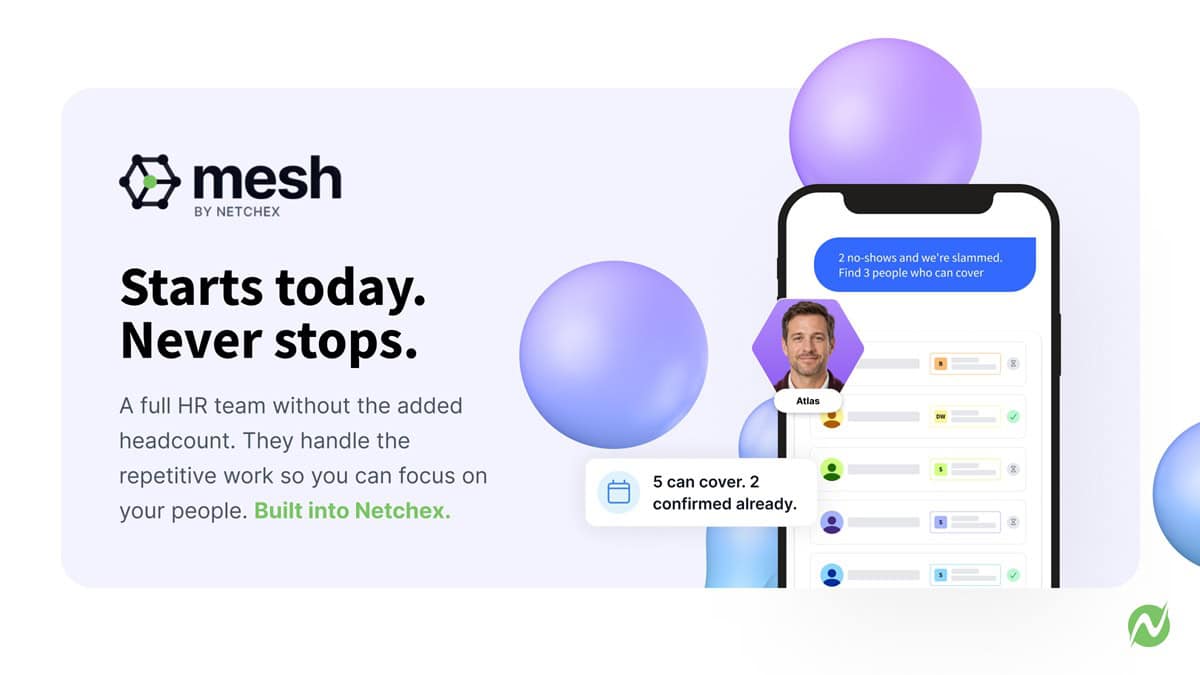

For multi-location operators a hotel group, a restaurant chain, a dealership network this is the agent handling the constant churn of people moving, starting, and changing roles across sites.
What you can ask Atlas:
- Onboard the three new hires starting Monday
- Move an employee to a different location, effective a set date
- Process the compensation changes from a leadership review
Atlas also handles reposting open shifts; in Netchex’s example, an uncovered Friday closing shift gets reposted and filled within the hour.
Sentinel: the anomaly teammate
Sentinel is the one that never waits to be asked. It watches operations around the clock and surfaces only what needs a human’s attention: hours approved in error, sudden compensation drift, a compliance window about to close.
This is the clearest expression of what separates Mesh from ask-and-answer AI. Sentinel’s output is not a reply to a question; it is an unprompted flag.
What Sentinel tells you:
- Three managers have not approved timecards, and cutoff is in two hours
- An employee’s last paycheck is significantly below peers in the same role
- I-9 documentation expires next week for two employees
Netchex’s broader example of this kind of pattern-catching is spotting expiring technician certifications weeks before they turn into a staffing gap, or noticing a scheduling pattern that is quietly turning a strong employee into a flight risk.
Nova: the insights and analytics teammate
Nova turns operations data into answers without anyone writing a query. Netchex’s pitch here is blunt about who this replaces in practice: no SQL, no business intelligence license, no waiting on a data team.
For a lean HR function, reporting is often the task that simply never gets done not because it is hard, but because nobody has an hour spare to build the report.
What you can ask Nova:
- How is overtime trending this quarter versus last
- Which locations had the most callouts last month
- Show turnover by manager for the quarter
Netchex claims workforce reports come back roughly ten times faster when asked of Nova rather than built manually; a directional early-access figure rather than an audited one.
Milo: the HR and employee teammate
Milo is the only one of the six built for employees rather than admins, and it is arguably the most consequential for a deskless workforce.
It files PTO, fixes missed clock-ins, completes review forms, and updates direct deposit details all through chat, from wherever the employee happens to be.
It also answers policy questions directly, drawing on the employer’s actual policies rather than generic HR guidance: benefits details, upcoming tax changes, and the difference between statutory leave and a company’s own parental leave plan.
What employees can ask Milo:
- Apply for PTO next Friday for a medical appointment
- Fix a missed clock-in from this morning
- Complete a self-review form using existing performance objectives
The more striking behavior is unprompted. Netchex demonstrates Milo sitting inside an existing team group chat. When a worker messages the group to say that their kid is unwell, Milo privately offers to file for a sick day and start arranging shift coverage visible only to that employee, and acted on only once they confirm.
That is the “shift swaps happen over group texts” problem being met where it actually lives, rather than redirected into a portal nobody opens.
Nettie — the service partner teammate
Nettie is the agent for the admin who is stuck. It troubleshoots issues and answers product questions, pulling from Netchex’s knowledge articles, training modules, and bug history so the admin is not waiting on a support ticket to move.
What you can ask Nettie:
- Why did a particular timecard fail to sync to payroll
- Walk me through setting up a new pay group
- Is this the same login issue we saw last month
It is a quietly practical inclusion. In a small HR team, a blocked admin at 4 pm on a payroll day is its own kind of emergency.
How much are they allowed to do? The four levels of autonomy
Mesh agents do not go from zero to fully automated. Netchex describes four levels, with the customer deciding how far to delegate:
- Ask — plain-language questions, instant answers.
- Act — you tell them what to do, and they do it: approve a batch of timecards, process a transfer, run a report.
- Anticipate — they prompt you before you ask, flagging cutoffs and uncovered shifts.
- Automate — once trusted, they handle the repeat work and escalate only the exceptions.
Across all of it, Netchex says nothing sensitive is submitted without human approval. The customer quoted in the launch, Tabitha Lehman of hotel group Northwest X Southern, singled out transparency as what made it workable: being able to see exactly what the agent checked, why something was flagged, and what happens next.
Where the agents work
Mesh is not confined to the Netchex platform. Employees can file PTO, swap shifts, and check pay stubs directly inside ChatGPT or Claude. Managers can spot overtime trends and approve requests, and admins can run payroll audits and pull headcount reports without opening Netchex at all.
What Netchex claims the agents deliver
The company reports the following from its early access program, and is explicit that these are directional results rather than audited benchmarks:
- 48% fewer payroll corrections once Penny reviews every run
- 65% faster onboarding, from offer accepted to first shift worked
- 80% of PTO, schedule, and policy questions answered instantly, without a call to HR
- 10x faster workforce reporting
Treat these as the vendor’s own early indicators. They are useful for understanding what the product is aiming at, not as a guarantee of what any given business would see.
More agents are coming
The six are described as a founding roster. Netchex says specialists covering recruiting, benefits administration, learning and development, and compliance are already in training, built on the same conversational foundation.
Frequently asked questions
How many Mesh AI agents are there? Six at launch: Penny, Atlas, Sentinel, Nova, Milo, and Nettie, with more in development.
Which Mesh agent do employees use? Milo. The other five are built primarily for admins and managers, with Nettie specifically supporting admins on product and troubleshooting questions.
Do the Mesh agents act without human approval? Netchex states that nothing sensitive is submitted without human approval. How much routine work an agent handles independently depends on which of the four autonomy levels a customer has enabled.
Can Mesh be used outside the Netchex platform? Yes. Core tasks can be carried out inside ChatGPT and Claude, without opening Netchex.
Is Mesh available now? It is rolling out to Netchex customers beginning with early access. Businesses can request access or a demo at netchex.com/mesh.
Conclusion
Naming AI agents and giving them job titles could easily be dismissed as branding. But the structure underneath it is doing real work: by splitting HR into six defined roles that share one view of pay, time, scheduling, and people data, Mesh can connect things that separate tools only see in fragments.
For lean HR teams in the US operations Netchex serves today, and eventually in the frontline-heavy sectors that dominate employment across Nigeria and much of Africa and Asia, that is the pitch worth watching. Not AI that answers questions faster, but AI that notices the question needed asking in the first place.