

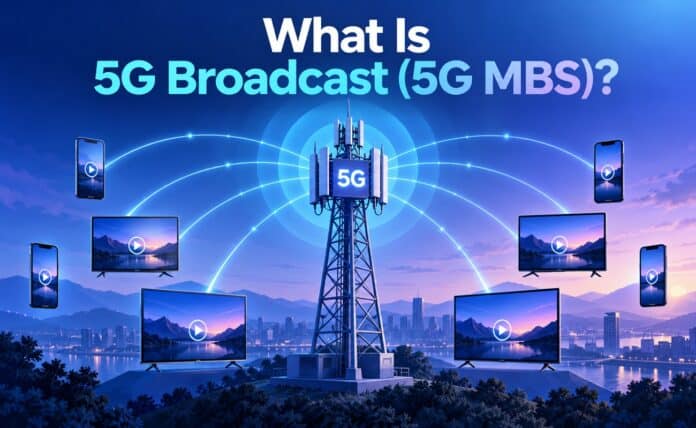

Every time a million people stream the same football match, mobile networks waste bandwidth by sending a million separate copies of the same video. Broadcast towers solved this problem decades ago by sending one signal that any receiver in range can pick up. 5G Broadcast is the attempt to bring that one-to-many efficiency into the cellular world, so a single transmission can serve a whole neighborhood, stadium, or apartment block.
The idea is finally leaving the lab. Commercial receivers, government rollouts, and new reliability research all landed within the past year. Here’s what the technology actually is, where the confusing terminology trips people up, and how close it really is to replacing cable.
Unicast versus Multicast
Normal mobile data is unicast, offering one dedicated stream per device. Ten thousand phones watching the same stream means ten thousand streams, and the cell tower runs out of capacity long before the audience runs out of interest. That’s why live video quality collapses in crowded stadiums.
Multicast and broadcast flip the model. One transmission goes out; every device tuned to it decodes the same data. The network cost is the same whether ten people are watching or ten million.
For anything where large numbers of people want identical content at the same moment live sport, breaking news, emergency alerts, software updates this is a dramatically more efficient use of scarce radio spectrum.
5G Broadcast vs 5G MBS: two different things with similar names
This is where things usually get muddled, so it’s worth separating clearly.
5G Broadcast is aimed at traditional broadcasters. It is designed to use 5G infrastructure to deliver linear and live TV directly to mobile devices with no SIM card and no internet connection required, closer in spirit to an over-the-air TV tower than to a mobile subscription.

5G MBS (Multicast-Broadcast Services) is the mobile operator-side version. Introduced under 3GPP Release 17 in 2022 and built on the 5G Core and New Radio, it lets a mobile network choose the most efficient delivery method point-to-multipoint or point-to-point and switch between them based on how many users in a given cell want the content.
Unlike 5G Broadcast, it works within the normal SIM-and-subscription world, and it’s pitched primarily at mobile operators rather than TV stations.
Put simply, 5G Broadcast is a broadcast tower that speaks 5G. 5G MBS is a mobile network that has learned to send one copy when multiple users view the same content, saving bandwidth.
Why broadcast video freezes and why AI is being thrown at the problem
Broadcast mode has one hard constraint that ordinary mobile data doesn’t. A normal 5G connection is two-way, so a device that misses a data packet simply asks for it again. A one-to-many transmission often has no return path, so lost packets are gone for good and the picture stutters or freezes.

That forces a permanent judgment call. Transmission settings the modulation and coding scheme, or MCS can be tuned aggressively for speed and picture quality, or conservatively for robustness.
Standard 5G logic assumes mistakes can be corrected by retransmission, so it leans toward speed. In broadcast mode, that assumption is wrong.
This gap is what a Waseda University team targeted in research presented at the IEEE Vehicular Technology Conference in Boston in September 2026. Their transformer-based model predicts how radio conditions will change and picks the transmission setting in advance rather than reacting after the damage is done.
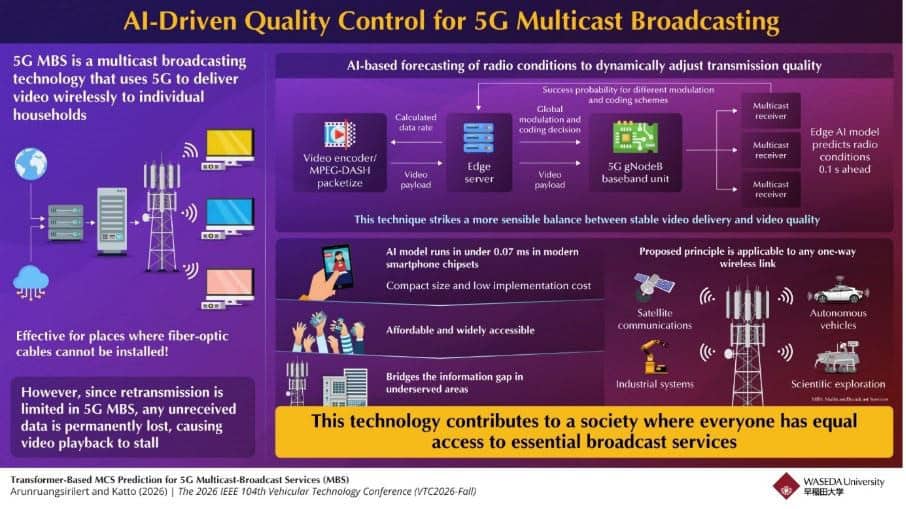
The work is published as “Transformer-Based MCS Prediction for 5G Multicast-Broadcast Services (MBS)“. Trained on roughly 26 million measurements captured every 0.5 milliseconds from a live commercial 5G network, it selected an error-free setting for about 87% of video segments, compared with 32% for a conventional speed-first approach, and runs in under 0.07 milliseconds on smartphone chipsets from 2020 onward.
Other groups are chipping away at the same reliability question from the open-source side. A 5G MBS testbed published in September 2026, combining a 5G-MAG core with an MBS-enabled base station and modified OpenAirInterface devices, ran a 30-minute point-to-multipoint trial in which both receiving devices recovered every message sent during the observable window with byte-exact payloads.
Where 5G Broadcast actually stands in 2026
United States: The standard is moving past demos. Commercial 5G Broadcast receivers are expected to reach the market in the second quarter of 2026, backed by 3GPP Release 19, which standardizes Broadcast Bands 112 and 113.
Two Boston stations, WCRN and WWOO, have applied to the FCC for experimental 5G Broadcast licenses covering more than 8.3 million people to test video, audio, and data delivery; first-responder use cases; receiver performance; and coverage verification, with a wider phase planned across 10 broadcast-enabled stations.
Europe: Germany ran live signal tests in five cities in 2024 using Xiaomi handsets and Qualcomm reference designs, with Vantage Towers planning commercial deployment in 2026 and MediaBroadcast in 2027. France has had a TDF-operated trial running since the Paris 2024 Olympics.
China: China Broadnet has run 5G NR MBS trials from the Shanghai TV tower using 700 MHz spectrum with an antenna at roughly 320 meters and expected coverage of around 15 km, with live TV, emergency broadcasting, and ultra-high-definition testing ahead of larger commercial deployment.
India: The most aggressive national push uses a related but separate technology, Direct-to-Mobile. A Committee of Secretaries drawn from the Department of Telecommunications, the Ministry of Information and Broadcasting, MeitY and the Department of Space granted in-principle approval, moving D2M into the implementation phase with spectrum planning and stakeholder consultation still to come.
Prasar Bharati is running pilots in over 19 cities with IIT Kanpur and Saankhya Labs, using both high- and low-power transmitters and focusing on cost-effective delivery for Tier-II and Tier-III regions. Trials confirmed that D2M transmissions do not interfere with existing cellular networks and that ordinary telephony keeps priority during playback.
Not everyone is enthusiastic. Telecom operators have resisted the proposal since its early stages, arguing that D2M threatens their data-driven revenue models. That tension broadcasters want the efficiency; carriers sell the data it would displace is the real obstacle in most markets, not the physics.
The honest answer on replacing cable TV
Three things have to line up, and only one of them is close to settled.
The technology works: Field trials across four continents have demonstrated live TV delivery, and the reliability gap that caused freezing is now an active research target with credible results.
The devices are the bottleneck: Support from major device makers has been the missing ingredient for European broadcasters hoping to reach mobile handsets.
A broadcast standard with no receivers in people’s pockets is a transmitter shouting into an empty room. Release 19 band standardization and the first commercial receivers in 2026 mark the beginning of a fix, not the end.
The business model is unresolved: Broadcasters see a spectrum-efficient route to mass audiences. Carriers see mobile video revenue walking out the door. Regulators are being asked to referee.
A competing standard is also in the mix. Compared with ATSC 3.0, the IP-based NextGen TV standard rolling out in the United States, 5G Broadcast has been criticized for lower bandwidth efficiency and for lacking a bootstrap signal that would allow new modulation profiles to be introduced later, though it was judged stronger on most other performance measures. The NAB has asked the FCC to mandate a full ATSC 3.0 transition by February 2028 for the top 55 markets and February 2030 for the rest.
The realistic near-term picture is narrower and more useful than “cable is dead.” Broadcast 5G looks strongest as a last-mile fix: apartment blocks where fiber retrofits are impractical, districts where trenching cable is uneconomic, and public-service delivery of emergency information where reaching everyone at once matters more than picture quality. That’s the scenario the Waseda work is built around, and it is a genuine problem in aging housing stock in Tokyo, Lagos, Mumbai, and Naples alike.
5G Broadcast and 5G MBS FAQ
Do I need a SIM card to receive 5G Broadcast?
Not for 5G Broadcast itself, which is designed to work without a SIM or internet connection. 5G MBS is different and operates within a normal mobile network subscription.
Does 5G Broadcast use my data allowance?
No. Content arrives as a broadcast signal, not as data delivered over your mobile subscription.
Will my current phone work?
Almost certainly not without a compatible receiver or chipset. Device availability is the single biggest barrier to adoption right now.
Is D2M the same as 5G Broadcast?
They are close cousins solving the same problem: broadcast video straight to a handset with no data connection, but India’s D2M program is built on its own transmitter and chipset ecosystem rather than being a simple rebadge of the 3GPP standard.
Can it carry 4K?
Bandwidth is shared across all channels in the broadcast, so operators face the usual trade-off between number of channels and picture quality. Reliability work like the Waseda model aims to push more quality through the same spectrum without stuttering.