


Today, nearly everyone uses a mobile phone. As a result, users also need to connect to the internet. Many people couldn’t live even a second without their phones. The World Wide Web also poses many threats and dangers. But there are also threats in the real world. Online threats include phishing and computer viruses.
From phone calls to a wide range of useful apps like a camera, email access, banking, and more, we depend on our mobile devices for everyday tasks. Often, when problems develop, we know how dependent we are on them. The security of our smartphones must come first because of how much of an impact they have on our lives.
What is a Risky Place for a Device?
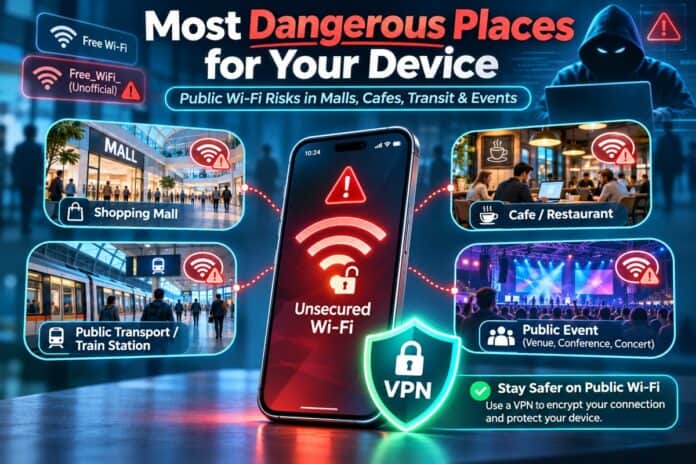
The greatest danger for your location is using public Wi-Fi. Using hotspots in places like airports, malls, hotels, train stations, and other areas is a risky thing to do with your data. It wasn’t long ago that these networks were known for being unreliable.
When you connect to public Wi-Fi networks with your devices, you expose sensitive data like logins. Due to the large number of users on public Wi-Fi, it becomes an easy target for cybercriminals. If used without protection, you put your personal information and devices at huge risk.
Using public Wi-Fi hotspots has two risks. The first risk is that the routers lack security against online attacks. It can often be difficult to assess the safety of a network before connecting to it. If a hacker has already gained access to the network, they might watch your online actions in real time.
Second, attackers sometimes set up their public networks, hiding them as the nearest companies. These attackers might place malware on devices and gather information when users connect.
By concealing your IP address and encrypting your data transfers, a reliable VPN often improves your safety while using public Wi-Fi. It makes it more difficult for online cyberattacks to succeed. To find out how many users in each country face these threats, Surfshark performed worldwide research.

What Does the Data Show?
Surfshark surveyed internet users in many countries, including the United States, Sweden, Canada, Australia, Spain, the United Kingdom, the Netherlands, Italy, Germany, and Poland.
Mobile Data vs. Public Wi-Fi
In all these countries, most of the respondents prefer using mobile data over public Wi-Fi. It improves general security even while it doesn’t completely remove online threats. A computer or phone connected to an unsecured Wi-Fi network may be vulnerable to Man-in-the-Middle (MITM) attacks. Hackers can snoop on your data flow, steal information, install malware, and even take over your device.
Malware infections can have serious consequences, including data theft and ransomware attacks that lock users out of their files or systems. The growing sophistication of these threats is evident in the activities of some of the most notorious ransomware groups, which have targeted organizations and computer systems worldwide.
So, you may come across “honeypot” Wi-Fi hotspots, which are fraudulently built by cybercriminals to execute MiTM attacks while appearing as usual, free Wi-Fi networks. Avoid using free Wi-Fi and use mobile networks instead. If necessary, use a virtual private network (VPN). To improve security for critical operations like banking, move to a cellular connection.
Canadians use public Wi-Fi the most, at 43%, and mobile data the least, at 60%, across all the countries assessed. In the United Kingdom, 41% of residents use public Wi-Fi. On the other hand, Poland had the lowest percentage of users utilizing public Wi-Fi (17%), with 80% preferring to use mobile data. While the use of public Wi-Fi isn’t unfavorable without users using proper safety measures, they face significant risks often using these networks.
Where Do People Feel Most at Risk?
Using public Wi-Fi is the greatest risk to your location. Across these countries, shopping centers, public transportation, and food outlets such as cafes, restaurants, and bars are often mentioned. Always avoid using public Wi-Fi because it is risky for your sensitive information. Hackers use free, open networks to obtain information by spying on users or creating malicious networks.
Many people use public Wi-Fi for private, sensitive tasks even though the risks are significant. It’s important to consider how you use these networks and to take the appropriate safety precautions. Below is a table that shows how many people use the Internet in public spaces in such countries:
| Mobile Internet Users | Percentage(%) of Users |
| Sweden | 83% |
| Poland | 80% |
| Italy | 75% |
| Spain | 74% |
| Netherlands | 73% |
| United States | 70% |
| United Kingdom | 70% |
| Germany | 64% |
| Australia | 64% |
| Canada | 60% |
Most public Wi-Fi hotspots can be dangerous. The data suggests a need for more effective cybersecurity precautions, even among internet users. The table below shows the percentage of internet users who access public WiFi.
| Public WiFi Users | Percentage(%) of Users |
| Canada | 43% |
| United Kingdom | 41% |
| United States | 39% |
| Netherlands | 39% |
| Sweden | 38% |
| Germany | 37% |
| Australia | 27% |
| Italy | 24% |
| Spain | 21% |
| Poland | 17% |
Where Do People Feel Most at Risk?
The survey discovered that consumers in ten nations generally view restaurants, bars, cafes, public transportation, and shopping centers as high-risk places to use the Internet. Italians were less concerned about public event locations than Germans were, whereas Canadians and Spaniards were most concerned about retail malls. This table shows where people think their devices are most at risk in these locations.
| Countries | Risky Public WiFi locations | Percentage (%) |
| Poland | Shopping malls | 60% |
| Canada | Shopping malls | 57% |
| Germany | Public event place | 56% |
| Spain | Shopping malls | 56% |
| Sweden | Shopping malls | 55% |
| Australia | Shopping malls | 54% |
| United Kingdom | Cafes, bars and restaurants | 52% |
| United States | Shopping malls | 51% |
| Netherland | Public event place | 51% |
| Italy | Shopping malls | 44% |
Public Wi-Fi hotspots often create dangers that worsen because many users take insufficient cybersecurity measures.
Do Users Protect Themselves in Risky Situations?
The Surfshark survey assessed the precautions consumers took in each country when accessing public Wi-Fi.
Sweden produced information, with 23% of respondents admitting to taking no precautions to protect their devices when using public Wi-Fi. It is nevertheless a concerning trend even though
it is lower in other nations, such as the US and the UK, where it is 11%. These people use public WiFi without taking any security measures:
| Countries | Percentage(%) |
| Sweden | 23% |
| Italy | 16% |
| Netherlands | 15% |
| Canada | 14% |
| Australia | 13% |
| Spain | 13% |
| Germany | 12% |
| United States | 11% |
| United Kingdom | 11% |
| Poland | 9% |
Even though more users reported using antivirus software, VPNs are very successful at avoiding the dangers posed by unsecured networks. Increased VPN adoption would decrease risks for many internet users.
How to Keep Yourself Safe in Dangerous Places?
Using mobile data in locations like restaurants, shopping centers, and event venues is the simplest method to protect yourself from internet risks. Avoiding these networks lowers your exposure because insecure public Wi-Fi is the main source of danger in these places.
Some survey respondents went so far as to avoid using the internet in any public place worldwide. There are approximately these people who do not use public internet in the following countries:
| Countries | Percentage(%) |
| Australia | 26 |
| Germany | 25 |
| Canada | 22 |
| United Kingdom | 21 |
| Spain | 17 |
| United States | 16 |
| Poland | 16 |
| Italy | 15 |
| Netherland | 14 |
| Sweden | 9 |
When you need Wi-Fi in a situation where mobile data isn’t available, a VPN will help you to protect your data. A VPN app helps you connect your device safely to one of its servers. VPN will hide your location and encrypt all the traffic generated from browsing.
Threats while using public Wi-Fi are everywhere. Surfshark protects you with its Threat Protection feature. It is also reliable for removing ads, blocking trackers, and scanning downloads for any potential viruses. You can use this app in potentially dangerous places, knowing that it’ll keep you safe.
Conclusion
As you may already know, public Wi-Fi is dangerous. Many public spots like restaurants, malls, and event space networks aren’t secure at all. Users who connect to them are exposed to cyber threats. It increases the risk of an attack on your device or data, but despite this knowledge, people still use public Wi-Fi without taking any precautions in various countries.
Many people continue to use public Wi-Fi without proper protection despite these concerns in various nations. Many people still use public networks for sensitive jobs, even though mobile data is safer. Many even go as far as to use these networks for sensitive tasks when they know that mobile data would be much safer.
The Surfshark poll conducted across many nations revealed a preference for mobile data over public Wi-Fi due to its comparably superior security, even though it does not eliminate all online hazards. Canadians use public Wi-Fi the most, but Poland uses it the least. Despite this, most users, regardless of country, continue to utilize public Wi-Fi for private work, endangering their data.
With a reliable VPN, you get protection against those cyberattacks, and it encrypts data transfers. A trustworthy VPN reduces the risks related to unprotected networks. When looking for a VPN service, find one with Threat Protection like Surfshark. It’s an essential tool for keeping yourself safe online when using public Wi-Fi in high-risk areas.
FAQs
Are VPNs safe to use while connected to public Wi-Fi?
By encrypting your internet traffic, it becomes more difficult for illicit users to snoop on you and access your device or activities. So yes, we suggest using one if you often use public Wi-Fi.
What are the main risks of using free VPNs?
Due to a lack of security measures, public WiFi threats are vulnerable and prone to attacks people do on public Wi-Fi. Cybercriminals prey on sensitive data and create fake networks that spread malware or obtain users’ device information.
How can I make sure my device is safe when using public Wi-Fi?
The best way to protect devices and sensitive data from potential cyber dangers is to use mobile data when available and a trustworthy VPN such as Surfshark while utilizing public Wi-Fi.
Where is it risky to use free WiFi in public?
In shopping centers, transport centers, and food outlets, such as coffee shops, restaurants, and bars, these sites are frequently identified as high-risk due to the widespread use of public WiFi.