

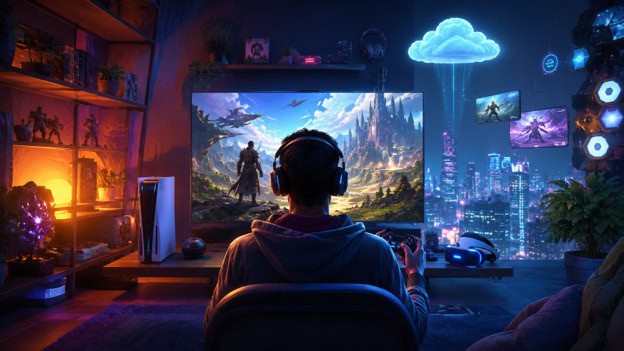
The gaming industry has never stood still for long. Every few years, new technology changes how people play. It also changes how they connect and enjoy digital entertainment. What once felt like the future is now here. Streaming games don’t need expensive hardware. Lifelike virtual worlds and smart characters are now part of everyday gaming.
Artificial Intelligence Is Becoming a Creative Partner
AI is changing game development. Its impact will keep growing. AI is used to control non-player characters (NPCs). Now, today’s systems are much more advanced.
Now, developers can use AI for smarter opponents. These opponents change based on each player’s style. This is better than just using scripted behavior. This makes gameplay more rewarding. It also feels less predictable. This is particularly valid for games that involve strategy, action, and sports.
AI is also speeding up the creative process. Artists and designers can make concept art faster now. They can also create dialogue ideas quickly. Animations and environmental details are easier to produce, too. AI is not replacing creative professionals. Instead, it’s a helpful tool. Teams can now focus on refining ideas rather than doing repetitive tasks.
In the future, players might have their own adventures. Quests could change based on their choices. Dialogue may shift, too. Challenges might adjust based on how they play.
Virtual and Augmented Reality Keep Evolving
Technological advances are influencing every corner of interactive entertainment. Even platforms connected to Bandy betting are adapting to new player expectations as gaming experiences become more immersive and connected.
Virtual reality puts players in digital worlds. However, many anticipated that it would gain traction more quickly. As headsets get more affordable, lighter, and more comfortable, that might change.

Future VR will have sharper displays. It will have better motion tracking, too. Users will enjoy more natural interactions. Players will use hand tracking and eye tracking. They will also use real gestures. This is better than just pressing buttons.
Augmented reality is also expected to gain momentum. AR mixes digital content with the real world. This creates unique gaming experiences. Users stay connected to their surroundings, unlike in VR.
Wearable devices are getting better. Developers will find fresh ways to blend real-life spaces with games. They will make gameplay more interactive and fun.
Cross-Platform Gaming Will Become the Standard
Modern gamers demand versatility and frequently possess many devices. A player may begin on a console, transition to a PC, and use a smartphone to complete a goal.

This seamless experience is becoming one of the industry’s biggest priorities.
Cross-platform multiplayer lets friends play. They can use different systems. This trend will grow more. Future games will sync progress across devices. This means you can switch platforms easily, and you won’t lose your achievements or saved data.
Publishers use many ecosystems. This helps them reach more people. Players can choose their hardware.
Graphics Continue to Improve, but Realism Isn’t Everything
Every new hardware generation gives us better graphics. It also improves lighting. Physics is more realistic now. Ray tracing and other technologies have improved visuals a lot. They make worlds look really real.
However, the industry’s focus is gradually shifting beyond graphics alone.
Players want smooth play. They like steady frame rates. Responsive controls are important. Fun gameplay is better than good graphics. Artistic direction is more powerful than photorealism. That’s why many stylized games have millions of players.
Future changes will improve graphics. They will be easier to access. Performance will get better. More devices will work with them.
Community Features Are Becoming More Important
Gaming is no longer seen as a solitary pastime. People’s perceptions of contemporary titles are increasingly shaped by online groups.
Developers now put a lot of effort into:
- Social systems
- Voice communication
- Live events
- Cooperative gameplay
- User-generated content
These features help games remain active for years rather than months.
These days, streaming services and content producers are important participants in the gaming industry. It’s enjoyable to see other people play. Sharing highlights helps too. Joining online chats keeps a game popular even after it’s released.
As communities grow, developers will make new tools. These tools help people work together. They spark creativity. They also support lasting engagement.
Looking Ahead
Predicting the future of gaming is tough, but some trends are clear. AI will help developers and players. Cloud gaming will make great games easier to access. VR and AR will keep getting closer to mainstream use. Future games will work on all platforms. Online communities matter.
Tech innovation will change designs. The industry’s next chapter won’t depend on one big breakthrough. It will be shaped by many technologies. These will join forces to create richer gaming experiences. Players will enjoy more connection and better access all around the world.