

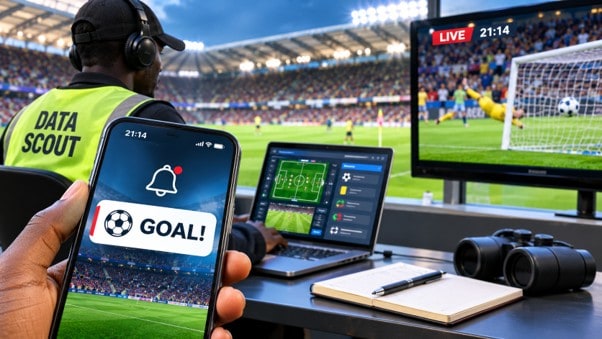
Many football fans have seen a goal alert on their phone before the ball crosses the line on their screen. A survey by the comparison service Uswitch found that 47% of smart TV viewers had had a goal spoiled this way, against 12% of fans listening on analogue radio. The reason is that a match reaches viewers by two different routes. One runs through television production and streaming servers. The other is a data feed built by people inside the stadium.
Those feeds do more than send notifications. They also drive betting prices, which change with every goal, card, and substitution. A fan using the BetKing coupon code for this week to build a weekend accumulator, with a ₦100 no-deposit free bet for new customers, depends on the same data to settle each selection. On a slip of three or more matches, every leg is graded on the official result the feed delivers at full time.
Who records the match: scouts in the stands and analysts at a screen
Live football data starts with people. Sportradar, one of the largest providers, said in 2019 that it used more than 7,000 scouts worldwide, each rated on performance to decide which matches they cover next. In November 2025, after buying IMG Arena, the company said it covers more than one million matches a year across 14 sports.
A scout sits in the stadium with a device and logs each event as it happens: kick-off, goals, cards, corners, substitutions and, in many competitions, every shot and foul.
Stats Perform, which owns the Opta brand, describes a mix of human analysts, optical tracking systems and AI models. It collects data both in real time and after the match, then checks it against standard event definitions. The live version has to be fast; the post-match version has to be exact.
From the stadium to the server: how a goal reaches your phone
Once a scout records a goal, the event goes straight to the provider’s central servers. There it is checked and sent out through APIs to the apps, media sites and bookmakers that pay for the feed. A live-score app then pushes a notification to every user following that match.
The whole chain is built for speed, and it usually runs ahead of the television picture. VAR is the main exception. If a goal is ruled out after a review, the feed corrects the score, but the first notification may already have gone out. That is why an alert can occasionally be reversed a minute or two after it arrives.

Why your screen is behind: broadcast and streaming delays
Television isn’t instant either. Industry figures quoted by FEED magazine put traditional broadcast TV under 10 seconds behind real time, while online streams usually run 15 to 30 seconds behind. Standard streaming formats sit around 30 seconds, and newer low-latency versions bring that down to between four and eight seconds.
For Nigerian fans, the gap depends on how they watch. A satellite decoder is usually closest to live. A stream on a phone adds the delay of internet delivery, and a slow mobile connection adds more.
Mobile networks also send a separate copy of the video to every viewer, which is the problem that 5G Broadcast, a way to send one live signal to many phones at once, is designed to solve. Until that reaches ordinary phones, a friend’s message in a WhatsApp group can easily beat the picture on a busy match day.
Data scouts at English grounds: when speed becomes a legal fight
The time difference has value, and in English football it has ended up in court. Football DataCo holds the rights from the Premier League, the English Football League and the Scottish Professional Football League to collect live match data. Since May 2019 it has licensed them exclusively to Genius Sports.
Both companies later sued Sportradar and a group of scouts, accusing them of collecting data from the stands without a licence, in breach of ticket conditions and ground regulations. According to Football DataCo, 335 scouts were ejected from stadiums in the 2018/19 season, across at least 272 matches, as set out in a summary of the claims by the law firm Mishcon de Reya.
Sportradar argued that a football match is a public event and that the exclusive deal breaches competition law. It brought its own claim before the Competition Appeal Tribunal. The dispute shows what is at stake: a few seconds of advance information are enough for someone to bet before the odds move. That is why bookmakers suspend in-play markets as soon as a key event is detected, then reopen them with new odds.
What it means for in-play betting
For a punter, latency explains several things that can look like glitches: a market that locks just before a penalty, odds that jump while the TV still shows the ball in midfield, or a bet refused because the price has changed. All three come from the same chain. Bookmakers price from the data feed, not from the picture on the punter’s screen.
Pre-match accumulators are less affected, because they settle on final results rather than on the minute-by-minute feed. For any bet placed during a match, it’s safer to assume the data is a few seconds ahead of the stream, and usually further ahead on a mobile connection.
18+. Please gamble responsibly and only stake what you can afford to lose.