

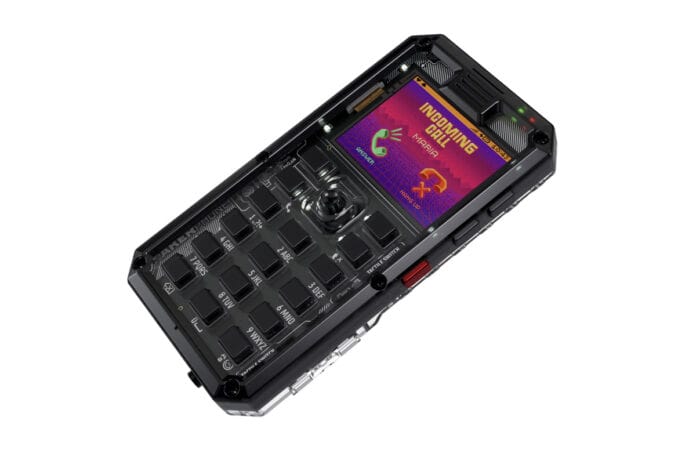

MAKERphone 2.0 is a fully functional 4G mobile phone that arrives as a box of parts. You assemble it yourself in about two hours, with no soldering and no prior experience needed; insert a nano-SIM, and it makes real voice calls and sends real SMS on live cellular networks. Then you program it, starting by describing ideas in plain English and progressing to MicroPython and Arduino C++.
It is made by CircuitMess, a Croatian educational electronics company, and launched on Kickstarter on 10 September 2026 with a 30-day campaign closing on 10 October. Early pledge tiers start around $129, and the kit is expected to retail near $169, with backer deliveries estimated for Q3 2027.
This is the sequel to the 2018 original, which raised $324,453 from 2,154 backers against a $15,000 goal and asked every one of them to spend roughly seven hours with a soldering iron.
MAKERphone 2.0 Specifications
| Component | Specification |
|---|---|
| Processor | ESP32-S3, dual-core — 4 MB flash, 4 MB PSRAM |
| Cellular | 4G LTE Cat-1 with 2G fallback, nano-SIM |
| Display | 1.77-inch colour, 160 × 128 pixels |
| Input | 12-key numpad, navigation joystick, 4 function keys, power key, volume up/down |
| Audio | DAC and speaker, I²S microphone, 3.5 mm headphone jack |
| Battery | 1,000 mAh, USB-C charging |
| Storage | microSD card slot |
| Connectivity | WiFi, Bluetooth, USB (charging and programming over one cable) |
| Expansion | UMAX modular connector — six add-on modules, auto-detected |
| Extras | Programmable RGB LEDs, real-time clock |
| Assembly | No soldering, approximately 2 hours |
| Programming | VibeBoy AI Studio, MicroPython, Arduino C++ |
| Dimensions | 11.5 × 6 × 1.8 cm |
| Weight | 104 g assembled |
The ESP32-S3 at the center is an Arduino-compatible microcontroller, the same chip family found across the hobbyist electronics world, not a smartphone SoC. That is a deliberate choice, and it defines both what the phone can do and what it cannot.
The build: two hours, no soldering
The single biggest change from the 2018 original is that the soldering iron is gone.
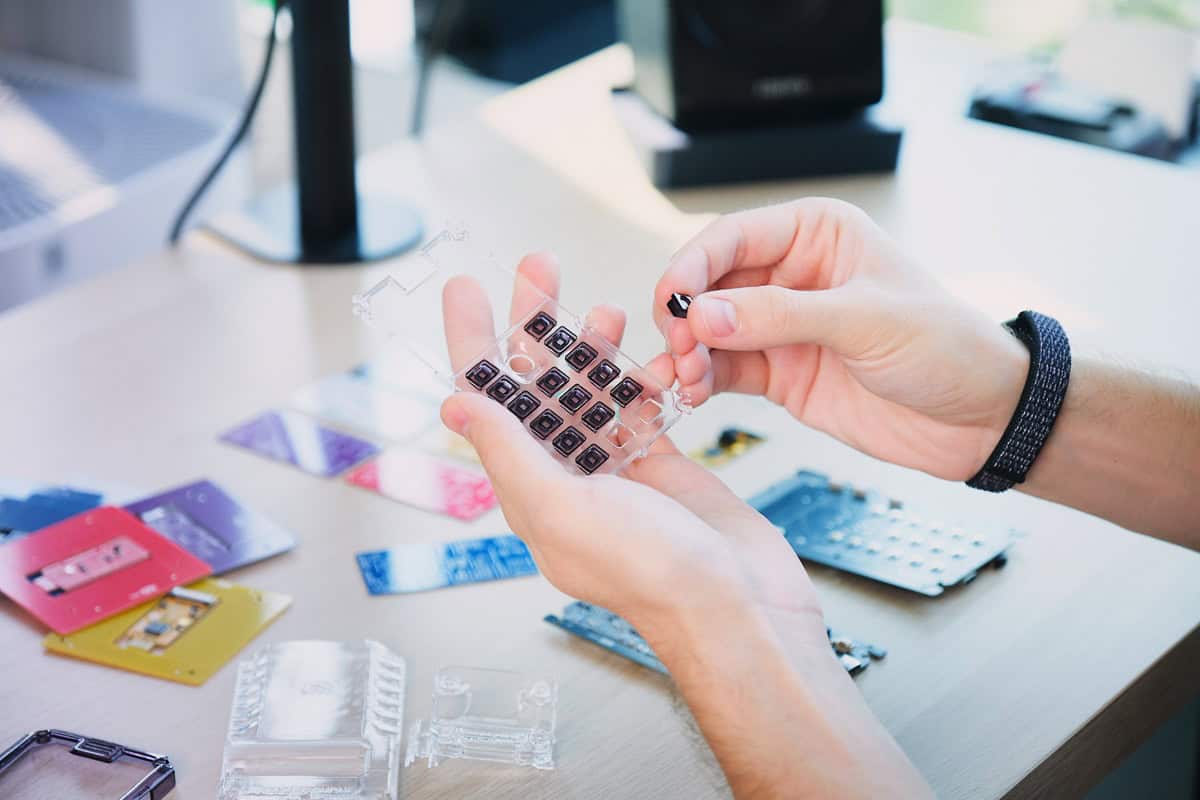
Every component now clicks, screws, or plugs into place. The kit contains everything: PCB, display, 12-key numpad, joystick, battery, casing, and the remaining hardware, plus a LEGO-style illustrated assembly manual. Video guides are available online.

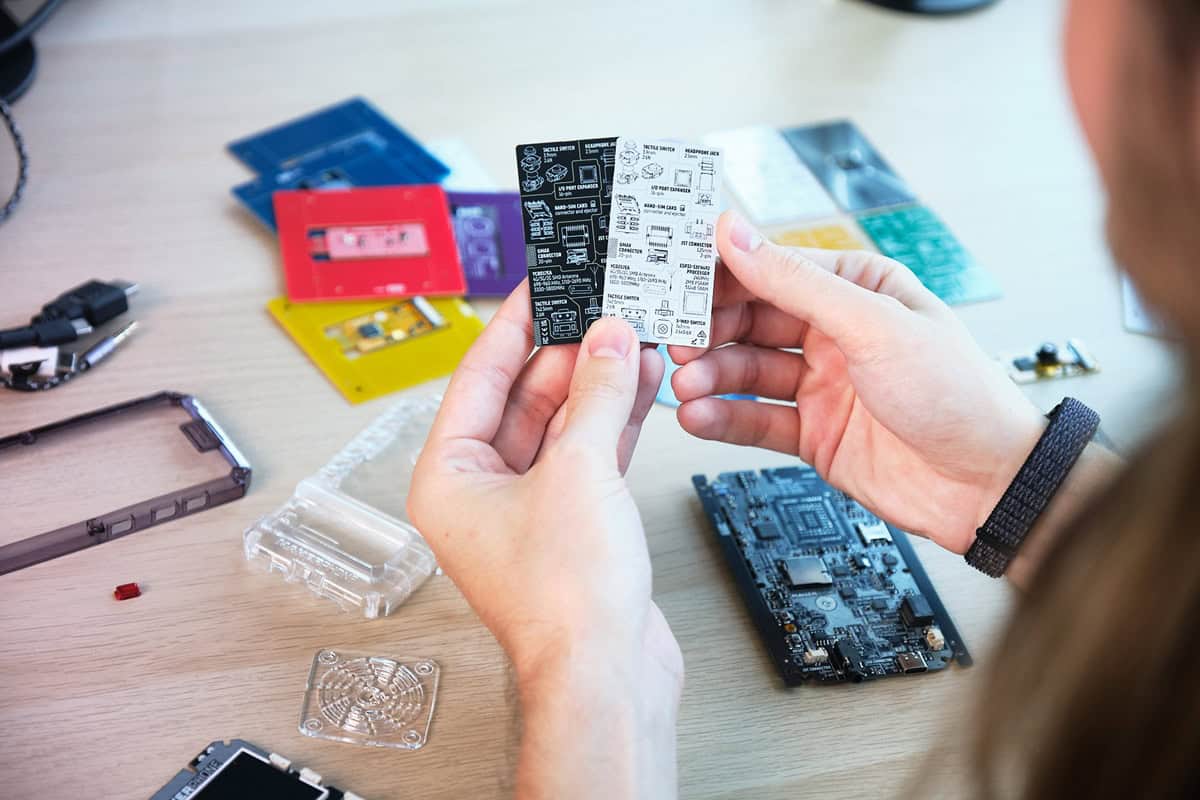
CircuitMess puts the full build at roughly two hours. Along the way, the whole process is designed to be educational. You handle the processor, the modem, the display, and the battery individually, and come out the other side knowing what a phone is inside.
That shift, from seven hours of soldering to two hours of assembly, is what moves MAKERphone from a maker-community project to something a nine-year-old can finish in an afternoon.
What it does out of the box
- Calls and SMS: It supports calls and SMS over 4G LTE Cat-1, with 2G fallback where LTE is unavailable.
- Contacts, call history, ringtones, alarms, calendar, and notes
- Music player: It offers a Music player with playlist support
- Photo and video gallery and a file explorer
- More than 10 built-in retro games
- Programmable RGB LEDs and a real-time clock
What it does not have is equally deliberate. It comes with no app store, no social media, and no web browser. No platform decides what you can install, because there is no platform. New apps come from one place: you write them.

VibeBoy: coding that starts in plain English
Programming happens through VibeBoy, CircuitMess’s AI-assisted coding studio at vibeboy.com. You open it on a computer, describe what you want in plain language, watch AI generate the code, and send it to your phone with one click.
The company’s own example is deliberately silly: “make me a game where a taco dodges falling pickles.” Other examples it cites include SMS automations: press a key, text a parent that you’re home, and custom watchfaces for the companion smartwatch.
The part that matters comes next. You open the code the AI wrote, learn to read it, fix what is broken, and gradually take over. CircuitMess structures this as a four-rung ladder:
| Level | Age | What you do |
|---|---|---|
| Pixel Rookie | 9+ | Describe ideas in plain English; AI writes the code |
| Signal Hacker | 11+ | Read and edit generated code |
| Modder | 14+ | Modify and extend apps, work with modules |
| Vibe Coder | Any | Write MicroPython and Arduino C++ from a blank file |
CircuitMess is emphatic that VibeBoy is not autocomplete. The pitch is that it teaches you how to think with AI. How to describe a problem precisely, read what a model produced, and correct it when it is wrong. That is arguably a more useful skill in 2026 than memorizing syntax, though it is a claim worth testing rather than accepting.
Every MAKERphone 2.0 includes three months of unlimited VibeBoy AI usage and a free tier for life. After that, the Pro tier costs $4.99 a month.
UMAX expansion modules
The UMAX port on the side takes six snap-on modules:
- Camera
- Big Speaker
- Flashlight
- Environment: temperature and humidity sensing
- Infrared: for controlling TVs and other IR devices
- DIY Perf Board: a blank board for soldering your own circuits
Plug in any one of these modules, and the phone detects it automatically, adding the matching app to the menu with no setup. The base kit doesn’t include modules. They’re sold separately, so factor that into the real cost if any of the modules (say, a camera or a DIY Perf Board) is essential to you.
MAKERband: the optional companion
MAKERband is a buildable, programmable smartwatch sold alongside the phone.
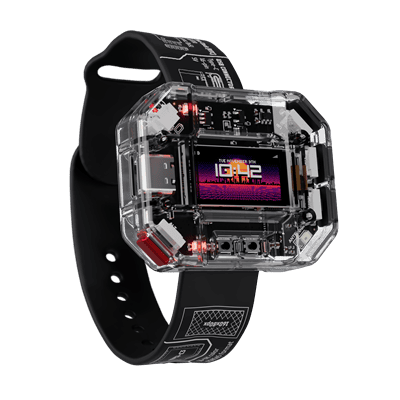
| Component | Specification |
|---|---|
| Processor | ESP32-C3 (RISC-V), 4 MB flash |
| Display | 0.96-inch colour, 160 × 80 px |
| Input | 4 buttons |
| Radios | WiFi, Bluetooth 5.0 |
| Battery | 1,000 mAh |
| Features | 15 watchfaces, 5 mini-games, notifications, music and camera shutter control |
Usefully, it pairs with iOS and Android, as well as the MAKERphone, so it isn’t dead weight for someone carrying a normal smartphone. Like the phone, it is programmable through VibeBoy.
Who MAKERphone 2.0 is for
The curious child, aged 9 and up: The kid who asks how things work. They build the phone, play the built-in games, then make their own. The learning covers electronics assembly, real programming, and using AI as a creator rather than a consumer.
Makers and tech enthusiasts: An ESP32-S3 phone with an open expansion port, a headphone jack in 2026, and no locked bootloader or walled garden. This will appeal to the hobbyist electronics crowd.
Parents looking for a first phone: A device that calls and texts the people a child needs, with no feed to fall into. CircuitMess’s positioning line is that MAKERphone 2.0 doesn’t fight screen time; it turns it into create time. That lands at a moment when governments from Australia to France to the UK are legislating minimum ages for social media and banning phones in classrooms.
Teachers: A STEM lab in a box covering electronics, programming and AI literacy in one project. CircuitMess sells a Classroom Pack of 10 phones, 10 MAKERbands and 10 module packs.
MAKERphone 2.0 Price and Availability
Pricing is tiered and rises as the discounted batches sell out. CircuitMess’s press materials cite early-bird pricing from $109; the company’s own product page currently lists tiers starting from $129; coverage from It’s FOSS reports entry pledges at $119 with an expected retail price of $169. The practical reading is that the cheapest tiers have already gone, and the entry point climbs through the campaign.
- Campaign window: 10 September – 10 October 2026 (30 days)
- Funding goal: $30,000, reportedly met within the first 49 minutes
- Current status: past 900% of goal
- Shipping: worldwide
- Backer deliveries: Q3 2027 (estimated)
- Retail: after backer fulfillment, worldwide
It’s FOSS notes that backers in the US, EU, UK, and Canada should not face import fees, though VAT may apply depending on location. Shipping costs are handled separately.
Can you trust the delivery date?
This is the question that matters most with any crowdfunded hardware, and MAKERphone 2.0 has a better answer than most.
CircuitMess was founded in Karlovac, Croatia, in 2017 by Albert Gajšak, who built his first game console kit as a teenager and left college to turn it into a company. Since then, it has shipped more than 300,000 kits to customers in over 100 countries, developed 37 products, and raised over $2.2 million across six previous Kickstarter campaigns, all of which were delivered.
Its kits have been covered by Forbes, TechCrunch, Wired, BBC, The Verge, The New York Times, Popular Science, Tom’s Hardware, and GameSpot.
The company also says this is not a prototype pitch. Hardware design is complete and final production hardware exists; software is feature-complete and in final testing. The Kickstarter funds manufacturing at scale, not R&D.
None of that is a guarantee. It is, however, a materially stronger position than the average hardware campaign, and it explains why the project cleared nine times its goal in under a week.
What to know before you back it
It is not a smartphone: A 160 × 128 display and 4 MB of flash set hard limits. No WhatsApp, no maps, no email, no browser. For most of the world, where WhatsApp is the default way families stay in touch, this cannot be the only phone in a household.
No parental dashboard: Unlike Bark, Pinwheel, or Gabb, there is no GPS tracking, contact approval, remote lock, or message monitoring. The safety model here is “nothing to be unsafe on,” not “an adult is watching.”
Modules cost extra: The base kit includes none of the six modules. The modules are sold separately or in special bundles.
The wait is long: Q3 2027 is roughly a year after the campaign closes. If you need a phone for a child this school year, this is not it.
Crowdfunding is not retail: Even with CircuitMess’s record, a pledge supports a project, not a purchase with a guaranteed date.
Conclusions
MAKERphone 2.0 is competing with a STEM kit, a coding course, and a feed-free first phone. All three at once for roughly the price of any one of them, with no monthly subscription attached.
Judged as a phone, it is underpowered and a year away. Judged as the thing it actually is: a device that teaches a child what a phone is by having them build one, then teaches them to program it by letting them start in their own language; nothing else quite like it is on the market.
The campaign runs until 10 October 2026 on Kickstarter.
Frequently asked questions about MAKERphone 2.0
Is MAKERphone 2.0 a real working phone? Yes. It accepts a standard nano-SIM and makes voice calls and sends SMS over 4G LTE Cat-1 networks, with 2G fallback.
Do I need to know how to solder? No. Every part clicks, screws, or plugs together, guided by an illustrated manual. Only the optional DIY Perf Board module involves soldering.
How long does it take to build? About two hours, with no previous experience required.
What age is it suitable for? CircuitMess sets the entry point at 9+, with the skill ladder running through 11+, 14+, and an open level for adults.
What programming languages does it support? Plain English through VibeBoy’s AI studio, plus MicroPython and Arduino C++ directly.
Does it need a monthly subscription? No. It works on any carrier with a nano-SIM. The only optional recurring cost is VibeBoy Pro at $4.99 a month, and three months of unlimited AI plus a lifetime free tier are included.
Can it run Android or iOS apps? No. It runs CircuitMess firmware on an ESP32-S3 microcontroller. There is no app store; you write the apps.
How much does MAKERphone 2.0 cost? Kickstarter tiers start around $129 and rise as batches sell out, with retail expected near $169. Expansion modules and the MAKERband are sold separately.
When will it ship? Backer deliveries are estimated for Q3 2027, with general retail availability afterward.
Does it ship internationally? Yes, worldwide. Backers in the US, EU, UK, and Canada are not expected to face import fees, though local VAT may apply.