

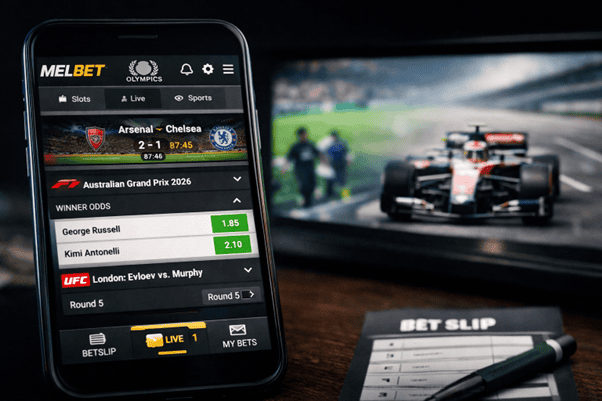

A betting app earns trust in short bursts, not in slogans. On March 1, 2026, Arsenal beat Chelsea 2-1 and restored a five-point cushion at the top of the Premier League, and that is the kind of afternoon when users stop caring about ad copy and start caring about fast odds, a stable slip, and one clean route back to the live screen.
The useful app is the one that keeps pace with the match as Martin Ødegaard shifts the angle of attack or as a late card changes the market tone. That is the real test for any mobile sportsbook built for daily use.
The first screen tells the truth
The opening impression is usually mechanical: how much can be seen without scrolling twice, how quickly football gives way to Formula 1 or UFC, and whether the bet slip stays visible after one tap too many.
Current company materials describe MelBet as available across iOS, Android, the web, and mobile web, with more than 200 sports options and 30,000 daily events, a scale that only works if the front page does not become cluttered.
The better choice here is a narrow hierarchy: top sports first, live section near the top, and match pages that keep odds, score, and market groups close together. A mobile interface either respects the thumb or it does not.
Markets that fit the match
A serious sportsbook app is judged less by how many markets it lists than by whether those markets match the rhythm of the sport.
Football needs result, totals, both-teams-to-score, corners, cards, and live next-goal logic; Formula 1 needs winner, podium, fastest lap, and head-to-heads; UFC leans on winner, method, round, and over-under time.

The range only becomes useful when it stays readable under pressure, the way Albert Park’s 2026 race made head-to-head markets relevant right to the end as George Russell beat Kimi Antonelli by 2.974 seconds, or the way UFC London on March 21 turned a featherweight main event into a scorecard decision when Movsar Evloev beat Lerone Murphy 48-46, 48-46, 47-47. Good category design does half the work before a stake is entered.
- Football: result, totals, both teams to score, corners, and cards become most useful when a match opens up after halftime, as it did in Arsenal 2-1 Chelsea on March 1.
- Formula 1: winner, podium, and head-to-heads suit races with late volatility, and the Australian Grand Prix on March 8 was decided by margins small enough to keep those screens alive deep into the race.
- UFC: moneyline, method, and round markets suit fights that can flip on a single sequence, but UFC London still went to the judges in the Evloev-Murphy main event.
When live mode starts to matter
Live betting is where the layout either holds together or starts to fray. On March 1, Arsenal beat Chelsea 2-1, and the match moved through the kind of phases that test any app: a title-race setting, a red-card swing, and a finish that kept the live screen relevant deep into stoppage time.
In that rush, the Melbet application works best when the price, cash-out option, and match tracker are in the same thumb zone, rather than sending the user back to the home screen. The same rule applies outside football, because one safety-car phase in Melbourne or one late momentum shift in a UFC main event can make a slow refresh feel older than it is.
Speed shows up in small places
Speed matters. Small delays cost bets. The useful measure is not a lab number but whether a user can move from a live market to the slip, back to stats, and then to settlement history without losing context, and that is where cleaner mobile design usually beats louder design.

There is also a security side to convenience: Android’s current guidance says installs from outside Google Play require explicit user opt-in, and Google Play Protect may scan unknown apps, which means a careful install path is part of app usability in 2026, not a side issue.
One app, several sporting clocks
A betting day is rarely one long session now; it is a run of short checks between work, transport, and second screens. On March 30, WWE’s official Raw results were still leading with CM Punk powerbombing Roman Reigns through the announce table, while the football calendar was already bending around March fixture changes and European ties, and that kind of split schedule is exactly why users want one app that opens fast and keeps saved preferences near the surface.
A betting platform earns its place by letting a user move from Premier League prices to UFC method markets and back without losing the slip or reloading the same event twice. That sounds small, but repeated friction is what breaks a mobile routine.
What stays after the first week
The strongest long-term case is not only about design. Curaçao Gaming Authority records show MelBet is operated by Pelican Entertainment B.V. under licence OGL/2024/561/0554, granted on November 15, 2024, and currently marked active, while company materials describe over 60 languages, more than 60 payment methods, and live plus pre-match coverage built around sport first.
That combination gives the app a clear frame: broad market depth, cross-platform access, and enough structure to handle a busy Saturday without turning the screen into noise. The practical takeaway is simple: install from the verified source, check the permissions, test the live screen during one real event, and keep the markets tight enough that the phone stays a tool rather than a distraction.