

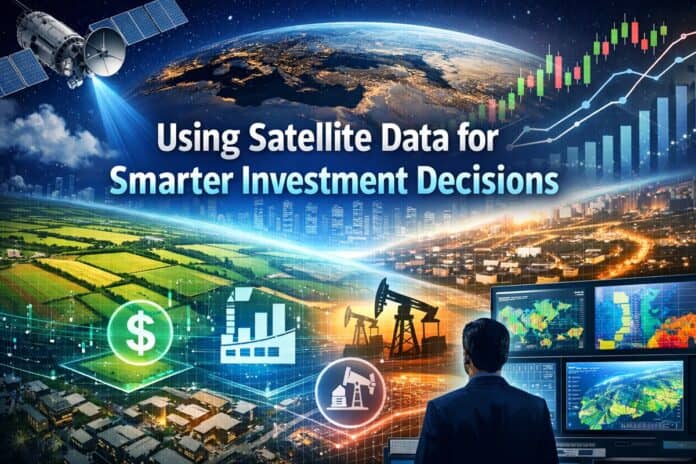

Investors today are looking for every possible edge to stay ahead. Beyond financial statements and market reports, satellite data is providing a new perspective. It allows investors to see real-world activity as it happens, giving insights that were once impossible to obtain. This technology is transforming how investment decisions are made across industries and is quickly becoming a key tool in the modern investor’s toolkit.
The Advantage of Real-Time, Unbiased Data
Traditional investment sources are often lagging indicators, capturing events only after they happen. Satellite imagery offers near-real-time observations, providing objective insights without human bias.
For instance, monitoring the number of cars in a retailer’s parking lot over time can signal shifts in consumer demand before earnings reports reflect them. Hedge funds and quantitative investors are increasingly integrating such non-traditional data into predictive models to gain a competitive edge.
Monitoring Supply Chains and Commodities
Satellite data is particularly useful in assessing global supply chains. Traders can analyze images of storage facilities or ports to estimate inventory levels of commodities like oil, grain, or metals.
Early detection of shortages or surpluses allows investors to anticipate price movements before official statistics are released. This is invaluable in volatile markets or during geopolitical disruptions.
The Technology Behind Satellite Insights
The rise of private satellite operators has made high-resolution imagery more accessible. Modern satellites equipped with optical, infrared, and radar sensors can revisit key locations multiple times per day.
Coupled with machine learning and cloud processing, these images can be transformed into actionable intelligence. Platforms like Skyfi make it easier for investors to acquire satellite imagery and integrate it into analytical workflows, opening up space-based data to both institutional and individual investors.

Applications in Retail and Real Estate
Investors in retail and real estate can leverage satellite data to track physical developments. Monitoring new store openings or construction progress on commercial properties can indicate future revenue streams.
Similarly, observing competitors’ expansion or logistical infrastructure can reveal shifts in market dynamics, helping investors make timely decisions.
Supporting ESG and Sustainable Investments
Environmental, social, and governance (ESG) concerns are increasingly important for investors. Satellite imagery enables independent verification of environmental commitments, such as tracking deforestation or land use changes.
This transparency allows portfolio managers to identify potential ESG risks that may not appear in corporate disclosures, aligning investment strategies with sustainability goals.

Limitations and Considerations
While satellite data is powerful, it is not a standalone solution. Analysts must interpret it carefully, considering factors such as weather conditions, image resolution, and revisit frequency. It works best when combined with traditional research and financial analysis, providing early signals that enhance, rather than replace, conventional decision making.
Summing Up
Satellite data is revolutionizing investment analysis. By offering real-world, unbiased insights across industries, it enables investors to spot trends early, assess risks more accurately, and make smarter, more informed decisions.
Tools are making this space-based intelligence accessible, giving both professionals and individual investors the ability to see what was once invisible from the ground.