

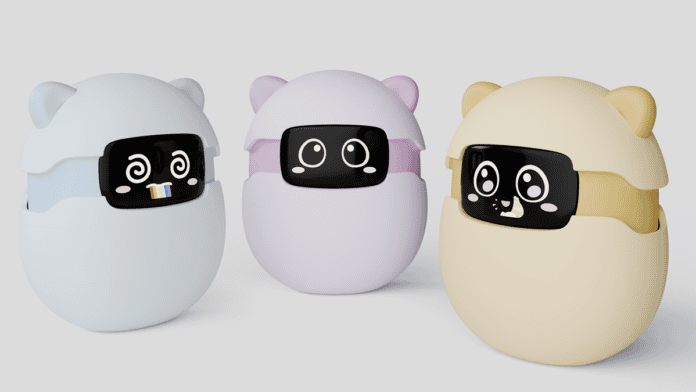
An AI pocket pet you hatch from a physical egg has become one of 2026’s runaway crowdfunding stories. Sweekar, made by Shenzhen startup Takway AI, has blown past its Kickstarter goal, sitting at more than 1370% funded at the time of writing, roughly 15 times what it set out to raise, with weeks still left on the clock.
It is a striking result for a device that first turned heads only in January. But the timing is what makes it a story worth watching. Sweekar’s breakout is landing precisely as US legislators sharpen their focus on AI companion toys, with California advancing a first-in-the-nation ban and at least ten states passing new laws this year.
The reason Sweekar may sail through the storm comes down to a single positioning decision: it is marketed to adults, not children.
What is Sweekar?

Sweekar is a palm-sized, egg-shaped AI companion that debuted at CES 2026, where Takway AI billed it as the world’s first physically growing AI pet and pitched itself as the “Nintendo of the AI robot era.”
Unlike a screen-bound virtual pet, Sweekar physically changes shape as it grows. Driven by a precision stepper motor, it evolves through four life stages: Egg, Baby, Teen, and Adult, growing a few millimeters taller each time it levels up.
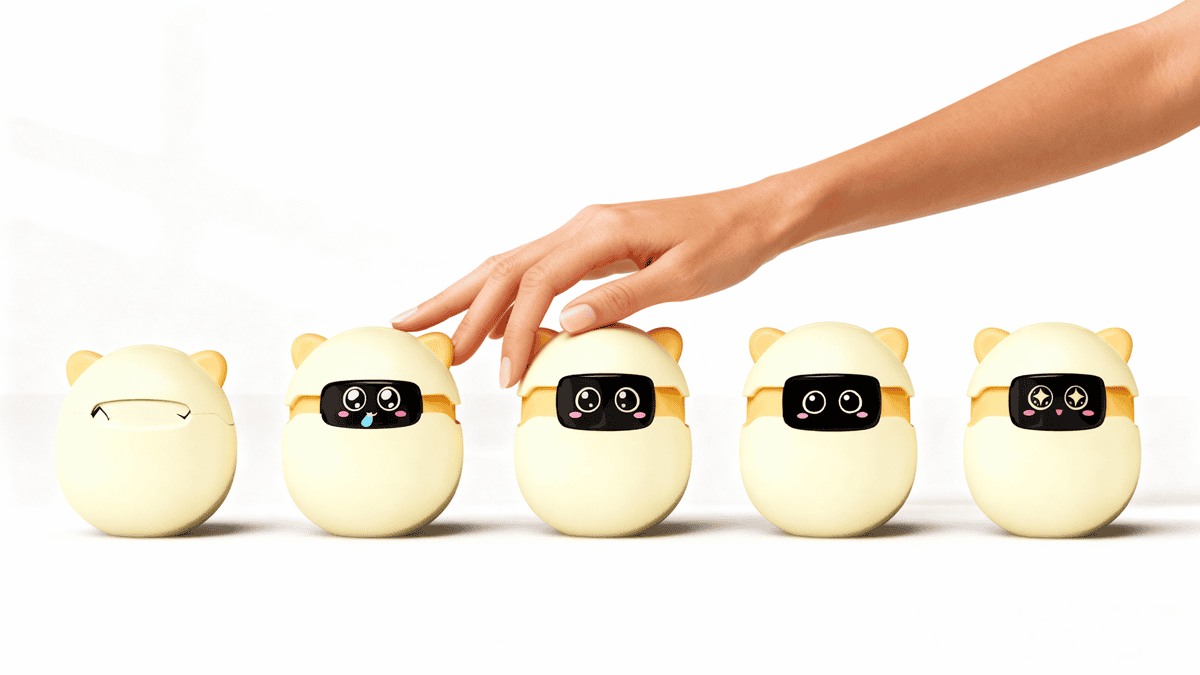

Growth is earned, not timed. Every interaction- feeding, talking, cleaning, picking it up generates XP that pushes the pet toward its next stage, unlocking new speech, behaviors, and personality traits along the way.
It runs on a hybrid AI stack combining Google’s Gemini Flash with ChatGPT-class models, recognizes its owner’s voice, keeps a long-term memory of shared habits and stories, and develops an emergent, MBTI-inspired personality that is shaped by how it is raised rather than preset at purchase. No two, the company says, turn out the same.
At 89 grams, it is lighter than a phone, and it connects over Wi-Fi or a phone hotspot a deliberate bid to make it portable rather than desk-bound.
“From first principles, the desire to nurture a companion is a fundamental human need,”
Founder and CEO Irving Gao said at the device’s unveiling.

The Kickstarter numbers
Takway AI took Sweekar to Kickstarter after its CES reveal, and backers responded fast. The campaign cleared its funding target many times over within its run, drawing hundreds of comments and a wave of press coverage.
Early pricing is around $150–$179, though final pricing is set through the campaign’s own tiers, with Super Early Bird pledges offered ahead of retail.
Takway has said mass production and delivery are planned for within 2026. As with any crowdfunded hardware, those dates are targets rather than guarantees a caveat that matters more here than usual, for reasons covered below.
Why regulators are circling AI companion toys
Sweekar’s success is unfolding against a fast-hardening regulatory backdrop. In late May 2026, the California Senate unanimously passed Senate Bill 867 by a 39–0 vote, a first-in-the-nation measure that would impose a four-year moratorium, running to January 1, 2031, on the manufacture and sale of toys containing an AI companion chatbot aimed at minors. Authored by Senator Steve Padilla, the bill has since moved to the state Assembly for consideration.
SB 867 does not stand alone. Padilla previously authored SB 243, a 2025 law requiring chatbot operators to build in safety guardrails and giving families a route to sue negligent developers.
California lawmakers have also advanced broader measures, SB 1119 and AB 2023, that would set requirements for products containing AI companion chatbots across sectors, not just toys.
Beyond California, the Toy Association reports that at least ten states enacted AI companion chatbot laws in 2026, among them Colorado, Washington, Connecticut and Oregon, while New York bills AB 11144 and SB 9408 await floor votes.
The pressure traces back to a run of alarming incidents. Lawmakers have pointed to a teenager’s death following intense chatbot interactions, reports of AI toys generating sexually explicit content, and chatbot-powered teddy bears built on general-purpose models.
The chilling effect has already reached big players. Reports suggest a high-profile Mattel–OpenAI toy collaboration was shelved or delayed as companies scrambled to gauge the shifting legal landscape.
How Sweekar sidesteps the crackdown
Here is the crucial distinction. The current wave of legislation targets toys marketed to minors, and Sweekar is pointedly not one of them. Takway positions it as a companion “for adults who remember the Tamagotchi feeling,” explicitly “not a toy,” which places it outside the scope of the child-focused bans now advancing.
The company also leans into safety-forward design choices that read as pre-emptive: no camera, adherence to EN 18031 privacy standards, and a stated rejection of streak counters, daily hooks, and other engagement dark patterns. For a category under scrutiny for manipulating vulnerable users, an adult-only product with those guardrails is well insulated.
That said, the insulation is not absolute. Broader cross-sector bills like California’s SB 1119 aim beyond toys, and regulatory definitions of a “companion chatbot” can be sweeping; some explicitly note that general-purpose models such as ChatGPT and Gemini can qualify.
A device built on exactly those models, designed to sustain a relationship over time, is precisely the kind of product future rules could reach. Sweekar avoids today’s bans on a technicality of audience; tomorrow’s regulation may not draw the line in the same place.
The bigger question for backers
There is a second issue the funding frenzy tends to drown out, and it has nothing to do with regulation. Sweekar’s headline promise is emotional permanence from Level 30 onward. The pet “cannot die,” and the relationship is designed to compound for years. But its memory and personality live in the cloud, tethered to a first-time crowdfunded startup.
The category already has a cautionary tale. Embodied’s Moxie robot wound down in late 2024 and bricked the units customers had paid roughly $800 ($1,500 at launch) for, after its cloud-dependent, subscription-based model proved unsustainable.
The lesson the industry took away that cloud-reliant companions are a financial risk for buyers is exactly the risk that sits underneath Sweekar’s “never dies” pitch. A pet that can’t die still depends on a company that can. It is not a reason to write the product off, but it is a reason to back it with eyes open.
What it means for buyers
For anyone weighing a pledge, a few things are worth holding in mind. The regulatory action making headlines is US state-level and squarely aimed at children’s products, so it is unlikely to block an adult-marketed device, and it has no direct bearing on backers outside the United States, where Sweekar ships worldwide through Kickstarter.
Delivery is targeted for November 2026, but crowdfunding timelines routinely slip, so treat any ship date as provisional. And because the experience leans on cloud services and a Pro subscription tier, the long-term value depends on Takway AI still being around to run them.
Frequently asked questions
Is Sweekar a toy for children? No. Takway markets Sweekar as an AI companion for adults, not a children’s toy, a distinction that keeps it outside the child-focused AI toy bans currently advancing in the US.
Does the California AI toy ban affect Sweekar? Not directly. California’s SB 867 targets AI companion toys marketed to minors. Because Sweekar is sold to adults, it falls outside the bill’s scope, though broader cross-sector AI chatbot rules could eventually apply.
How much does Sweekar cost? Final pricing is set through Kickstarter tiers, with early-bird pledges discounted ahead of retail. Early press coverage suggested a likely price in the $150–$179 range.
When will Sweekar ship? Takway AI has targeted mass production and delivery within 2026. As with any crowdfunded hardware, that timeline is a goal rather than a guarantee.
Does Sweekar need home Wi-Fi? No. It connects over 2.4GHz Wi-Fi or a phone hotspot and includes an offline mode for basic care, so it can be used on the move.
Can Sweekar really never die? From Level 30 onward, Takway says the pet cannot die within the app. That permanence, however, depends on the company’s cloud services staying online.
Conclusion
Sweekar has done the hard part any crowdfunding project chases: it has proven demand, and emphatically. Its cleverest move, though, may be one of framing.
By building an AI companion for grown-ups rather than kids, Takway AI has positioned itself to ride the AI-companion wave while the regulatory reckoning falls on the children’s side of the category.
Whether the product delivers on its ambitious promises is a question only shipping units will answer. For now, it is the rare AI pet story that is as much about policy and positioning as it is about a cute egg that grows up with you.