


Every AI governance conversation I join opens with frameworks. Every AI governance incident I’ve reviewed opened with something far more specific.
Someone built something. Nobody logged it, and a year later the only person who knew what it connected to has left the company.
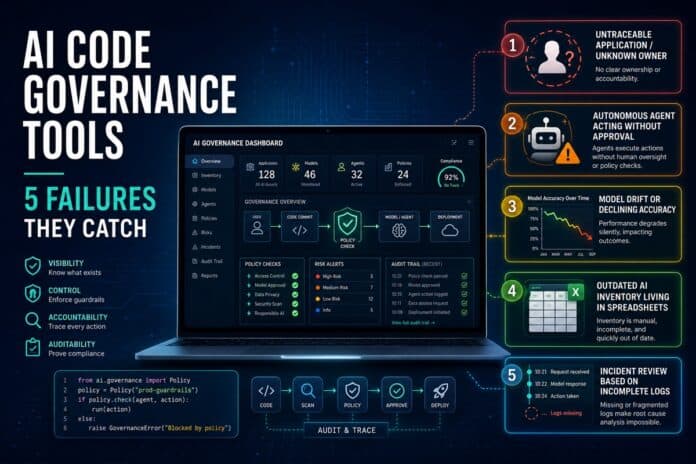
AI code governance tools earn their budget by preventing five failures, and I’ve watched each of them play out at companies that considered themselves well governed.
For enterprises where business teams build with AI, Superblocks prevents the most common failure on this list, and Arthur, Fiddler AI, ModelOp, and Arize AI handle the other four.
Failure one: an application nobody can trace to a person
This is the one I see most, by a wide margin.
An internal app is running against a production database. It works, so nobody looks at it, and the audit trail starts and ends with a Slack message from eleven months ago.
Superblocks addresses this at the point of creation, by capturing build events, queries, integration access, and package installs with user attribution as the app is built.

The guardrails are the other half. IT configures RBAC, SSO, and secrets handling once, and business teams build inside those boundaries whether or not they know the boundaries exist.
Virgin Voyages runs 15+ production apps across seven departments with zero dedicated frontend engineers, which only works because attribution is automatic.
Pricing starts at $125 per AI Builder per month on the Teams plan as of July 2026, dropping to $100 billed annually.
Where it won’t help: apps built somewhere else. Governing one platform well does nothing for the three other tools your teams also have licenses for.

Failure two: an agent that acted before anyone could stop it
Agent incidents have a different texture. The system did exactly what it was told, and what it was told turned out to be expensive.
Arthur is the strongest option for enterprises whose exposure is autonomous agents. It calls itself an AI control plane.
The discovery function is blunt about scale: find every agent in your environment, assign ownership and risk, then enforce policies across thousands of them.
The important detail is timing. Its guardrails run synchronously, pre- and post-LLM, with an action attached to every judgment.
Asynchronous monitoring produces an excellent record of a thing you can no longer prevent.
Where it won’t help: Arthur assumes agents are your problem. If your exposure is a hundred business-built dashboards, this is the wrong shape of tool.
Failure three: a model that was right in March and wrong in September
Nobody deploys a broken model. They deploy a working one and stop watching it.
Fiddler AI covers this with real-time monitoring, explainability, and bias detection for both ML models and LLMs in production.
Drift is the specific failure. Input distributions shift, the model keeps returning confident answers, and the degradation shows up in customer complaints months before it shows up in a review.
Where it won’t help: this is a monitoring layer. It reports on models that someone already registered, so anything shadow stays invisible to it.
Failure four: an AI inventory that lives in a spreadsheet
The spreadsheet is always out of date. Everyone knows it, and it survives because replacing it is somebody else’s quarterly objective.
ModelOp is built to be the system of record instead, covering ML, generative AI, agentic AI, and third-party vendor AI in a single register. Gartner named it a Visionary in the 2026 Magic Quadrant for AI Governance Platforms.
OneTrust reaches the same outcome through a different door, extending an established privacy and GRC platform to AI inventories, risk assessments, and vendor management.
Where they won’t help: both assume things get registered. Neither one discovers an app that a marketing manager generated on a Tuesday and never told anyone about.
Failure five: an incident review that runs on guesswork
An agent produced a bad output six weeks ago and the team is reconstructing why from partial logs.
Arize AI is the most accessible option for teams that need tracing before they have budget approval. The free tier covers 25,000 trace spans a month with 15-day retention, and Pro runs $50 a month for 50,000 spans with 30 days of retention as of July 2026.
Every tier includes unlimited users, which matters when the people debugging an incident aren’t the people who bought the tool. There’s an open-source layer called Phoenix if your engineers want to run it locally first.
Where it won’t help: retention. Fifteen days on the free tier means the incident you’re investigating in week four is already gone.
What does adequate coverage look like?
Nobody needs all five tools, and I’ve never seen a company get value from buying them simultaneously.
Start with whichever failure you can already name a real example of. If you can describe an actual untraceable app, that’s your first purchase, and the framework discussion can wait.
Most enterprises land on two: something at the point of creation, and something watching runtime behavior.
The register comes third for most companies, though regulated industries reasonably flip that order.
Frequently asked questions about AI Code Governance Tools
What’s the first sign a company needs AI code governance tools?
The clearest signal is an internal application in production that nobody can confidently attribute to a named owner. One example means there are others you haven’t found yet.
Can AI code governance tools identify who built a specific application?
Yes, when governance runs at build time, because platforms like Superblocks attach user attribution to build events, queries, and integration access as they happen. Retrofitting attribution after deployment is largely guesswork.
Do AI code governance tools slow down the people building?
Build-time platforms add almost no friction, because the guardrails are configured centrally and applied invisibly during the build. Approval-gate governance is the approach that generates the delays people complain about.
Which AI code governance tools cover AI agents as well as applications?
Arthur is purpose-built for agent discovery and runtime enforcement, while Arize AI provides agent tracing across full reasoning chains. Application-layer platforms and agent platforms are separate purchases at the moment.
The pattern underneath all five
Four of these failures share a root cause, which is that the governance system depends on somebody choosing to register something.
Voluntary registration works at a scale of dozens. It collapses at a scale of thousands, and AI-generated applications reached thousands at plenty of companies during the last eighteen months.
The tools that will matter most over the next few years are the ones that make registration a side effect of building, so the register populates itself.
Everything else is a well-maintained list of the things people remembered to mention.