

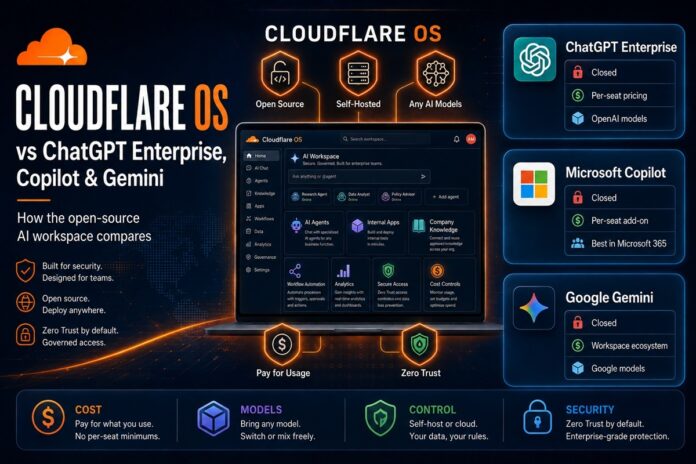

When Cloudflare launched Cloudflare OS on August 5, 2026, it walked into a market that already has three well-funded occupants: OpenAI’s ChatGPT Enterprise, Microsoft 365 Copilot, and Google’s Gemini. All four promise the same broad thing: AI that helps a whole workforce get work done. But the way Cloudflare built its version is different enough that the comparison is worth making carefully, because those differences are exactly what matter to a cost-conscious business.
The short version: the three incumbents are closed, proprietary, per-seat subscriptions tied to a single AI vendor and, in two cases, to a specific productivity suite. Cloudflare OS is open-source, self-hostable, and model-agnostic. That single distinction ripples through everything else: price, lock-in, and control.
Key takeaways
- Cloudflare OS is free, open-source software (Apache 2.0) that you self-host on your own Cloudflare account; you pay only for the compute and AI usage it consumes, not a per-seat license.
- ChatGPT Enterprise is quote-only at a reported ~$60 per seat per month with a ~150-seat minimum — a realistic floor near $108,000 a year.
- Microsoft 365 Copilot is a $30 add-on that sits on top of a Microsoft 365 license, pushing the true all-in cost to roughly $69–$90 per seat.
- Google Gemini is now bundled into Google Workspace plans (~$7–$28 per seat), with a separate per-seat Gemini Enterprise agent platform above it.
- The trade-off: Cloudflare OS removes the per-seat tax and vendor lock-in, but it is early-access software that you have to deploy, connect, and maintain yourself.
Cloudflare OS vs. the incumbents: at-a-glance
| Cloudflare OS | ChatGPT Enterprise | Microsoft 365 Copilot | Google Gemini | |
|---|---|---|---|---|
| Model | Open source (Apache 2.0), self-hosted on your Cloudflare account | Closed, hosted by OpenAI | Closed, hosted by Microsoft | Closed, hosted by Google |
| AI models | Any provider, via AI Gateway | OpenAI (GPT-5.x) only | OpenAI / Microsoft models | Google Gemini models |
| Pricing | Free software; pay only for usage (compute + model inference) | Quote-only, ~$60/seat/mo reported, ~150-seat minimum | $30/seat/mo add-on on top of a Microsoft 365 license | Bundled into Workspace (~$7–$28/seat); separate agent platform priced per seat |
| Ecosystem lock-in | None — connects to your systems | OpenAI account | Microsoft 365 stack | Google Workspace stack |
| Security model | Zero-trust by default; agents start with no access | Enterprise controls; data not trained on | Enterprise Data Protection within M365 boundary | Enterprise data protection within Google boundary |
| Outputs | Live, full-stack apps you can share and edit | Chats and custom assistants | AI inside Office documents | AI inside Workspace documents |
| Maturity | Early access — open-sourced Aug 2026, “under heavy development” | Established | Established | Established |
Pricing figures are reported/negotiated 2026 rates; none are official Cloudflare comparisons.
Pricing: per-seat subscriptions vs. pay-for-usage
This is where the gap is widest, and where it matters most for businesses watching every line of spend.
ChatGPT Enterprise: No published price. OpenAI negotiates every contract, and 2026 procurement reports put the figure at roughly $60 per seat per month within a $45–$75 range, typically with a reported minimum of around 150 seats and annual prepayment as a realistic entry point near $108,000 a year.
Microsoft 365 Copilot: Looks cheaper at $30 per user per month, but that is an add-on you can only buy if you already own a qualifying Microsoft 365 license. After Microsoft’s July 2026 base-price increases, the true all-in cost lands closer to $69 per seat on an E3 plan and around $90 per seat on E5, before you touch any of the extra agent features.
Google Gemini: took a different route. Google discontinued its standalone Gemini Business and Gemini Enterprise add-ons in March 2025 and folded the AI into Workspace plans, raising base prices to match Workspace Business tiers, which now run roughly $7 to $28 per user per month with Gemini included. Above that sits a separate Gemini Enterprise agent platform, sold per seat, for companies that want autonomous agents rather than AI in documents.

Cloudflare OS: Breaks the per-seat model entirely. The software itself is free and open source; you deploy it into your own Cloudflare account and pay only for what it actually uses: the underlying compute and the AI model inference that runs through Cloudflare AI Gateway.
Because you are not buying a fixed seat for every employee whether they use it or not, and because administrators can route routine jobs to cheaper models and see spend broken down by person, team, or app, the cost curve is fundamentally different. There is no 150-seat floor and no productivity-suite tax underneath.
The catch, and it is a real one: “pay only for usage” is not the same as “cheap.” Heavy agent use consumes real compute and real tokens, and self-hosting means you carry the deployment and maintenance yourself rather than handing it to a vendor. What Cloudflare OS removes is the fixed, dollar-denominated per-seat bill, not the need to manage cost.
Vendor lock-in: one model vs. any model
The three incumbents each tie you to their own AI. ChatGPT Enterprise runs OpenAI’s models. Copilot runs on the Microsoft/OpenAI stack. Gemini runs Google’s models. If a better or cheaper model arrives from a different lab next quarter, you cannot simply switch; you are inside that vendor’s walls.

Cloudflare OS routes every inference call through AI Gateway, which means the organization decides which models are available and which model handles each job. You are not betting your entire AI strategy on one lab staying ahead. In a market where model quality and pricing are still moving every few months, that flexibility has real value.
A second layer of lock-in is easy to miss. Copilot and Gemini assume you live inside their productivity suites. Copilot’s value is deepest if your company already runs on Word, Excel, Outlook, and Teams; Gemini’s if you run on Google Workspace.
Cloudflare OS is not a productivity suite. It connects to whatever systems your company already uses, through governed connectors, rather than asking you to move your work into its ecosystem.
Security: bolted on vs. built in
All four take enterprise security seriously, but Cloudflare’s approach is architecturally different. In ChatGPT Enterprise, Copilot, and Gemini, your data is protected because you trust the vendor’s boundary and their contractual commitments not to train on it.
Cloudflare OS starts from zero. Built on Cloudflare Access, every agent and app starts with no access and is granted only what a specific task requires.
Its “Gatekeepers” let the owner of each internal system control exactly what an agent can see, change, or do read GitHub issues but not source code, for instance- or require a human sign-off before merging a pull request.
It also records every resource an agent observes, so an output built from sensitive data cannot quietly become a way to leak that data to people who shouldn’t see it. For a bank or fintech, that capability-based model is a meaningfully stronger answer than “trust our boundary.”
Where the incumbents still win
An honest comparison has to say this clearly. Cloudflare OS is brand new as a public product, open-sourced only this month, labeled early access, and described in Cloudflare’s own documentation as very capable but still having many rough edges. The managed, dashboard-deployed version does not yet have a release date. The other three are mature products used by millions.
If your company already lives in Microsoft 365 or Google Workspace, Copilot and Gemini offer polish and native depth AI sitting right inside the documents your team uses all day that Cloudflare OS does not try to match. ChatGPT Enterprise gives you frontier models and a dedicated success manager with zero deployment effort.
Cloudflare OS asks you to deploy, connect, configure, and maintain it, and to bring the technical capacity to do so. For a company that just wants AI in its email tomorrow morning with no engineering involved, an incumbent is still the easier path today.
Frequently asked questions about Cloudflare OS
Is Cloudflare OS free? The software is free and open source under the Apache 2.0 license. You do not pay a per-seat fee, but you do pay for the Cloudflare compute and the AI model usage it consumes when you run it on your own account.
Is Cloudflare OS better than Microsoft Copilot or ChatGPT Enterprise? It depends on what you value. Cloudflare OS wins on cost structure, model flexibility, and control, and it has no per-seat license. Copilot and ChatGPT Enterprise win on maturity, out-of-the-box polish, and native integration with tools your team already uses. Cloudflare OS is also early-access software, so it requires more technical effort to deploy.
What AI models does Cloudflare OS use? Any of them. Cloudflare OS routes model calls through Cloudflare AI Gateway, so an organization can choose which providers and models to use and route different tasks to different models, including cheaper models for routine work.
Can I self-host Cloudflare OS? Yes. It is designed to run in your own Cloudflare account from the open-source repository. A fully managed version deployable through the Cloudflare dashboard is planned, but Cloudflare has not announced a release date.
Is Cloudflare OS ready for production? Cloudflare labels the August 2026 release as early access and “under heavy development,” and its documentation notes many rough edges. Companies should plan for testing, custom integration, and security review before using it for sensitive or business-critical workflows.
Conclusion
The AI workspace race is no longer just about which model is smartest. Cloudflare OS is a bet that companies will increasingly want to own the platform, not rent it. For well-resourced teams and cost-conscious markets like Nigeria and other emerging markets, where per-seat dollar subscriptions bite hardest, that bet is genuinely compelling.
The honest caveat is timing: this is early-access software today, and the easy, turnkey path still belongs to the incumbents. Each company has to answer whether owning its AI workspace is worth the work of building on one.