

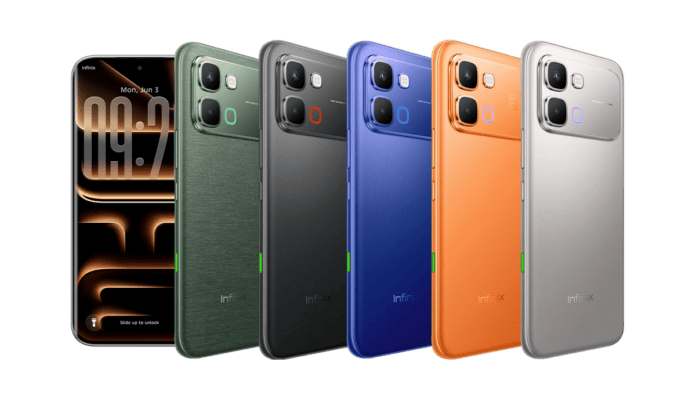

The Infinix Note Edge, launched globally on 19 January 2026, is the brand’s boldest attempt yet to bring genuinely premium design into the affordable mid-range. It pairs a striking 6.78-inch 3D-curved AMOLED display with the world’s first MediaTek Dimensity 7100 5G chipset, a slim 7.2mm body, and a huge 6,500mAh battery wrapped in headline-grabbing “self-healing” battery technology.
Compared with earlier Infinix Note models, the Note Edge moves the line forward in meaningful ways: a brand-new, more efficient processor, a slimmer, curved-glass design in place of the chunkier, flat builds of before, a much brighter panel, and a battery engineered to stay healthy for years rather than months.
Add IP65 protection, JBL-tuned stereo speakers, and Android 16 out of the box, and you have a device that looks and feels far costlier than its price tag suggests. Here is a full breakdown of what the Infinix Note Edge offers.
Design
Design is where the Note Edge earns its name. Infinix has built a phone just 7.2mm thick and roughly 190g, finished with a glass front, a plastic back, and a plastic frame that together create an unexpectedly premium in-hand feel.
The 3D-curved screen tapers into ultra-narrow symmetrical bezels measuring as little as 1.87mm, so the display appears to flow over the edges. Buyers can choose from finishes including Lunar Titanium, Silk Green, Stellar Blue, Shadow Black, and Orange.
Two standout extras set it apart: a customizable color-accented “one-tap” key on the frame that can trigger the torch, camera, sound profiles, or Infinix AI, and an RGB “Halo” light on the rear that glows for notifications, music, and gaming. An IP65 rating adds dust and splash resistance, a welcome touch at this price.
Display
The 6.78-inch AMOLED panel is the visual centerpiece. It runs at a 1.5K resolution of 1208 x 2644 pixels (around 429 ppi) with a smooth 120Hz refresh rate, delivering crisp text and fluid scrolling.

Infinix quotes an exceptional peak brightness of up to 4,500 nits, which keeps the screen readable under direct sunlight while enabling punchy HDR highlights, and high-frequency 2160Hz PWM dimming helps reduce eye fatigue during long sessions.
Corning Gorilla Glass 7i protects the front, and the aggressive curve adds to the immersive, cinema-like feel for video and games. The slim symmetrical bezels push the screen-to-body ratio close to 89%.
Paired with the JBL-tuned stereo speakers, the Note Edge turns into a genuinely enjoyable portable media machine, comfortably outclassing the flatter, dimmer panels found on many rivals near this price.
Camera
Imaging is the area where the Note Edge makes its clearest compromise. Rather than a multi-lens array, Infinix fits a single 50-megapixel main camera (1/2.0-inch sensor with phase-detection autofocus) and skips the ultrawide entirely.

The trade-off is that the company has concentrated on making that one sensor perform well, and in good daylight, it captures detailed, natural-looking shots that exceed expectations for the segment.
Low-light performance from the main camera is also noticeably improved compared to older Infinix Note phones. On the front sits a 13-megapixel selfie camera that handles well-lit portraits nicely but understandably struggles in dim conditions.
Video tops out at 2K (1440p) at 30 fps, and the camera app is loaded with AI tools, including portrait mode, night mode, and Infinix’s first Live Photo feature. Photography enthusiasts will miss the zoom and ultrawide flexibility, but casual shooters are well served.
Hardware and Software
Under the hood, the Note Edge debuts the MediaTek Dimensity 7100, a new 6nm 5G chip and successor to the Dimensity 7050. It uses an octa-core CPU (four Cortex-A78 cores up to 2.4 GHz plus four Cortex-A55 cores at 2.0 GHz) paired with a Mali-G610 MC2 GPU.
The result is dependable everyday performance and the ability to sustain high frame rates in popular games. It ships with 8GB of RAM and a choice of 128GB or 256GB of UFS 2.2 storage, neither of which is expandable.
Software is XOS 16 layered over Android 16, with smoother animations, depth-effect wallpapers, and improved touch responsiveness. Crucially, Infinix promises three major OS upgrades plus five years of security patches, which is strong for the segment. Gemini handles AI duties alongside the Folax assistant, though a few pre-installed extras count as bloat.
Battery and Charging
This is arguably the Note Edge’s biggest selling point. The 6,500mAh battery is the largest Infinix has ever fitted into a Note device, yet it sits inside that slim 7.2mm frame.
It is rated for marathon endurance, with Infinix citing figures such as 22 hours of YouTube playback. The real talking point is the self-repairing battery technology: when fully drained, a low-current recovery process uses “dynamic recrystallization” to heal micro-damage in the cells, which Infinix claims allows over 80% capacity retention after 2,000 charge cycles, roughly six years of typical use.
Charging is handled by a 45W wired system that reaches 50% in about 27 minutes and a full charge in roughly an hour. Bypass charging and 10W reverse wired charging round out a genuinely strong battery package.
Connectivity
Connectivity is comprehensive for an affordable handset. The Note Edge supports 5G (both standalone and non-standalone networks) with dual-SIM functionality, ensuring it stays relevant as networks expand across Africa and beyond.
Wireless connectivity includes dual-band Wi-Fi and Bluetooth 5.4 for stable, low-latency pairing with earbuds and accessories. NFC is on board for contactless payments, and there is an under-display optical fingerprint sensor for secure unlocking, backed by the usual accelerometer, gyroscope, proximity, and compass sensors.
A USB Type-C 2.0 port with OTG support handles charging and data transfer, while satellite positioning includes GPS, GLONASS, Galileo, and QZSS. Infinix even retains enthusiast-friendly extras that many rivals drop: a built-in FM radio and an infrared (IR) blaster that lets the phone double as a universal remote for TVs and air conditioners.
At its price, the Note Edge faces stiff competition. From within the Transsion family, the Tecno Spark 40 Pro+ is the closest value rival; it offers a faster 144Hz display but relies on the older Helio G200, which is less capable than the Dimensity 7100.
The Samsung Galaxy A26, similarly priced in its 8GB/256GB form, counters with IP67 protection, Gorilla Glass Victus+ on both sides, an ultrawide camera, 4K video, and Samsung’s class-leading six OS updates, though its chipset and brightness trail the Infinix.
For pure endurance, Xiaomi’s Redmi 15 is worth a look. The Note Edge’s trump cards remain its curved design, blistering screen brightness, and that long-life self-repairing battery.
Infinix Note Edge Pricing and Availability
The Infinix Note Edge went on sale from late January 2026 and is rolling out across more than 70 markets. Global pricing starts at around US$200 for the 6GB/128GB model, making the value proposition genuinely aggressive.
In Nigeria, the phone is priced at roughly ₦440,000 (about $320) for the 8GB/128GB variant, while the Kenyan MSRP is KSh 32,999 (around $250). In India, it starts at about ₹22,999.
Pricing, battery capacity, and exact configurations vary by region, so local retailers in Port Harcourt, Lagos, and Abuja may list slightly different figures. Given its premium curved design, bright AMOLED display, modern 5G chipset, and standout battery technology, the Note Edge represents one of the better-value mid-rangers of 2026 for shoppers who can live without an ultrawide camera.
Verdict
The Infinix Note Edge is an easy recommendation for buyers who want an Android phone that looks and feels expensive without the high price. Its curved AMOLED screen, slim build, dependable Dimensity 7100 performance, and remarkable self-repairing battery make it stand out, even if the single-camera setup and lack of an ultrawide hold it back from perfection.
| General | |
|---|---|
| Announced / Released | January 19, 2026 / January 31, 2026 (global) |
| Positioning | New sub-line within the Infinix Note series (no direct same-name predecessor) |
| Colours | Lunar Titanium, Stellar Blue, Shadow Black, Silk Green |
| Design and Build | |
| Dimensions | 163.1 × 77.4 × 7.2 mm |
| Weight | 190 g |
| Build | Glass front, plastic back, plastic frame; 3D-curved design |
| Durability | IP65 (dust-tight, resistant to low-pressure water jets) |
| SIM | Dual Nano-SIM + eSIM |
| Display | |
| Type | AMOLED, 1B colors, 2160Hz PWM dimming, TÜV blue-light certified |
| Size | 6.78 in (~88.8% screen-to-body), symmetrical 1.87 mm bezels |
| Resolution | 1208 × 2644 px (1.5K), ~429 ppi, 19.5:9 ratio |
| Refresh rate | 120Hz (30 / 60 / 90 / 120Hz modes) |
| Brightness | 700 nits (typ), 1,600 nits (HBM), 4,500 nits (peak, advertised) |
| Protection | Corning Gorilla Glass 7i |
| Other | Widevine L1 (FHD streaming); no HDR video support |
| Platform | |
| OS | Android 16 with XOS 16; 3 major OS upgrades + 5 years security patches |
| Chipset | MediaTek Dimensity 7100 (6 nm) |
| CPU | Octa-core (4× 2.4 GHz Cortex-A78 & 4× 2.0 GHz Cortex-A55) |
| GPU | Mali-G610 MC2 |
| AnTuTu (V11) | ~810,000 |
| Memory | |
| RAM | 8 GB (LPDDR5X); 6 GB base variant in some markets |
| Storage | 128 GB / 256 GB (UFS 2.2) |
| Card slot | No (non-expandable) |
| Main Camera | |
| Camera | 50 MP (wide), 1/2.0″, 0.8 µm, PDAF; aperture not officially specified |
| Features | Dual-LED flash, HDR, panorama; AI tools (Live Photo, AI Eraser) |
| Video | 1440p@30fps (2K), 1080p@30fps |
| Selfie Camera | |
| Camera | 13 MP, f/2.2 (wide) |
| Video | 1440p@30fps, 1080p@30fps |
| Sound | |
| Loudspeaker | Stereo speakers, tuned by JBL; DTS equalizer |
| 3.5 mm jack | No |
| Audio | 24-bit/192kHz Hi-Res & Hi-Res Wireless |
| Connectivity | |
| Network | 5G (SA/NSA, Sub-6), 4G LTE; dual-SIM active |
| Wi-Fi | Dual-band 802.11 a/b/g/n/ac (Wi-Fi 5) |
| Bluetooth | 5.4, A2DP, LE |
| Positioning | GPS, GLONASS, Galileo, BeiDou, QZSS |
| NFC | Yes |
| Infrared | Yes (IR blaster / universal remote) |
| Radio | FM radio |
| USB | USB Type-C 2.0, OTG |
| Features | |
| Sensors | Under-display optical fingerprint, accelerometer, gyroscope, proximity, compass |
| Extras | Active Halo RGB light; customizable one-tap side key; UPS 3.0 AI signal boost; Folax AI assistant |
| Battery | |
| Type | 6,500 mAh (6,150 mAh in some markets) |
| Charging | 45W wired (proprietary); 50% in 27 min (claimed); full ~62 min claimed |
| Reverse charging | 10W wired |
| Other | Bypass charging; self-repairing battery (dynamic recrystallisation; ~80% capacity after ~2,000 cycles) |
| Pricing | |
| Global (8/128) | From ~US$200 |
| Nigeria | Around ₦440,000 |
| Kenya | KSh 32,999 (MSRP) |
| India (6/128) | From ₹22,999 |
Frequently Asked Questions (FAQ)
Is the Infinix Note Edge a 5G phone? Yes. It supports 5G on both standalone and non-standalone networks, thanks to the MediaTek Dimensity 7100 chipset, along with dual-SIM functionality.
How big is the battery, and how fast does it charge? The Note Edge packs a 6,500mAh battery (6,150mAh in some regions) with 45W wired charging that reaches about 50% in 27 minutes and a full charge in roughly an hour. It also supports bypass charging and 10W reverse wired charging.
What is the “self-repairing” battery? It is a technology that, on full discharge, runs a low-current recovery process to heal micro-damage in the battery cells. Infinix claims this keeps the battery above 80% capacity after 2,000 charge cycles, around six years of typical use.
Does the Infinix Note Edge have an ultrawide camera? No. It uses a single 50MP main rear camera with phase-detection autofocus and a 13MP front camera. There is no dedicated ultrawide or telephoto lens.
What software does it run, and will it get updates? It ships with XOS 16, based on Android 16, with a promise of three major Android upgrades and five years of security patches.
Is the Infinix Note Edge water-resistant? It carries an IP65 rating, meaning it resists dust and light splashes or rain, but it is not built for submersion.
How much does the Infinix Note Edge cost in Nigeria? It is priced at around ₦440,000, though exact pricing varies by retailer and region. Global pricing starts at roughly US$200 for the base 6GB/128GB model.