



On July 10, 2026, China did something only one other country had ever pulled off: it recovered an orbital-class rocket booster after launch. But it didn’t copy SpaceX to get there. Instead of the four landing legs that lower a Falcon 9 gently onto a pad, China’s Long March-10B fired four hooks into a giant net stretched across a ship at sea.
If SpaceX’s rocket landing looks like a controlled touchdown, China’s looks more like a fighter jet snagging an arrestor wire on an aircraft carrier. Both solve the same expensive problem, how to reuse a rocket, in strikingly different ways. Here’s how each method works, and what China’s net-catch approach could change.
What Happened With the Long March-10B
China’s Long March-10B lifted off from the Hainan Commercial Space Launch Site in Wenchang at 12:15 p.m. local time, carried a satellite to its target orbit, and then brought its first stage back down for a controlled recovery about six minutes after the stages separated.
That made China only the second nation, after the United States, to recover an orbital-class booster under control. The rocket is a medium-lift vehicle roughly 63 meters (207 feet) tall and 5 meters wide, built by the China Academy of Launch Vehicle Technology (CALT).
Its first stage runs on seven liquid oxygen-kerosene engines, and in reusable mode, it can lift about 16 tonnes to low Earth orbit. The booster was caught by a recovery vessel named Linghangzhe, which translates roughly to “the Navigator.”
How SpaceX’s Falcon 9 Lands
SpaceX’s Falcon 9 has been landing itself since December 2015, and the method is now the most proven in the world. After the first stage separates, it flips around and fires its engines in a series of controlled burns to slow down and steer back toward a target, either a concrete pad on land or a floating droneship at sea.
Grid fins, the small lattice-shaped panels near the top of the booster, adjust its attitude as it falls through the atmosphere. In the final seconds, four sturdy landing legs unfold from the base, and the rocket settles upright on them.

This approach is extremely mature. SpaceX now flies the Falcon 9 around 150 times a year, roughly three launches a week, and reuses individual boosters dozens of times. Blue Origin’s New Glenn, which first landed a booster in November 2025, also uses landing legs.
How China’s Net-Capture Landing Works
For most of its return trip, the Long March-10B behaves much like any other reusable rocket. Its first stage deploys grid fins to steer through the atmosphere and reignites its engines to slow down, aiming for the waiting sea platform.
The difference is entirely in the last few seconds. Rather than extending its legs and touching down on its own, the booster hovers over the platform, cancels out its sideways motion, and lowers itself straight down.
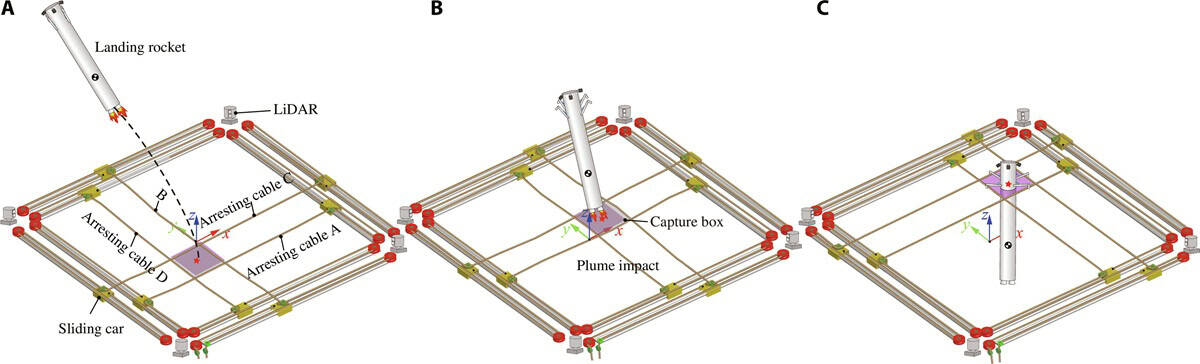
As it does, four arresting hooks on the rocket’s body snag a net arranged in a grid pattern across the vessel. A flexible net-and-cable system with hydraulic damping absorbs the downward momentum bit by bit, bleeding off the energy so the booster is slowed and held rather than dropped.

Auxiliary cables then steady it against wind and waves before an automated platform locks it in place for the trip back to shore. Chinese engineers compare the whole sequence to a jet catching an arrestor wire on a carrier deck.
Net vs. Legs: The Key Differences
The clearest difference is where the “catching” hardware lives. On a Falcon 9, the landing gear travels with the rocket: four heavy legs and their support structures are bolted to the booster and carried all the way to space, even though they only do their job for a few seconds at the very end.
China’s net-capture design moves that hardware off the rocket and onto the recovery ship. The booster only needs lightweight hooks; the net, cables, and shock-absorbing gear stay behind on the platform.
A second difference is autonomy: the Falcon 9 lands itself on its own structure, while the Long March-10B relies on a coordinated catch between the rocket and the vessel.
The trade-off is maturity versus novelty. SpaceX has hundreds of successful landings behind it, while China’s sea-based net catch has now worked exactly once.
Why China Went With a Net Instead of Legs
According to CALT, moving the recovery hardware onto the ship carries real engineering advantages. Landing legs add “dead weight” that the rocket must haul from liftoff, and heavier legs mean less room for payload cargo, so removing them can free up payload capacity.
A CALT expert, Chen Muye, told state media that net-based recovery simplifies the booster’s structure, reduces its mass, and increases its payload capacity.
He also argued the approach is more forgiving of small errors: because a wide net can catch a booster that arrives slightly off-target, the “capture window” is larger than the narrow bullseye a legged rocket needs to hit.
That flexibility matters at sea, where wind and waves make a pinpoint landing harder. The obvious downside is that the technique is brand new, and two earlier Chinese attempts at leg-based landings by LandSpace and by a state team failed in the past year before this net-capture success.
What It Means for the Reusable Rocket Race
Reusing the first stage is the single biggest lever for cutting launch costs, which is why China has spent nearly a decade working toward this moment, from low hover tests to full orbital recoveries.
The Long March-10B team plans to actually re-fly the recovered booster before the end of the year, the real test of reusability, since a rocket you can only catch once isn’t yet saving anyone money.
For readers following the satellite-internet race, this is the part to watch: cheaper, repeatable Chinese launches are exactly what Beijing needs to accelerate its Guowang and Qianfan mega-constellations, systems positioned to rival Starlink in markets across Africa and beyond.
For now, SpaceX remains far ahead on cadence and reliability, but China has proven there’s more than one way to bring a rocket home.
Frequently Asked Questions
How is China’s Long March-10B landing different from SpaceX’s Falcon 9? The Falcon 9 lands upright on four deployable legs on a pad or droneship. The Long March-10B has no legs; it uses four hooks to catch a net mounted on a ship, then a cable system absorbs the impact.
Is China now ahead of SpaceX in reusable rockets? No. China became the second country to recover an orbital booster, but SpaceX is far ahead in practice, flying the Falcon 9 about 150 times a year and reusing boosters dozens of times. China has recovered one booster once and still has to prove it can re-fly it.
What is the net-capture recovery system? It’s a sea-based platform fitted with a grid-shaped net, tensioned cables, and hydraulic dampers. Hooks on the descending booster snag the net, which gradually slows and holds the rocket, much like a jet catching an arrestor wire on an aircraft carrier.
Why doesn’t the Long March-10B use landing legs? Landing legs add weight to the rocket; they carry the entire flight while being used for only a few seconds during landing. Moving the catching hardware onto the ship lets the booster stay lighter, which can increase payload capacity, and a wide net is more forgiving of a slightly off-target landing.
Can the Long March-10B booster actually be reused? That’s the next milestone. China recovered the first stage on its maiden flight and says it aims to launch the same booster again before the end of 2026, which would confirm the rocket is genuinely reusable.
How big is the Long March-10B, and what can it carry? It stands about 63 meters (207 feet) tall and 5 meters wide, and, in reusable mode, it can carry roughly 16 tonnes to low Earth orbit, a capability broadly comparable to SpaceX’s Falcon 9.