


With four days to go, the countdown clock for the launch of Nigeria’s digital postcode on postcode.gov.ng is still ticking down to October 1, 2026, and all indications suggest the Nigerian Postal Service (NIPOST) will meet its deadline. The National Digital Alphanumeric Postcode System, which assigns every building in Nigeria a unique 11-character digital address, is arguably the most ambitious piece of location infrastructure the country has ever attempted.
But hitting a launch date is the easy part. Nigeria has tried to fix its addressing problem for nearly two decades and fallen short every time. The real question isn’t whether the technology works on October 1; early signs suggest it does. It’s whether Nigerians, businesses, banks, and delivery firms will actually use it. That is exactly the risk NIPOST’s own leadership keeps pointing to.
We tested the postcode portal four days before launch
To gauge how ready the system really is, we spent time on the public site, postcode.gov.ng, on September 26, four days out. Here’s what we found.
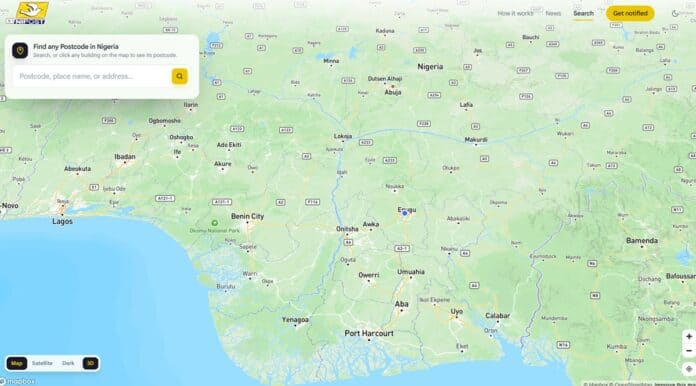
The homepage countdown confirms the launch is on track. The public search page at postcode.gov.ng/search is now live, a step forward from earlier in the month. But text search isn’t switched on yet: typing a street name produced no results and no map movement. It looks built but dormant, almost certainly waiting to be activated on launch day.
The more revealing test was the map itself. When we granted the browser location permission, the tool pinpointed our location accurately. Zooming in, it correctly identified the exact building we were in, not the street number, but the specific structure. Just as notably, the street names on the map were accurate, which Nigerians aren’t used to seeing on digital maps of their own neighborhoods.
The search page offers map, satellite, and dark mode in 3D and 2D views (Map mode in 3D view is the default as of our testing).
That combination of precise building-level mapping already in place, with the public text-search layer held back, tells you where the project actually is. The hard part, the underlying GIS map, appears to be working. What’s pending is the citizen-facing lookup, which will likely be activated come October 1.

The real risk isn’t the technology; it’s adoption
NIPOST Postmaster General Tola Odeyemi has been unusually candid about where this project could stumble. She has consistently said that implementation, not engineering, will decide whether the system succeeds, and that the job now is to move Nigerians from simply being aware of the postcode to actually using it.
That’s a telling admission, because Nigeria’s history here is littered with technically sound systems that never achieved everyday use. A postcode is only valuable if the delivery rider asks for it, the bank captures it, the e-commerce checkout has a field for it, and the ordinary citizen knows their code and gives it out. None of that is guaranteed by a working map.
A concrete gap underlines the point. As of late September, authorities had not fully spelled out the exact procedures ordinary Nigerians will follow to obtain and use their codes day to day. The infrastructure is arriving ahead of the habits, and the how-to and closing that gap is a communications and behavior-change challenge, not a mapping one. Perhaps we will know more on October 1.
Why this attempt has gone further than the last four
To understand why observers are cautiously optimistic this time, it helps to see how many previous attempts failed.

Nigeria has used a six-digit numeric postcode since 1986 (Lagos Island’s is 100001), but because street names and house numbers are missing across much of the country, it never became a reliable way to find a specific building.
A push to digitize it first surfaced in 2009, but stalled amid leadership changes. NIPOST then tried narrower fixes. A 2017 partnership with UK location startup what3words, and in 2018, two verification platforms: the Address Verification System and the Digital Addressing System.
By 2020, Google’s own Plus Codes had entered the market with a similar workaround. None produced a nationwide, building-level addressing layer.
Four things make the current effort different:
Federal backing: The Federal Executive Council approved the GIS-enabled postcode in March 2026, giving it political weight its predecessors lacked.
It reuses existing data: Rather than remapping the country, NIPOST is building on the National Population Commission’s Enumeration Area Framework from the 2022 digital census, which had already used satellite imagery and GIS to record every building, road, footpath, and waterway. NIPOST organized this into roughly 400 Postcode Areas.
It was pilot-tested: NIPOST validated the model in Bwari Area Council in the FCT, then ground-tested it across a dozen more states, confirming it could generate codes without remapping buildings.
It’s designed as a reusable service: The platform is being built for address lookup, validation, standardization, and API access, so logistics firms, fintechs, and government systems can plug into one shared location layer instead of each building its own.
The coverage math: what October 1 actually covers
It’s worth being precise about what “launch” means, because the messaging can be misread as a single nationwide switch-on. It isn’t.
NIPOST has said it expects to have captured more than 90% of the country by launch day, with larger population centers going live first and full rollout across all 36 states and the FCT targeted for December 2026.
The long-term goal is coverage across all 774 Local Government Areas. Officials have cautioned that field teams are still validating the aerial model against ground conditions state by state, and that they will confirm the exact areas covered on day one at launch.
In other words, October 1 is a real, substantial launch, but if your specific area isn’t fully live on the first day, that’s expected, not a failure.
The challenges that will decide the next 12 months
Beyond adoption, several hurdles will determine whether the postcode becomes essential infrastructure or another underused government platform:
The developer portal isn’t open yet
The full portal that businesses and logistics platforms need to integrate the postcode into their own apps is still being finalized. For now, NIPOST is only collecting expressions of interest at postcode.gov.ng/integration. Until banks, e-commerce sites, and dispatch apps can integrate it, everyday utility stays limited.
Rural and low-connectivity reach
The promise to cover rural communities is central to the pitch, and the USSD channel is meant to serve Nigerians without smartphones or data. Whether that access works smoothly in practice remains an open question.
Privacy and data governance
Linking buildings to precise coordinates and potentially to identity via NIN raises obvious concerns.
NIPOST says access is tiered under the National Data Protection Commission, with public, restricted, and security-only levels, and that the Federal Republic owns the data through NIPOST. How firmly that line holds once agencies and companies start integrating is worth watching.
Consistency across wildly different terrain
The system deliberately uses different mapping models for different states, since dense areas like Lagos’s Mushin behave nothing like Abuja. Keeping accuracy uniform across that variety is a standing test.
What to watch after launch day
These are the signals that will show whether the postcode is gaining real traction:
- Does the text search go live? If the currently dormant search on postcode.gov.ng starts returning building codes on October 1, that’s the clearest sign citizens can begin using it.
- Which areas are covered on day one? Which areas are covered on day one, and how quickly does the map fill out toward the December target?
- When the developer portal opens: When will the developer portal open, and which banks, fintechs, and logistics platforms integrate first?
- Whether delivery and KYC flows start asking for your postcode: the true test of adoption.
Nigeria Digital Postcode FAQs
Is Nigeria’s digital postcode still launching on October 1, 2026? Yes. As of late September, the countdown on postcode.gov.ng and NIPOST’s messaging both indicate the launch remains on track for October 1, 2026.
Can I search for my postcode now? The search page at postcode.gov.ng/search is live, but text search doesn’t yet return results; it appears set to activate at launch. The map already pinpoints individual buildings accurately when you allow location access.
Will the whole country be covered on day one? No. NIPOST expects to cover more than 90% of the country by launch, starting with larger cities, with full coverage across all 36 states and the FCT targeted for December 2026.
Why might the system struggle even if the technology works? NIPOST’s own leadership has flagged adoption as the bigger risk. The postcode only delivers value if citizens, banks, and delivery firms actually use it a behavior and integration challenge, not just a mapping one.
How is this different from past failed attempts? It has Federal Executive Council approval, reuses the 2022 census mapping data instead of starting over, was pilot-tested in the FCT and a dozen states, and is designed as an API-based service other apps can plug into.
Conclusion
Four days out, the engineering looks ready. The map is precise down to the individual building, street names are accurate, and only the public search layer is waiting to switch on. That alone puts this attempt further than anything Nigeria has tried since 1986.
But the harder work starts on October 2, turning a working system into one that Nigerians reach for by habit, and that banks and logistics firms build into their everyday flows. On its own technology, this postcode should launch on time. Whether it lands depends on adoption. That’s the number worth watching.