

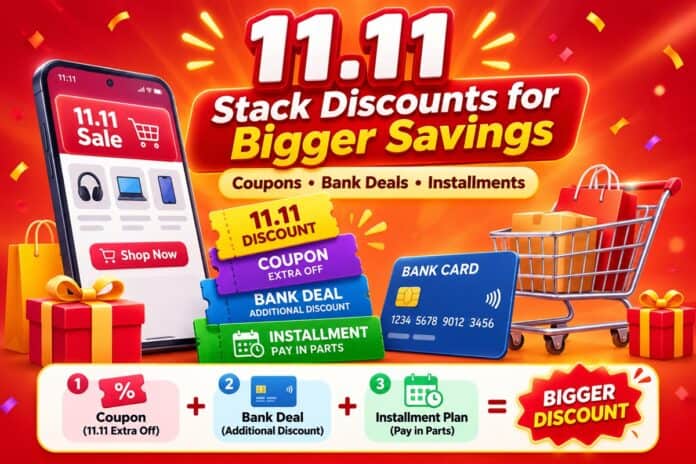
The cheapest 11.11 checkout is rarely the lowest sticker price. It is the order in which a platform discount, a store coupon, a bank or wallet reduction, and an interest-free installment plan all land on the same cart, in the right order, before the vouchers run out.
Singles’ Day (11 November, also called Double 11 or 11.11) started as a one-day Alibaba sale in 2009. It is now a month-long season across Tmall, Taobao, JD.com, Douyin, Shopee, Lazada, AliExpress and Amazon’s regional stores. What has changed most in recent years is not how deep the price cuts go, but how much of the saving now sits at the payment step.
This guide explains how the discount layers fit together, how the payment perks work in China, Southeast Asia and the rest of the world, and why banks are now building campaigns specifically for Singles’ Day shoppers. The method works every year; the 2026 figures show you what to look for this season.
Why payment perks now decide your final 11.11 price
Platforms have simplified headline discounts, so extra savings have shifted to how you pay. Three shifts explain it.
1. Simpler platform discounts: For the 18th Double 11 in 2026, Tmall leaned on official instant discounts applied straight to the product price, while Douyin kept single-item direct discounts plus an official 15% instant discount. Shoppers no longer need to pad baskets to hit cross-store spend thresholds. Fewer puzzles means the checkout is where careful shoppers still gain an edge.
2. Interest-free installments are now standard: In China, interest-free installments through Ant Group’s Huabei, JD’s Baitiao and bank credit cards have become a default Double 11 feature, with some electronics offering up to 24 interest-free months. In Southeast Asia, Shopee’s SPayLater runs special 0% campaigns around 11.11 and 12.12. On AliExpress, pay-later methods such as PayPal Pay Later and Klarna now carry their own 11.11 discounts in some markets.
3. Governments and banks are subsidizing credit: China extended its consumer-loan interest subsidy to the end of 2026 and brought credit card bill installments into it. Banks across Asia now treat Singles’ Day as a campaign in its own right, issuing card-specific vouchers and installment rebates timed to the sale.

As a result, two shoppers can buy the same phone from the same store on the same night and pay noticeably different amounts, depending only on which card or wallet they chose at checkout.
The five layers of an 11.11 discount stack
Every marketplace names its discounts differently, but nearly all of them fall into five layers, and they generally apply in this order.
| Layer | What it is | Where it applies | Typical examples |
|---|---|---|---|
| 1. Item price | The sale price or official instant discount already on the listing | Product page | Tmall official instant discounts, Douyin direct discounts, AliExpress “Choice” prices |
| 2. Platform voucher | A marketplace-wide coupon, usually “X off a minimum spend”, capped | Cart or checkout | Shopee and Lazada platform vouchers, AliExpress promo codes, Taobao/JD red packets |
| 3. Store or category voucher | A coupon funded by the seller or limited to one category | That store or category only | LazMall store vouchers, AliExpress store coupons, JD category coupons |
| 4. Payment reduction | An instant discount for paying with a specific bank card, wallet, or pay-later service | Payment page | Bank 11.11 vouchers in China, Singapore, and Malaysia, Alipay and UnionPay random reductions, PayPal discounts on AliExpress |
| 5. Financing perk | Interest-free or reduced-interest installments, sometimes with a rebate on top | Payment page or after purchase | Huabei and Baitiao interest-free months, bank card installment rebates, SPayLater 0% plans |
Two things sit outside the stack but still lower your effective price: cashback portals (such as ShopBack or Rakuten) and card rewards like points or miles. They pay out after the order is confirmed, so treat them as a bonus, not as part of the checkout price.
The rule that matters most is that layers 4 and 5 depend on choosing the right payment method. Pay with the wrong card or wallet and the bank voucher simply fails to apply, even if everything else in the stack worked.
China: Tmall, Taobao, JD and Douyin
China’s Double 11 is where payment stacking is most developed, because platforms, consumer-finance apps, banks and the state all fund discounts at the same time.
Timing: The festival now runs for more than a month. In 2026, JD opened its first spot-sale round on 12 October, and Tmall opened pre-orders on 15 October, with spot sales starting on 20 October. Chinese shopping guides point to 8 pm on 10 November through midnight on 11 November as the window when platform, category, store, subsidy, and payment offers overlap most.
The China stack, in order:
- Official instant discount or direct price cut on the listing.
- Red packets and platform coupons, often unlocked by searching a daily password phrase in the Taobao or JD app.
- Store and category coupons, including trade-in vouchers on eligible appliances and electronics.
- Payment reductions from Alipay, JD Pay, UnionPay or a bank card, such as random instant discounts or spend-threshold cuts.
- Interest-free installments through Huabei (Alipay), Baitiao (JD) or a bank credit card, which may also qualify for the state interest subsidy.
Interest-free installments are the big story: During Double 11 2025, Taobao and Tmall launched a “national interest subsidy” zone where every listed item supported interest-free Huabei installments. Platforms and merchants offered more than 100 million such products, and average installment spending per user rose 18% compared with September.
The state now subsidizes installment interest: In January 2026, China extended its personal consumer-loan interest subsidy to 31 December 2026, removed category limits and added credit card bill installments at a 1 percentage point annual subsidy. From 1 August 2026, a further notice covered more types of new credit card installments and lifted the yearly cap per borrower, per institution, from 3,000 to 5,000 yuan.
Trade-in subsidies are smaller this year: Central funding for the 2026 consumer trade-in program totaled 250 billion yuan, about 16.7% below 2025’s 300 billion. Subsidy vouchers still exist, but they are scarcer, which makes the financing layer relatively more valuable.
What to check before you pay: the product page shows whether an item carries an interest-free label and how many months; the subsidy label confirms trade-in eligibility; and your bank’s app or WeChat account lists the card-specific Double 11 reductions you must register for first.
Southeast Asia: Shopee, Lazada and bank vouchers
In Singapore, Malaysia, the Philippines, Indonesia, Thailand and Vietnam, 11.11 is mostly a one-day voucher event, and banks are a core part of it.
Collect first, spend later
Shopee and Lazada use a “collect before you can use” model. Vouchers drop into a voucher wall in the weeks before the sale, and only collected vouchers apply at checkout. Deals cluster in three windows on the day itself: midnight to 2 am, noon to 2 pm, and 8 pm to midnight.
The Southeast Asia stack, in order:
- Platform voucher: (Shopee or Lazada, platform-wide, capped).
- Mall or store voucher: (LazMall, Shopee Mall or a single seller).
- Free-shipping voucher: collected separately from spend vouchers.
- Coins or wallet credit: such as Shopee Coins or LazWallet cashback.
- Bank card voucher or pay-later offer: applied at the payment step.
Bank vouchers are the payment layer
In Singapore, DBS/POSB, UOB, OCBC, Citi, HSBC, Standard Chartered and Trust Bank each issue their own 11.11 vouchers for Lazada, Shopee and Amazon Singapore, valid only when you pay with the matching card.
In Malaysia, bank vouchers usually come in limited batches; for the 2026 10.10 sale, BSN’s Shopee and Lazada vouchers were capped at 100 redemptions each. Collect them the moment they appear.
SPayLater makes installments part of the deal
In Singapore, SPayLater offers 0% interest on 1-month and 3-month plans at participating sellers, while 6- and 12-month plans carry 0.5% a month there and up to 1% a month at other sellers. Shopee Philippines says SPayLater 0% offers can be combined with shop vouchers and free-shipping vouchers in one checkout.
The trade-off to watch is that a bank voucher needs that bank’s card, and an SPayLater 0% plan needs SPayLater. You usually cannot use both on one payment, so compare the two before you pay (see the worked example below).
Rest of the world: AliExpress, PayPal and pay-later offers
Outside Asia, 11.11 mostly reaches shoppers through AliExpress, and its stack looks familiar: listing price, platform code, store coupon, then a payment-method discount.
Timing: AliExpress 11.11 Sale runs from 1 to 18 November, 2026, with the biggest promo codes often limited to specific days and stock.
Stackable codes: Platform-wide codes, store coupons, and some product-specific coupons can usually be combined on the same order. Codes are tiered by spend, so a basket just under a threshold can often be nudged into a better tier.
Payment-method discounts: In the US in 2026, AliExpress and PayPal offered up to $35 extra off at checkout, but only for orders paid with PayPal Pay Later: $20 off orders of $139 or more and $35 off orders of $259 or more.
In Italy, the PayPal discount ran in time slots, with three spend tiers in the first slot (1 to 4 November) and fewer in later ones.
This means that outside China, the payment layer on 11.11 is increasingly a pay-later layer. The discount rewards you for choosing a financing option, so read the repayment terms as carefully as the coupon terms.
Amazon’s regional stores and Western retailers mostly save their deepest cuts for Black Friday and Cyber Monday, a couple of weeks later. If an item is not discounted on 11.11 sale, note its price and compare it again then.
Banks are now building campaigns around Singles’ Day
Banks no longer treat 11.11 as just another busy shopping day. They now plan dedicated Singles’ Day campaigns, and the 2026 season shows where that is heading.
From sign-up gifts to installment rebates, Chinese banks rolled out Double 11 card offers across Taobao, JD, Douyin, and Pinduoduo in 2026, shifting their focus from welcome gifts and small payment discounts to large-ticket installment rebates and interest-free terms. Two examples from that report:
Agricultural Bank of China (Up to ¥160 Off)
UnionPay-branded credit card holders who pay for selected Taobao items in installments between 21 October and 30 November could get up to ¥160 off.
Check the offers below:
| Minimum Purchase | Discount |
|---|---|
| ¥500 | ¥25 off |
| ¥1,500 | ¥60 off |
| ¥3,000 | ¥100 off |
| ¥5,000 | ¥160 off |
The offers are available to eligible Agricultural Bank of China UnionPay credit cardholders with verified mainland Chinese Alipay accounts, and Purchases must be completed through the Taobao mobile app using qualifying installment payments.
The ¥3,000 discount tier requires at least six installments; the other tiers require at least three.
Postal Savings Bank of China
Invited cardholders buying from Apple’s official Tmall store could get ¥160 off a ¥5,000 installment purchase, with up to 24 interest-free months on eligible items.
China Minsheng Bank: Up to ¥200 Off JD.com Purchases
China Minsheng Bank has introduced additional financing discounts for eligible JD.com purchases.
| Purchase Requirement | Savings |
|---|---|
| ¥1,000, six or more installments | ¥20 off |
| ¥3,000, six or more installments | ¥50 off |
| ¥5,000, six or more installments | ¥80 off |
| ¥8,000, twelve or more installments | ¥160–¥200 off |
ICBC, China Everbright Bank, SPDB and Bank of Jiangsu ran similar tiered installment discounts through Alipay, JD and Taobao, according to the same report.
The state subsidy has become a selling point
Banks including China Construction Bank, Bank of Communications and China Guangfa Bank now advertise the government interest subsidy as a headline Double 11 benefit, sometimes combined with spend-threshold discounts and interest-free plans.
However, some big-ticket rebates shrank. Bank of China’s Taobao installment rebates for 1,500-yuan and 5,000-yuan orders fell about 20% from 2025, to 60 and 160 yuan. Meanwhile, several banks cut the minimum for small Alipay payment discounts to 20 yuan, down from the 50 or 100 yuan common in earlier years.
Banks are switching to installment rebates because interest has become a key source of card income as fee and margin growth slows, so banks are spending their marketing budget where it creates interest-earning balances. China’s central bank counted 677 million credit and dual-purpose cards at the end of Q2 2026, nearly 20 million fewer than at the start of the year.
This pattern is also seen across Southeast Asia. Malaysian banks now attach vouchers to every double-digit sale date, not just 11.11. Alliance Bank, for instance, began giving its Visa credit cardholders a Shopee voucher on each monthly double-digit sale from June 2026.
This means bank offers are worth more than ever, but they are designed to pull you into installments. Take the rebate if you would have paid in full anyway; skip it if the installment plan only makes a purchase feel affordable.
How to stack 11.11 discounts: a step-by-step playbook
These steps work on any marketplace, any year. Start two to four weeks before 11 November.
- List what you actually need, with a target price: Note today’s price for each item on two or three platforms. Use the pre-sale price as your benchmark for spotting fake “discounts”.
- Map your payment options: Write down every card, wallet, and pay-later account you hold. Check each bank’s app, website, or social pages for 11.11 offers, and sign up for any that require it.
- Collect vouchers as they drop: Platform, store, free-shipping and bank vouchers are often limited and must be collected in advance. Collect generously; unused vouchers cost nothing.
- Pre-load your cart: Add items before the sale so you can check out within minutes when the voucher window opens.
- Group items by store and payment method: Store vouchers only apply within one seller, and bank vouchers only apply with one card. Split the cart so each order clears the best thresholds.
- Apply discounts in order: Item price, then platform voucher, then store voucher, then the payment-step offer. Most apps do this automatically; your job is to confirm each one appeared.
- Choose the payment method last, by comparing totals: If a bank voucher and a 0% installment offer compete, work out which leaves you better off (next section).
- Check the final price before you confirm: Compare it with your benchmark from step 1, including shipping and any installment fees.
- Set reminders for every repayment. Interest-free plans usually stay free only if you pay every installment on time.
- Keep receipts and watch the price: Some platforms offer price protection; if not, note the price for 11.11, 12.12, or Black Friday comparisons.
Worked example: bank voucher or 0% installments?
The right payment choice has the lowest total cost, not the smallest monthly payment. Use this formula for every option:
True cost = Listing price - Vouchers - Payment discount + Installment fees or interestHere is an illustrative case with made-up but typical numbers: a $600 phone on a Southeast Asian marketplace.
- Listing price: $600
- Platform voucher, 10% off capped at $40: $560
- Store voucher, $20 off $500: $540 before payment
| Payment option | Discount at payment | Fees | True cost | Paid as |
|---|---|---|---|---|
| A. Bank card with a $30 off $500 voucher, paid in full | $30 | $0 | $510 | One payment |
| B. Pay-later 3-month plan at 0% | $0 | $0 | $540 | 3 × $180 |
| C. Pay-later 6-month plan at 0.5% a month (flat) | $0 | $16.20 | $556.20 | 6 × $92.70 |
Option A is $30 cheaper. Option B only wins if you genuinely need to spread the cost, or if it includes a pay-later voucher worth more than $30. Option C looks cheap per month, but a flat 0.5% monthly fee works out to roughly 10% a year, because you pay it on the full amount even as the balance shrinks.
Two extra checks:
- Does the bank voucher work with an installment plan? Some card offers apply to installment purchases (common in China); others apply only to full payment. Read the terms.
- Are you charged in a foreign currency? Cross-border fees and exchange rates can quietly cancel a payment discount. More on that below.
Common stacking mistakes and traps
- Paying with the wrong method: A bank voucher fails if you pay with the platform wallet instead of the named card, or with a different bank’s card.
- Not collecting vouchers in advance: Most 11.11 vouchers do not apply automatically, and bank batches often sell out within hours.
- Chasing thresholds with filler: Adding a $15 item to the cart to unlock a $10 voucher is a $5 loss unless you needed the item.
- Hitting the voucher cap: Platform vouchers are usually capped, so a large basket may be better split into two orders.
- Inflated “before” prices: Some sellers raise prices before the sale, then discount back. Chinese consumer guides specifically warn about price hikes followed by subsidy offers. Your step-1 benchmark protects you.
- Treating installments as free money: A 0% plan is still a debt. Missed payments can trigger late fees, freeze your pay-later account, or hurt your credit score.
- Ignoring fee-bearing plans: “Pay in 6” or “pay in 12” often carries a monthly fee that adds up to a double-digit annual rate.
- Last-minute checkout: Payment failures in the final minutes can cost you a voucher you can’t reissue. Finish well before the window closes.
- Falling for fake subsidy offers: Chinese banks have warned customers that fraudsters use the interest-subsidy scheme to lure unsuspecting consumers. Only claim offers inside official bank and platform apps.
Notes for shoppers in Nigeria and across Africa
Most of the bank vouchers and installment perks above are tied to local cards in China and Southeast Asia, so they will not apply to a Nigerian or other African card. You can still stack the first three layers.
- Use the platform and store layers: On AliExpress, platform codes and store coupons work wherever the store delivers to your address. They are your main levers.
- Check what your card actually costs: On a naira card, the exchange rate, international spending limits, and any cross-border fee can outweigh a small coupon. Compare the final naira debit, not the dollar total.
- Confirm the payment-method offer applies to you: PayPal, pay-later, and bank discounts on AliExpress are usually limited to certain countries. If the discount does not appear at checkout, it is not available for your account.
- Price the landed cost: Add shipping time and any customs charges before comparing an 11.11 import with a local price.
- Benchmark against Black Friday: Locally, the bigger sale usually comes later in November, on Black Friday. Note the 11.11 landed price and compare it with Jumia and other local retailers before you commit.
Frequently Asked Questions about Maximizing Savings During 11.11 Sale
Can I combine a bank coupon with platform and store vouchers on 11.11?
Usually, yes. Platform and store vouchers apply first, and the bank voucher applies at checkout, as long as you pay with an eligible card. Some seller vouchers opt out of combining, so check each voucher’s terms.
Can I use a bank voucher and a pay-later 0% plan on the same order?
Often not, because each one requires its own payment method. In China, some bank offers are built around paying in installments with that bank’s card, so the two do combine there. Compare the true cost of each option before you pay.
Are 11.11 interest-free installments really free?
They’re interest-free if you pay every installment on time and the plan is labeled 0%. Longer plans often carry a monthly fee instead, which can add up to a double-digit annual rate.
When is the best time to check out during 11.11?
In China, the strongest overlap of offers usually runs from 8 pm on 10 November to midnight on 11 November. On Shopee and Lazada, vouchers cluster at midnight, noon, and the evening of 11 November. AliExpress runs a longer window, with some codes valid only on specific days.
Why are banks offering so many Singles’ Day promotions?
Because installment balances earn them interest. With card growth slowing, banks are shifting marketing money toward offers that turn big 11.11 purchases into installment plans.
Do Chinese government subsidies apply to foreign shoppers?
No. China’s trade-in and consumer-loan interest subsidies apply to eligible residents using participating Chinese institutions.
Key takeaways
- Every 11.11 discount falls into five layers: item price, platform voucher, store voucher, payment reduction, and financing perk.
- The payment layer now decides who gets the lowest price, and it only works with the right card, wallet, or pay-later account.
- Interest-free installments are standard across China, spreading fast in Southeast Asia and increasingly tied to pay-later discounts elsewhere.
- Banks now design Singles’ Day campaigns around installments, and in China the state subsidizes part of the interest.
- Always compare the true cost of each payment option, not the monthly figure.