

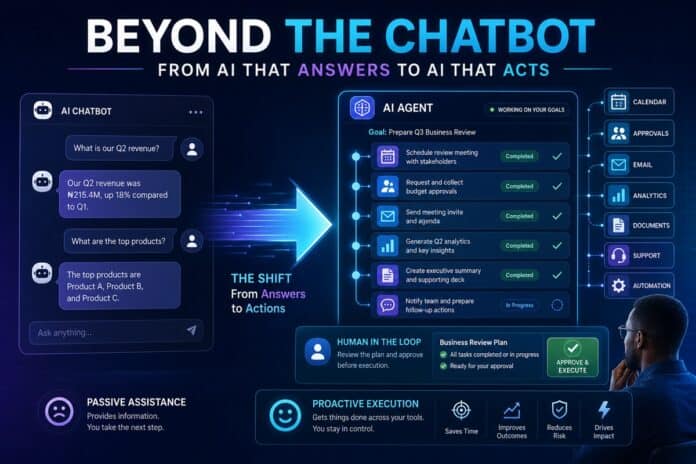

A sentence is doing the rounds in enterprise tech this year that sums up the whole shift in four words: a chatbot answers, an agent acts.
For three years, the story of AI in business was conversation. You typed a question, the model typed back. It drafted your emails, summarised your documents, and explained things you didn’t have time to read. Useful, but fundamentally passive; it waited to be asked, and it stopped at the answer.
In 2026, that’s no longer the frontier. The technology that used to answer questions is now expected to finish the job: notice what needs doing, plan the steps, and carry them out, with a human approving the parts that matter. This is agentic AI, and the move from “ask and answer” to “observe and act” is being described as the most significant change in enterprise AI since ChatGPT first arrived.
When Netchex launched Mesh in July 2026, a team of six named HR agents that chase missing timecards, file leave, and flag compliance gaps before anyone asks it wasn’t an outlier. It was one company’s version of a shift happening across the whole software industry.
What is agentic AI, and how is it different from a chatbot?
An agentic AI system is software that can pursue a goal on its own: it plans multi-step work, uses tools, and makes decisions with limited supervision. The distinction is about what happens after the AI understands you.
A chatbot understands your request and responds. An agent understands your request and does something about it across whatever systems it’s connected to.
A customer-service example makes the gap obvious. Ask a chatbot about a late delivery, and it tells you the status. An agent, faced with the same query, can diagnose the shipping delay, arrange compensation, update the records, notify the logistics team, and follow up, moving through the whole workflow rather than describing one slice of it.

That difference from reactive help to proactive execution is what separates agentic AI from both ordinary chatbots and the older, rule-based automation that could only follow a script.
The numbers behind the shift
The scale of the move is what makes it more than a buzzword.
Gartner projects that 40% of enterprise applications will feature task-specific AI agents by the end of 2026, up from less than 5% a year earlier one of the steepest adoption curves the firm tracks. Some analyses put the figure even higher, with reports that around 80% of enterprise applications shipped or updated in early 2026 embedded at least one AI agent.
The money follows the same slope. Spending on agent software is forecast to reach roughly $206 billion in 2026, up sharply from the prior year. And the ambition runs further out: Gartner has also suggested that by 2028, a meaningful share of routine day-to-day work decisions could be made autonomously through AI agents, from effectively none in 2024.

Actual production use is real but narrower than the headlines suggest. Depending on the survey, somewhere around a third of enterprises have at least one agent genuinely in production, with banking, insurance, and software teams ahead and healthcare and government further behind. The gap between “piloting” and “in production” is where a lot of 2026 is being spent.
Why deskless and frontline operations are a natural fit
Much of the early agentic AI attention has gone to white-collar knowledge work — coding, customer service, marketing. But some of the clearest use cases are in the opposite setting: lean, frontline operations where nobody has time to babysit software.
That’s the logic behind products like Netchex’s Mesh, aimed at restaurants, hotels, dealerships, and healthcare practices, where roughly 80% of staff never sit at a desk, and a single admin often runs payroll, scheduling, onboarding, and PTO before lunch.
In that environment, an AI that merely answers questions adds another thing to manage. An AI that quietly completes routine work and only surfaces exceptions removes items from the pile.
The pattern generalizes well beyond HR. Anywhere the real problem is a hundred small tasks rather than one big one, “does it for you” beats “tells you how” every time.
The hype problem: agent washing and the coming shakeout
Here’s the part most launch coverage skips, and the part worth reading closely before any business signs a contract.
Not everything labeled an “AI agent” in 2026 actually is one. Gartner has a name for the practice — agent washing — where vendors rebrand existing chatbots, robotic process automation, and assistants as agents without adding real autonomous capability. The firm’s striking estimate: of the thousands of companies marketing agentic AI, only around 130 are building the genuine article.
That hype has consequences. In a mid-2025 report, Gartner predicted that more than 40% of agentic AI projects will be canceled by the end of 2027, citing escalating costs, unclear business value, and inadequate risk controls. Whether this prediction still holds true remains to be seen.
The important nuance is why those projects fail. Analysts are fairly consistent that it’s usually not the models falling short; it’s the deployment: weak governance, no clear success metric, poor data quality, and agents pointed at the wrong tasks.
Strip out the “agent washing” projects that were never really agentic, and the remaining signal is sharper: the initiatives that survive to 2027 will be the ones that scoped narrowly, measured a real number, and defined the limits of the agent’s authority before switching it on.
None of this means the shift is fake. High failure rates are normal for genuinely transformative technology working through the early, over-hyped phase; the capital already committed makes a full retreat unlikely. But it does mean “we have AI agents” is a claim to interrogate, not just accept.
Keeping humans in the loop
The responsible end of the agentic AI market has converged on a shared principle: the agent handles the motion, the human owns the decision.
In practice, that looks like graduated autonomy. Netchex, for instance, describes four levels for its agents: ask, act, anticipate, and automate, with the customer choosing how much to delegate and sensitive actions still requiring human approval.
That structure isn’t unique to one vendor; it reflects a broader consensus that the agentic enterprise is not a company where AI runs unsupervised, but one where people set the goals, policies, and approvals while agents handle the repetitive coordination in between.
The reassuring irony of the 2026 data is that the failures make the humans more important, not less. Agents amplify whatever judgment sits behind them, which is exactly why the judgment can’t be an afterthought.
Conclusion
The chatbot isn’t dead; you’ll still ask AI plenty of questions. But in 2026, the center of gravity has moved. The interesting question is no longer “can the AI answer this?” It’s “can the AI safely complete this?”
That’s a higher bar, and plenty of projects won’t clear it. The ones that do will share a few traits: a narrow, well-chosen task; a real number they’re trying to move; clear limits on what the agent can do alone; and a human who stays in charge of the decisions that count.
Get those right, and the promise of the shift software that does the work instead of just describing it starts to look less like hype and more like the new baseline.