
Nigeria’s National Digital Alphanumeric Postcode System went live on October 1, 2026. The Nigerian Postal Service (NIPOST) has given every addressable building in the country its own 11-character digital postcode. It replaces the six-digit numeric postcodes Nigeria has used since 1986, which only pointed to a wide area.
“Everyone in Nigeria has a location. Now every location has a postcode,”
Postmaster-General Tola Odeyemi said at the launch.
This guide explains what the postcode is, what each part of the code means, how the system was built, and how to find a building’s postcode today.
What is Nigeria’s digital postcode?
The digital postcode is a short code made of letters and numbers that points to one specific building. It works differently from the old system in two ways:
- It is building-level: The legacy six-digit code generally pointed to a broad geographic area. The new code gives each addressable building its own unique identifier, whether that’s a home, shop, school, farm, or office.
- It is machine-readable and GIS-based: Each postcode is tied to exact map coordinates through a Geographic Information System (GIS), so banks, delivery apps, emergency services, and government systems can process it directly. Nobody has to interpret a landmark or a set of verbal directions. NIPOST describes it as the first GIS-enabled, building-level addressing system on the African continent.
‘Machine-readable’ is the key phrase. It means digital systems by banks, delivery apps, emergency dispatchers, and government portals can process the code directly, without a human interpreting a vague address, landmark, or set of verbal directions.
The goal is one standard location identifier that works the same whether it is attached to a parcel, a bank account, an ambulance call, or a government service.
Two points from NIPOST’s FAQ are often misunderstood:

- The postcode belongs to the building, not to you: Everyone in a building, whether that’s a family, a block of flats, or an office, shares the same postcode. If you move, you use the postcode of your new building.
- It sits alongside your address: Your street address still describes where you live. The postcode gives systems a standard reference for the same place, so you should use the two together.
How the 11-character postcode works
Each building is assigned an 11-character code consisting of five segments, going from the largest area (state or territory) to the smallest (specific building):
State > LGA > District > Area > Building
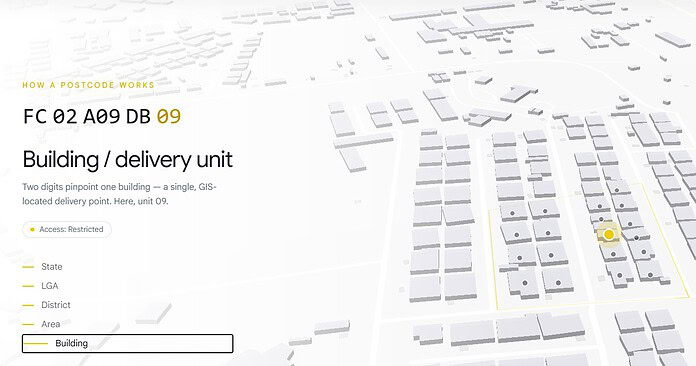
NIPOST provided a sample postcode on their website for illustration. The sample postcode is FC 02 A09 DB 09. Here is a breakdown of this code:
| Segment | Example | Characters | Format | What it identifies |
|---|---|---|---|---|
| State | FC |
2 | Letters | The state or FCT (FC = Federal Capital Territory) |
| LGA | 02 |
2 | Numbers | The Local Government Area within the state |
| District | A09 |
3 | Letters and numbers | The district within the LGA |
| Area | DB |
2 | Letters | The area within the district |
| Building | 09 |
2 | Numbers | The individual building |
The characters are not random; each block carries information that helps a system zoom in on the exact structure. The postcode is designed to sit alongside your normal address, not necessarily to replace it outright.

A few formatting rules, from NIPOST’s developer documentation:
- Number segments always have two digits and run from 01 to 99, never 00. LGA number 1 is written
01. - Spacing doesn’t matter.
FC 02 A09 DB 09,FC-02-A09-DB-09andFC02A09DB09all mean the same postcode. - Postcode areas stay inside LGA boundaries. One postcode area never covers parts of two Local Government Areas.
State and Territory Codes
Each unique digital postcode starts with a two-letter code that indicates which state or territory it belongs to. As you saw in the sample illustration, FC is the territory code for FCT, Abuja.
Here are the state and territory codes of all states and territories as released by NIPOST:
| State/Territory | Code | State/Territory | Code |
|---|---|---|---|
| Abia | AB | Kano | KN |
| Adamawa | AD | Katsina | KT |
| Akwa Ibom | AK | Kebbi | KE |
| Anambra | AN | Kogi | KG |
| Bauchi | BA | Kwara | KW |
| Bayelsa | BY | Lagos | LA |
| Benue | BE | Nasarawa | NA |
| Borno | BR | Niger | NI |
| Cross River | CR | Ogun | OG |
| Delta | DE | Ondo | ON |
| Ebonyi | EB | Osun | OS |
| Edo | ED | Oyo | OY |
| Ekiti | EK | Plateau | PL |
| Enugu | EN | Rivers | RI |
| FCT, Abuja | FC | Sokoto | SK |
| Gombe | GM | Taraba | TA |
| Imo | IM | Yobe | YB |
| Jigawa | JI | Zamfara | ZA |
| Kaduna | KD |
How the postcodes were built
NIPOST didn’t build Nigeria’s postcodes from scratch. The system builds on digital mapping the National Population Commission did for the census between 2014 and 2022. That work used satellite imagery to record buildings, roads, footpaths and waterways across the country. NIPOST then:
- organized the country into about 400 postcode areas using the census framework,
- piloted the model in Bwari Area Council (FCT) and ground-tested it in a dozen more states,
- ran a nine-month door-to-door data collection, with more than 25,000 field agents checking buildings on the ground before launch, according to Space in Africa. Basemaps were prepared by technical partner Milsat Technologies,
- set up a NIPOST GIS lab to manage the map and assign postcodes.
For each building, field agents recorded its address (including informal descriptions where there’s no street address), structure type, building use, ownership type, and photos. You’ll see these details on a building’s postcode card.
How to find your postcode
You can find a postcode at postcode.gov.ng or in the Postcode by NIPOST app on Android. In our tests, the iOS app hadn’t been released yet. The service is free for individuals.
The website currently offers three ways to look up a building:
| Option | How it works | Best for |
|---|---|---|
| Your location | Allow your browser or phone to share its location, and the map zooms to the building you’re in. | Finding the postcode of your home or office while you’re there |
| Use map link | Paste a Google Maps link for a building and click Find postcode. | Finding the postcode of a building somewhere else |
| Use postcode | Enter a postcode and click Find postcode to see the building on the map. | Finding a place when someone gives you their postcode |
To use a Google Maps link: open Google Maps, tap the building, tap Share, copy the link, paste it into Use map link on postcode.gov.ng, then click Find postcode.
Note on address search: at launch, the website had a Use address option for typing a street, business, or area name. In our tests, it often failed to find postcodes we knew existed. That option has since been replaced by Use postcode, which only searches by code.
It looks as if NIPOST has pulled typed address search from the website while it improves it. The search bar on the Android app still says “Search postcode, place, or alias”; any search other than a postcode is unresponsive. For now, the location and Google Maps link options are the most reliable.
If your building has no postcode, NIPOST says you can request one through the website or app by sharing your location, address, or a Google Maps link. It will review the request.
For a closer look at how each search option performed in testing, see our analysis: Nigeria’s Digital Postcode Is Live: The Map Works, Address Search Doesn’t (Yet), and Adoption Still Decides Its Fate.
What you can do with your postcode
Once you have a postcode, the app lets you:
- Copy and share it: Copy and share it in a WhatsApp chat, a delivery form, or a text message.
- Save postcodes you use often: After creating an account, you can save postcodes. You can label them Home, Office, and so on.
- Get directions: Find directions to a building using its postcode.
- Correct wrong details with Edit: You can change the address, structure type, building use, ownership, and photos. NIPOST says reviews take about 48 hours.
- Create an alias: a familiar name linked to a postcode, so people can find a place by name. You create general aliases, such as landmarks or community buildings, in the app. You have to be at the location, and NIPOST reviews each alias before it goes live.
Day-to-day uses include deliveries, online shopping, giving directions to visitors, business records, and account opening, as banks and other services start accepting postcodes.
What it offers businesses and developers
A dashboard for organisations is now open at dashboard.postcode.gov.ng. NIPOST says businesses can use it to verify customer and merchant addresses, look up any building’s postcode, and put their business on the map under its own name with a business alias. If a business moves, its alias can be linked to the new building’s postcode, so customers can still find it by name.
Developers can register, get an API key, and integrate through:
- a geo-enabled API with search, reverse geocoding (turning coordinates into a postcode), and postcode lookup,
- ready-made widgets for websites, Flutter, Android, iOS and React Native,
- bulk or dataset access for large volumes,
- a private government-to-government channel for public agencies.
Lookups come in five levels. Level 1 only confirms whether a postcode is valid and is free. Levels 2 to 5 add the address, building use, more building details, and finally exact coordinates, and these levels use paid credits. NIPOST hasn’t published credit prices yet.
Why Nigeria is replacing its old postcode
Across much of Nigeria, people find buildings by landmarks: “the blue gate after the second junction,” “opposite the filling station.” NIPOST estimates that failed and missed deliveries caused by hard-to-find addresses cost the economy ₦50 billion to ₦80 billion a year.
For decades, finding a specific building in Nigeria has meant landmarks rather than precise addresses, and the old numeric postcode alone never closed that gap.
The government is pitching the postcode as a shared location system for much more than mail:
- E-commerce and logistics: fewer failed deliveries, better route planning, more accurate delivery estimates.
- Banking and KYC: lenders currently struggle to verify where a customer actually lives. A verified postcode possibly linked to a person’s National Identification Number (NIN) could become a foundational Know Your Customer tool.
- Emergency response: ambulances, fire services, and police could be directed to an exact structure instead of a described junction.
- Security and government services: reliable location data supports policing, planning, and social intervention programmes, and even the basic ability to count and reach the population. Knowing where people and facilities are helps plan schools, hospitals, roads and social programmes.
This is not Nigeria’s first attempt
The push to digitize addressing stretches back to 2009 under the late President Umaru Musa Yar’Adua before it lost momentum.
NIPOST tried narrower fixes over the years: a 2017 partnership with location startup what3words, the 2018 launch of an Address Verification System (AVS) and Digital Addressing System (DAS), a 2020 collaboration with the telecoms regulator on SIM-card address checks, a 2022 memorandum with the National Population Commission, and a 2023 pilot in Abuja that tested the delineation model now being scaled up.
Officials say what is different this time is that NIPOST is not starting from scratch. It is building on mapping data already gathered by other agencies, particularly the National Population Commission’s Enumeration Area Demarcation work between 2014 and 2022, which recorded buildings, roads, footpaths, and waterways nationwide for census planning.
Partners include the Office of the Surveyor General and the National Space Research and Development Agency (NASRDA). The project also received Federal Executive Council approval in March 2026.
Privacy: who can see what?
NIPOST says the postcode data belongs to the Federal Republic of Nigeria and is held by NIPOST. Access is tiered under the Nigeria Data Protection Act, with the Nigeria Data Protection Commission overseeing it:
- Some information is public,
- some is restricted to approved organisations, which matches the paid API lookup levels,
- sensitive data is only available to security agencies and emergency responders under formal agreements.
The homeowner-name issue: Soon after launch, some users noticed homeowners’ names in building addresses. Odeyemi explained that field agents recorded informal addresses the way local people describe them, and that in some places, especially in the North, the only common way to describe a house is by its owner’s name.
“Names only appear in addresses in specific locations because there’s no other way the community and even the occupants know how to describe the house,” she said. NIPOST hasn’t announced an opt-out. If your building’s address includes a name you’d rather not show, the Edit option lets you propose a different address.
Some commentators have also raised surveillance concerns about a government map of every home. Space in Africa reported that the platform’s servers are hosted by Amazon Web Services in the United States and Ireland. That could raise data-sovereignty questions as the system grows.
What’s still missing
As of October 5, these promised features hadn’t arrived:
- Typed address search on the website. It was replaced by postcode-only search, apparently while NIPOST improves it.
- The iOS app. In our tests, only the Android app was available.
- USSD access for people without smartphones or data. We haven’t seen a USSD code published.
- Full coverage. Early users reported gaps outside big cities, including parts of Oyo State. NIPOST is aiming for full coverage of all 36 states and the FCT by December 2026.
- AI-assisted delivery routing, which NIPOST described before launch, isn’t publicly available yet.
What actually launches on October 1, 2026?
The October 1 launch was not a single nationwide switch-flip, but it is well beyond a pilot. NIPOST had said larger population centers will go live first and expects to have captured more than 90% of the country by launch day, with full rollout across all 36 states and the FCT targeted for December 2026. The long-term objective is coverage across all 774 Local Government Areas.
The public site, postcode.gov.ng, is now live with an app for Android users. The full developer portal that businesses and logistics platforms will need to integrate the system into their own apps also seems ready, and NIPOST is collecting expressions of interest from startups, enterprises, and government agencies.
Frequently asked questions about the National Digital Alphanumeric Postcode System
What is Nigeria’s digital postcode?
It’s an 11-character code, such as FC 02 A09 DB 09, that identifies one building in Nigeria. NIPOST launched it on October 1, 2026, replacing the old six-digit area postcodes.
What do the parts of the postcode mean?
In order, the five segments identify the state (2 letters), the LGA (2 digits), the district (3 characters), the area (2 letters), and the building (2 digits).
When did Nigeria’s digital postcode launch?
The National Digital Alphanumeric Postcode System began rolling out on October 1, 2026, with full nationwide coverage targeted for December 2026.
How do I find my postcode?
Go to postcode.gov.ng or open the Postcode by NIPOST app on Android. Either share your location while you’re at the building, or paste a Google Maps link for the building into Use map link and click Find postcode.
Can I search for my postcode by typing my address?
No. The address option was replaced with Use postcode, which only searches by code. During our initial tests, it often couldn’t match addresses to postcodes. The Use postcode function enables you to locate a building on the map by searching the postcode.
How do I find a building if someone gives me their postcode?
Enter the postcode in Use postcode on postcode.gov.ng and click Find postcode. The map shows the exact building.
Does my postcode change if I move?
Yes. The postcode belongs to the building, so you use the postcode of your new home.
Is the digital postcode free?
Yes, for individuals to find, save, and share postcodes. Businesses pay for higher-level API lookups.
Is there an iPhone app?
Not yet, based on our tests. The app is available on Android.
What if my building’s details are wrong or show my name?
Use the Edit feature in the app to propose a corrected address or other details. NIPOST says reviews take about 48 hours.
Can businesses use the postcode?
Yes. Businesses can register at dashboard.postcode.gov.ng to verify addresses, look up postcodes, create a business alias, or integrate through the API and widgets.
What does the new Nigerian postcode look like?
It is an 11-character alphanumeric code made up of five parts: State, LGA, District, Area, and Building; for example, FC 02 A09 DB 09.
Does the new postcode replace my current address?
Not entirely. It is a machine-readable location identifier designed to work alongside your conventional address, giving your specific building a unique, mappable code.
How will I find my building’s postcode?
You can find it on the official website (postcode.gov.ng), in mobile apps, and in future via USSD, which lets you access it without a smartphone or mobile data.
Who is running the project?
NIPOST, under the Federal Ministry of Communications, Innovation and Digital Economy, is using mapping data from partner agencies, including the National Population Commission, the Office of the Surveyor General, and NASRDA.
Does my personal data get exposed through the postcode?
NIPOST says access is tiered under the National Data Protection Commission, with public, restricted, and security-only levels. A postcode identifies a building’s location, not who lives there.
Conclusion
Nigeria now has a building-level digital address system, which no earlier attempt managed. The map is accurate, finding a postcode by location or Google Maps link works well, and banks, delivery firms and developers can already build on it.
The main thing that’s missing is a way to find a postcode by typing an address, which is how most Nigerians describe a location. NIPOST appears to be working on that, along with the iOS app, USSD access, and full coverage by December. Until then, find your postcode by location or map link, save it, and start sharing it.