

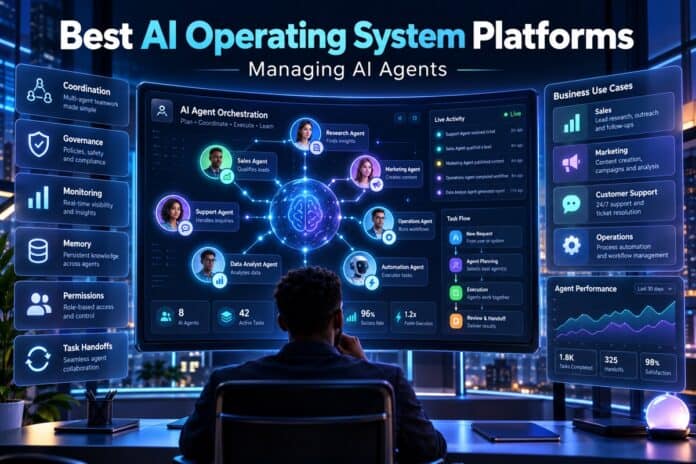
Businesses are deploying AI agents across sales, marketing, customer support, and internal operations. However, managing these agents becomes difficult when each runs in a separate application. Teams need a way to assign responsibilities, control access, and track agent activity.
AI operating system platforms help businesses manage multiple agents from a shared environment. Some provide centralized agent management, while others focus on specific business applications or technical workflows. Their capabilities differ in agent coordination, persistent memory, and execution controls.
This guide compares eight AI operating system platforms for managing AI agents in 2026. It covers agent management features, supported workflows, and limitations to help businesses choose a platform that fits their operations.
8 Best AI Operating System Platforms for Managing AI Agents
The following platforms help businesses deploy, coordinate, and manage AI agents. Each takes a different approach to agent management, from company-wide agent systems to specialized enterprise platforms.
- Harnyss AI: Best for managing coordinated AI agents across business departments.
- IBM watsonx Orchestrate: Best for centralized enterprise agent management and governance.
- Microsoft Copilot Studio: Best for managing agents within Microsoft business applications.
- Google Gemini Enterprise: Best for managing agents connected to enterprise knowledge and Google services.
- Salesforce Agentforce: Best for managing sales and customer service agents.
- UiPath: Best for coordinating AI agents with robotic process automation.
- ServiceNow AI Agents: Best for managing agents within IT and employee service workflows.
- Amazon Bedrock AgentCore: Best for developers managing custom agents on AWS.
1. Harnyss AI – Best for Managing AI Agents Across Business Departments
Harnyss AI brings agent management into a single AI operating system where businesses can organize, monitor, and control multiple agents. Its department-based structure makes it one of the best platforms for managing agents with different roles and responsibilities.
Rather than treating agents as separate tools, Harnyss allows them to work as connected teams and share responsibilities across business functions. Businesses can manage their entire agent workforce from one environment.
The platform provides an Agent Canvas that shows how agents are organized and which responsibilities each one owns. Agents can exchange information and pass tasks between departments based on their assigned roles. Persistent memory also lets agents retain relevant context across execution sessions.

Harnyss gives businesses control over how independently each agent operates. Administrators can set spending limits, configure approval requirements, and monitor execution through detailed activity records. Built-in quality checks can also identify unsuccessful work and send it back for revision.
Key Features
- Agent Canvas: Displays agents, their assigned roles, and reporting relationships in an organizational view.
- Department-based management: Groups agents according to business functions and responsibilities.
- Cross-agent handoffs: Allows agents to assign work to other agents when a task requires additional capabilities.
- Persistent memory: Maintains agent context across separate execution sessions.
- Autonomy controls: Supports approval-required, notification-only, and autonomous execution modes.
- Execution monitoring: Records agent actions and applies quality checks to completed work.
2. IBM watsonx Orchestrate – Best for Centralized Enterprise Agent Management
IBM watsonx Orchestrate provides a central environment to build and manage AI agents across business applications. Organizations can create agents for different processes and coordinate their activities through orchestration capabilities.
Its governance features help administrators monitor execution and apply operating policies. However, businesses seeking an existing departmental hierarchy may need to establish their own agent roles and reporting structure.
Key Features
- Agent orchestration: Coordinates multiple agents within shared business workflows.
- Centralized management: Provides a common environment for managing enterprise agents.
- Governance controls: Supports policies and oversight for agent activity.
3. Microsoft Copilot Studio – Best for Managing Agents in Microsoft Environments
Microsoft Copilot Studio allows organizations to create and manage AI agents connected to Microsoft 365 and other applications. Administrators can control how agents are deployed, what data they access, and which actions they perform.

The platform also supports agent publishing and monitoring through Microsoft’s administrative tools. However, coordinating agents across independent business departments requires organizations to configure the relevant workflows and connections.
Key Features
- Agent development: Creates agents using a visual interface and configurable instructions.
- Administrative controls: Manages agent access, deployment, and data policies.
- Agent analytics: Tracks agent activity and performance within supported environments.
4. Google Gemini Enterprise – Best for Enterprise Knowledge-Based Agent Management
Google Gemini Enterprise provides businesses with a shared environment to access and manage AI agents. Employees can use ready-made agents or develop custom agents connected to company information.
Administrators can manage access and oversee agent availability across the organization. However, businesses seeking continuous coordination between autonomous departmental agents may require additional development and workflow configuration.
Key Features
- Agent management: Provides centralized access to deployed enterprise agents.
- Agent Studio: Supports creating and configuring custom agents.
- Enterprise connections: Allows agents to work with connected business information and applications.
5. Salesforce Agentforce – Best for Managing Sales and Customer Service Agents
Salesforce Agentforce helps businesses deploy and manage AI agents connected to their CRM data. Teams can configure agents to handle customer inquiries, update records, and complete approved sales or service actions.
Salesforce provides tools to test agent behavior and monitor how agents perform assigned tasks. However, businesses managing agents across functions outside the Salesforce ecosystem may need additional integrations and coordination tools.
Key Features
- Agent Builder: Creates agents with defined instructions, topics, and actions.
- Agent testing: Helps teams evaluate agent responses and configured actions before deployment.
- CRM permissions: Controls access to Salesforce data and supported business operations.
6. UiPath – Best for Managing AI Agents Alongside Software Robots
UiPath helps organizations coordinate AI agents with traditional robotic process automation. Its orchestration tools can manage processes involving software robots, agents, and human reviewers.
Businesses can observe workflow execution and route tasks to different automation components when needed. However, organizations that want persistent agents organized by business department may need to establish that structure separately.
Key Features
- UiPath Maestro: Coordinates agent activities with robots and human tasks.
- Process monitoring: Tracks execution across workflows involving different automation systems.
- Human approvals: Introduces review checkpoints for actions requiring employee decisions.
7. ServiceNow AI Agents – Best for Managing IT and Employee Service Agents
ServiceNow provides tools to build and manage AI agents that work within enterprise service processes. Businesses can assign agents to tasks involving IT incidents, employee requests, and service management workflows.
ServiceNow AI Control Tower supports centralized visibility and governance across enterprise AI assets, including supported third-party agents. However, businesses seeking agents that independently manage wider departmental operations may need additional workflow configuration.
Key Features
- AI Agent Studio: Supports agent development and configuration for business services.
- AI Control Tower: Provides centralized monitoring and management for supported AI agents.
- Service workflows: Connects agents with existing service management processes.
8. Amazon Bedrock AgentCore – Best for Managing Custom AI Agents on AWS
Amazon Bedrock AgentCore provides services to deploy and operate AI agents in AWS environments. Developers can run agents using supported frameworks and connect them to tools through AgentCore Gateway.
Its identity and observability capabilities help technical teams manage access and inspect execution behavior. However, organizations that want a ready-made business department structure will need to build their own agent roles and workflows.
Key Features
- AgentCore Runtime: Runs custom AI agents in a managed execution environment.
- AgentCore Identity: Manages agent identities and access to connected services.
- AgentCore Observability: Provides execution traces and performance monitoring through Amazon CloudWatch.
How to Choose the Best AI Operating System for Managing AI Agents
Businesses may deploy AI agents for customer service, sales, marketing, and internal processes. The best platform depends on how agents work together and how easily administrators can manage their responsibilities.
Evaluate Agent Organization and Coordination
Managing several independent agents becomes difficult when their responsibilities overlap. Businesses should look for platforms that support clear agent roles and controlled task handoffs. Shared workflow context also matters when one agent depends on another’s completed work.
Review Agent Permissions and Security Controls
AI agents may access customer records, company documents, or connected business applications. A reliable AI agent guardrail should restrict unauthorized actions and enforce each agent’s assigned permissions. Human approval controls are also important when agents can modify sensitive information or execute high-impact operations.
Consider Agent Monitoring and Performance Management
Administrators need visibility into what agents are doing and how well they perform assigned tasks. Platforms should provide execution histories, error reports, and resource-usage information. Businesses can use these records to identify unsuccessful tasks and improve agent workflows.
Conclusion
The best AI operating system for managing agents depends on how many agents a business uses and the responsibilities assigned to them. Microsoft Copilot Studio and Salesforce Agentforce work well within their respective application ecosystems.
IBM watsonx Orchestrate and UiPath support agent coordination across enterprise workflows, while Amazon Bedrock AgentCore offers greater control for technical teams building custom systems.
Harnyss AI is a strong option for businesses that want agents organized around departments and ongoing responsibilities. Its Agent Canvas, persistent memory, and execution controls provide a shared environment for coordinating agent activity.
Businesses should compare how each platform handles permissions, handoffs, and monitoring before deciding. The right choice should make agents easier to manage as their responsibilities grow.