

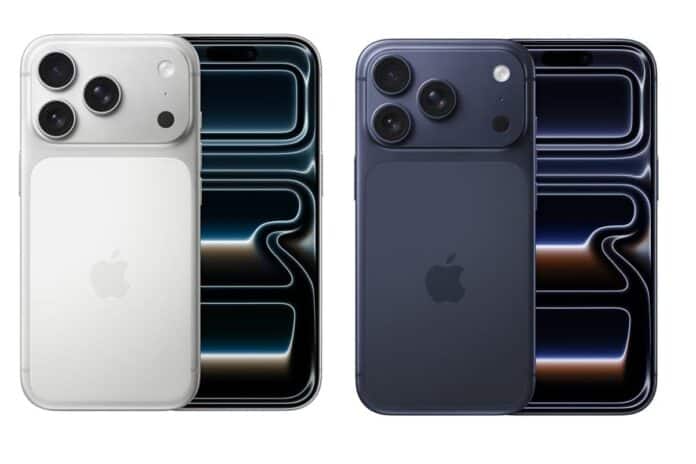
Announced on September 9, 2025, the iPhone 17 Pro replaces its predecessor, the iPhone 16 Pro, with a striking new identity, a unibody aluminum chassis, a revolutionary camera plateau design, vapor chamber cooling, and the most powerful chip Apple has ever put into an iPhone. Starting at $1,099 for 256GB of storage, it makes a bold statement about what a flagship smartphone should be.
The iPhone 17 Pro is powered by Apple’s A19 Pro chip, which offers up to 20% faster CPU performance than the A18 Pro that powered the iPhone 16 Pro. It runs iOS 26, a sweeping software redesign featuring Apple’s new Liquid Glass aesthetic and an expanded Apple Intelligence AI suite.
On the camera front, the iPhone 17 Pro takes a generational leap with a completely revamped triple 48-megapixel camera system, including an all-new telephoto sensor capable of 4x optical zoom. And for the first time, the iPhone 17 Pro ships with an 18MP Center Stage front camera that automatically tracks and reframes subjects, even rotating between portrait and landscape orientation.
Key improvements over the iPhone 16 Pro include: the shift from titanium to a thermally superior aerospace-grade aluminum unibody, a vapor-cooled internal architecture for sustained performance, a full glass back replaced with Ceramic Shield 2, the new horizontal ‘camera plateau’ design spanning the width of the device, a 40W wired charging upgrade, Wi-Fi 7 and Bluetooth 6 connectivity, and breakthrough battery life.
In this detailed review, we cover every aspect of the iPhone 17 Pro from design to display, camera to chipset, and compare it head-to-head against the Samsung Galaxy S25 Ultra and Google Pixel 10 Pro.

Design: Visually Compelling
Apple has redesigned the iPhone Pro lineup more dramatically with the iPhone 17 Pro than with any generation in recent memory.
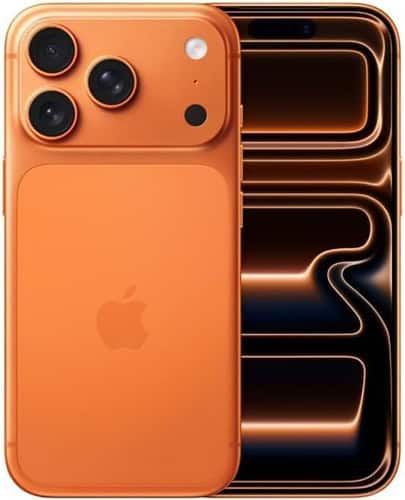
The most immediately obvious change is the elimination of the traditional square camera island in the top-left corner, replaced by what Apple calls the ‘camera plateau,’ a wide, horizontal, raised band of aerospace-grade aluminum that spans nearly the full width of the device’s rear.

It houses the three camera lenses on the left side, with the LiDAR scanner and True Tone flash on the right. This approach echoes Google’s Pixel design philosophy, though Apple’s implementation is bolder.
The iPhone 17 Pro also marks a material departure in the most literal sense, abandoning the titanium frame introduced with the iPhone 15 Pro in favor of a forged-aluminum unibody. Aluminum is both lighter and thermally superior to titanium, dispersing heat more efficiently, a critical consideration given the thermal demands of the A19 Pro chip.
The result is a smartphone that weighs approximately 8 grams less than the iPhone 16 Pro while feeling more robust in hand. The MagSafe cutout on the rear is crafted from Ceramic Shield 2, creating a subtle two-tone contrast between the aluminum body and the Ceramic Shield panel, which Apple says is 4x more crack-resistant than the glass used on the iPhone 16 Pro.
Color options for the iPhone 17 Pro include a vivid Cosmic Orange (widely praised as one of the boldest iPhone offerings in years), Deep Blue, and Silver. The Ceramic Shield 2 front glass offers 3x better scratch resistance than its predecessor.
Display: Super Retina XDR at Its Finest
The iPhone 17 Pro ships with a 6.3-inch Super Retina XDR OLED display at a resolution of 1206 x 2622 pixels, unchanged in size from the iPhone 16 Pro. The display supports ProMotion adaptive refresh rates up to 120Hz (always-on down to 1Hz for the lock screen), HDR10, Dolby Vision, and a peak brightness of up to 3,000 nits.
The key observation, Apple has made the iPhone 17 Pro’s display identical in specifications to the standard iPhone 17, a notable shift from previous generations, in which the Pro models commanded meaningful display advantages. Both devices now share the same 120Hz LTPO OLED panel, the same 3,000-nit peak brightness, and similar resolution.
For users upgrading from an iPhone 15 or older, the difference remains significant. For those debating between the iPhone 17 and iPhone 17 Pro, the display is no longer a major differentiator.
Camera: The Best iPhone Camera System Ever Made
Photography and videography have long been the defining battlegrounds for flagship smartphones, and the iPhone 17 Pro makes a compelling claim to the throne.
The device features three 48-megapixel rear cameras: Main (f/1.8, 24mm, 1/1.28-inch sensor), Ultra Wide (f/2.2, 13mm), and an all-new Telephoto (f/2.8, 100mm with 4x optical zoom), plus an 18-megapixel Center Stage front camera. Apple calls this system the ’48MP Pro Fusion Camera System,’ and the sheer versatility of having three full-resolution sensors is remarkable.
The headline camera upgrade is the new telephoto sensor. While the iPhone 16 Pro used a 12MP 5x periscope lens, the iPhone 17 Pro deploys a 48MP 4x periscope telephoto sensor that enables lossless sensor-crop zoom, delivering what Apple calls 8x ‘optical-quality zoom.’
In practice, this means photos at 8x zoom retain impressive detail, as the 48MP sensor allows cropping to 12MP while preserving resolution. This brings the iPhone 17 Pro close to the Samsung Galaxy S25 Ultra and Google Pixel 10 Pro in zoom performance.
On the video front, the iPhone 17 Pro is arguably the most capable smartphone video system ever built. It supports 4K recording at 120 frames per second from the main camera, ProRes and ProRes RAW recording, Apple Log 2 (a wider color gamut for professional grading), and broadcast frame rates for industry-standard workflows.
Apple notes that the iPhone 17 Pro is the first smartphone to support its Apple-developed video codec, ProRes, which offers the highest level of control and quality, and that it is compatible with tools used in Hollywood productions, including Blackmagic’s Camera ProDock.
Enhanced video stabilization, a new four-microphone array for richer audio capture, and Cinematic Mode further cement the iPhone 17 Pro’s credentials as a serious filmmaking tool.
The 18MP Center Stage front camera deserves special mention. Unlike typical selfie cameras with fixed focal lengths, Center Stage uses a wide-angle lens and intelligent tracking to keep subjects centered as they move.
Its square sensor aspect ratio means it can automatically switch between portrait and landscape framing without requiring the user to physically rotate the phone. In group video calls, the camera intelligently widens the field of view to include everyone.
Hardware and Software: A19 Pro and iOS 26
At the heart of the iPhone 17 Pro is Apple’s A19 Pro chip, a second-generation 3nm processor featuring a 6-core GPU (versus the 5-core GPU in the standard iPhone 17’s A19 chip), 12GB of RAM, and Apple’s most advanced Neural Engine to date.
The A19 Pro delivers approximately 20% faster CPU performance than the A18 Pro in the iPhone 16 Pro, and in GPU-intensive workloads such as gaming and video processing, the improvement is even more pronounced.
The vapor chamber is arguably the most significant internal engineering story of the iPhone 17 Pro. Apple claims this delivers up to 40% better sustained performance than the iPhone 16 Pro under intensive workloads.
Storage options begin at 256GB (double the iPhone 16 Pro’s 128GB base tier), with 512GB and 1TB tiers also available. The iPhone 17 Pro ships with iOS 26, Apple’s most visually ambitious software release in years.
iOS 26 introduces a ‘Liquid Glass’ design language that dynamically reflects and refracts content beneath it in real time, giving the interface a depth and translucency it has never had before. The App Library, Control Center, Lock Screen, and Home Screen have all been reimagined with this design system.
Apple Intelligence in iOS 26 introduces several new capabilities, including Live Translation (real-time text and audio translation in Messages, FaceTime, and Phone calls), updated Visual Intelligence for on-screen context detection, improved Genmoji generation, and notification prioritization. Six years of software updates are expected, providing compelling long-term value.
You may also be interested in the iPhone Air and the iPhone 17 Pro Max.
Battery Life and Charging: Finally, True All-Day Endurance
Battery life has historically been one of the more divisive aspects of the iPhone Pro line, with the iPhone 16 Pro frequently criticized for middling endurance compared to Android rivals.
The iPhone 17 Pro addresses this head-on. The aluminum unibody design, and specifically the space and weight freed up by eliminating the titanium frame and glass back, allowed Apple to fit a significantly larger battery.
The iPhone 17 Pro houses a 3,998mAh Li-ion battery (eSIM-only models gain an additional two hours thanks to a larger 4252mAh Li-ion battery by eliminating the physical SIM tray), and the efficiency gains from the A19 Pro chip compound the improvement.
Charging has also improved substantially. The iPhone 17 Pro supports 40W wired charging via USB-C, reaching 50% in just 20 minutes with Apple’s new 40W Dynamic Power Adapter (60W Max, sold separately for $39).
While this remains slower than some Android rivals, OnePlus and Xiaomi support 80-100W wired charging. The iPhone 17 Pro’s charging speed is the fastest ever offered by Apple and represents a genuine improvement over the iPhone 16 Pro’s 27W maximum.
Connectivity: Wi-Fi 7, Bluetooth 6, and Satellite SOS
The iPhone 17 Pro is equipped with the most comprehensive connectivity suite Apple has ever offered in an iPhone. Wi-Fi 7 (802.11be) support enables significantly faster wireless speeds and lower latency than Wi-Fi 6E, particularly beneficial in congested environments or for users with Wi-Fi 7 routers.
Bluetooth 6.0 improves connection stability, data throughput, and audio quality for wireless accessories. The device also supports 5G Sub-6GHz across more than 20 bands in the United States, ensuring broad carrier compatibility and strong performance in urban and suburban environments. For areas beyond 5G coverage, Gigabit LTE with 4×4 MIMO provides fast fallback connectivity.
Emergency SOS via satellite remains a key safety feature, connecting the iPhone 17 Pro to Globalstar satellites when neither cellular nor Wi-Fi is available. Apple is also extending free access to satellite features for existing iPhone 14 and iPhone 15 users for an additional year.
Thread networking support enables smarter home device connectivity, and Ultra Wideband (UWB) provides precise spatial awareness for features like AirDrop and Precision Finding for AirTags.
NFC, GPS with dual-frequency support, and an always-on barometer round out the sensor suite. The USB-C port supports USB 3 speeds, enabling faster data transfer and compatibility with a wide range of accessories, a significant improvement over the Lightning connector used in earlier iPhone generations.
For users who rely on Apple’s broader ecosystem, AirPods, Apple Watch, Mac, iPad, the iPhone 17 Pro’s tightly integrated connectivity experience remains unmatched.
Where to Buy iPhone 17 Pro
Amazon US – See Offers | Amazon UK – See Offers | Amazon Canada – See Offers
iPhone 17 Pro Price and Availability
The iPhone 17 Pro starts at $1,099 in the United States for 256GB of storage, a $100 increase over the iPhone 16 Pro’s $999 starting price. The 512GB model retails for $1,299, and the 1TB model for $1,499.
The device is available through Apple’s online store, Apple retail locations, all major US carriers (AT&T, Verizon, T-Mobile, Boost Mobile), and third-party retailers. Apple Card Monthly Installments and the iPhone Upgrade Program are available for qualifying customers.
iPhone 17 Pro price in Nigeria starts at ₦1,750,000 for the 256GB storage option, ₦2,190,000 for the 512GB storage option, and 2,599,000 for the 1TB storage option.
You can buy the iPhone 17 in Nigeria at iStore Nigeria, iConnect, Slot, Konga, Jumia, JustFones, and Jiji. You can find the smartphone at all leading phone stores in Lagos, Abuja, Port Harcourt, Ibadan, Abeokuta, Owerri, Enugu, Kano, Kaduna, Calabar, and other major cities in Nigeria.
Verdict: Should You Buy the iPhone 17 Pro?
The Apple iPhone 17 Pro is, without qualification, the best iPhone Apple has ever made. Its combination of the A19 Pro chip with vapor chamber cooling, the three-camera 48MP system with 8x optical-quality zoom, the new Center Stage front camera, Wi-Fi 7 and Bluetooth 6 connectivity, dramatically improved charging speeds, and the stunning Cosmic Orange colorway collectively represent a generational step forward, not merely an incremental refinement.
It is not without compromises. The $1,099 starting price is Apple’s most expensive standard Pro model ever, and the design’s wider camera plateau is not universally loved. iOS 26’s Liquid Glass aesthetic, while beautiful, can occasionally cause performance stutters that Apple will need to address in point updates.
Apple Intelligence, while improving, still lags behind Google’s Gemini in conversational capability. And if you already own an iPhone 16 Pro and are satisfied with your current battery life and cameras, the upgrade case, while real, is not urgent.
For those upgrading from an iPhone 14 Pro or older, or those switching from Android for the first time, the iPhone 17 Pro is a transformative device. It is the most capable video camera in a smartphone, a meaningful AI assistant in your pocket, and a beautifully engineered piece of hardware built for the next five to six years.
| General | |
|---|---|
| Announced / Released | September 9, 2025 / September 19, 2025 |
| Predecessor | Apple iPhone 16 Pro |
| Colours | Silver, Cosmic Orange, Deep Blue |
| Design and Build | |
| Dimensions | 150 × 71.9 × 8.8 mm |
| Weight | 206 g |
| Build | Ceramic Shield 2 front, aluminum unibody frame, glass back (Ceramic Shield) |
| Durability | IP68 dust and water resistant (up to 6 m, 30 min) |
| Display | |
| Type | 6.3-inch LTPO Super Retina XDR OLED, 120Hz ProMotion, HDR10, Dolby Vision |
| Resolution | 1,206 × 2,622 pixels, 19.5:9, ~460 ppi |
| Brightness | 1,000 nits (typ), 1,600 nits (HBM), 3,000 nits (peak) |
| Performance | |
| Chipset | Apple A19 Pro (3 nm) |
| CPU / GPU | Hexa-core CPU · 6-core GPU |
| RAM / Storage | 12 GB · 256 / 512 GB / 1 TB (NVMe, non-expandable) |
| Camera | |
| Main (wide) | 48 MP Fusion, f/1.78, 24mm, 2nd-gen sensor-shift OIS |
| Telephoto | 48 MP Fusion periscope, f/2.8, 100mm, 4x optical (8x optical-quality), tetraprism |
| Ultra-wide | 48 MP Fusion, f/2.2, 13mm, 120° FoV |
| Front | 18 MP Center Stage, f/1.9, multi-aspect |
| Video | 4K @ up to 120fps, ProRes RAW, Apple Log 2, Dolby Vision HDR |
| Battery, Software, and Connectivity | |
| Battery | 3,998 mAh (Nano-SIM) / 4,252 mAh (eSIM-only), 40W wired PD3.2 (50% in 20 min), 25W MagSafe/Qi2 |
| Software | iOS 26 (upgradable to iOS 26.5+) |
| Connectivity | 5G (Sub-6/mmWave on US model), Wi-Fi 6e/7, Bluetooth 6.0, USB-C 3.2 Gen 2, NFC, UWB, satellite SOS |
| Security | Face ID |
| SIM | Nano-SIM + eSIM (eSIM-only in USA; dual Nano-SIM in China) |
| Price | |
| Starting Price | $1,099 (256 GB) · $1,299 (512 GB) · $1,499 (1 TB) · ₦1,750,000 (256 GB) · ₦2,190,000 (512 GB) · ₦2,599,000 (1 TB) |