

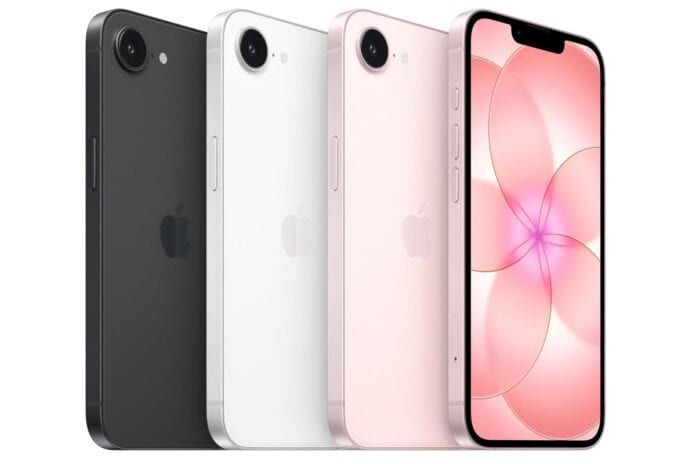

With the launch of the iPhone 17e in March 2026, Apple has taken everything it learned from the well-received iPhone 16e and refined it into a more compelling package, one that finally addresses the most common criticisms leveled at its predecessor. At $599 with 256GB of base storage, the iPhone 17e arrives as the most affordable new iPhone Apple currently sells, while packing some genuinely flagship-tier technology under its familiar aluminum hood.
The headline additions are hard to ignore. MagSafe, the magnetic wireless charging and accessory ecosystem that was inexplicably absent from the iPhone 16e, has finally arrived on the “e” series, bringing a rich array of chargers, wallets, mounts, and cases.
The A19 chip, the same silicon powering the standard iPhone 17, gives the 17e substantially better performance than last year’s model, with up to 30% faster graphics rendering.
The Ceramic Shield 2 front glass delivers three times better scratch resistance than the previous generation. And in a move that effectively makes the 17e $100 cheaper than the 16e at launch, base storage has doubled from 128GB to 256GB with no price increase.
None of this is to say the iPhone 17e is without compromise; it retains a 60Hz display, forgoes the Dynamic Island, and fields only a single rear camera. But for buyers who are either new to the iPhone ecosystem or upgrading from an aging handset, the 17e represents exceptional value by Apple’s own standards.

Design
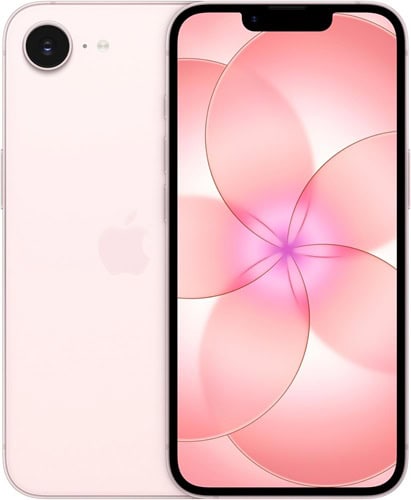
Apple continues to use what is essentially the iPhone 14 chassis: a 6.1-inch slab framed in squared-off, aerospace-grade aluminum, with a glass back and a notch housing the TrueDepth camera system.
There is no Dynamic Island here; the punch-hole cutout that graces the rest of the iPhone 17 family is reserved for pricier models, meaning the 17e still carries the more dated notch design.

That said, the build quality remains excellent for the price. The aluminum frame feels premium in hand, the phone is reassuringly compact at a time when Android flagships are trending toward 6.7-inch behemoths, and the IP68 water and dust resistance rating means the device can withstand immersion at up to 6 meters for 30 minutes, a feature more commonly found at flagship price points.
The new Ceramic Shield 2 front glass is a genuinely meaningful upgrade: it offers three times better scratch resistance than the Ceramic Shield glass used in the iPhone 16e, which means everyday scuffs and pocket-induced micro-abrasions should be far less of a concern.
Color options remain limited but have expanded slightly. Black and White return from the iPhone 16e, joined by a new Soft Pink finish that is likely to prove popular.
The Action button, which debuted on the iPhone 15 Pro and has now trickled down to the mainstream lineup, returns on the 17e, allowing users to assign a custom shortcut such as the flashlight, visual intelligence, or silent mode toggle with a single physical press.
Display
Apple has retained the same 6.1-inch Super Retina XDR OLED panel as the iPhone 16e, so there are no changes in resolution, brightness, or refresh rate year over year.
At 1170 x 2532 pixels and a pixel density of 460 pixels per inch, the screen is sharp and surpasses many Android phones at the same price point in terms of pixel density.
Wide Color (P3) support, True Tone adaptive color temperature, and a 2,000,000:1 contrast ratio round out a display specification that delivers rich, accurate colors and deep, inky blacks that only OLED technology can produce.
The brightness figures are respectable: 800 nits for typical content and up to 1,200 nits for peak HDR, which makes the display legible in direct sunlight and suitably immersive for streaming Dolby Vision content.
The elephant in the room is the 60Hz refresh rate. In 2026, this ceiling is increasingly difficult to defend in a $599 smartphone. The Samsung Galaxy A56 and Galaxy A57, which sell for $499 and $549, respectively, ship with 120Hz Super AMOLED displays.
Google’s Pixel 10a, also priced more affordably at $499, includes a smoother-scrolling panel. Apple’s own iPhone 17 steps up to ProMotion 120Hz adaptive refresh for $200 more.
Dynamic Island, the animated pill-shaped cutout that handles notifications and Live Activities so elegantly on the iPhone 17, is also absent here, leaving the older, static notch in its place.
Camera
Apple’s marketing framing around the iPhone 17e’s camera is clever: it positions the 48MP Fusion camera as “two advanced cameras in one,” referring to the sensor-cropping technique that enables an optical-quality 2x telephoto zoom from a single lens.
This is genuinely useful; the 2x zoom produces clean, detailed results because it draws on the full resolution of the 48MP sensor rather than resorting to digital interpolation, but it is worth understanding what this claim does and does not mean.
The 17e’s 48MP main sensor uses a 1/2.55-inch sensor, which is smaller than the main camera sensor on the standard iPhone 17, roughly half the sensor area, in fact. This size difference has real consequences in low-light situations, where sensor size is one of the most important variables in capturing clean, noise-free images.
In good daylight, the iPhone 17e’s camera performs admirably. The 12MP front camera handles Face ID biometrics and selfies, and performs well in adequate lighting.
However, the 17e is also limited to the original-generation Photographic Styles (Standard, Rich Contrast, Vibrant, Warm, and Cool), rather than the second-generation styles available on the iPhone 17, iPhone 17 Pro, and iPhone Air.
This means styles are baked into the image at capture, with no ability to change them non-destructively in post, and there is no live style preview in the viewfinder.
Compared with the Samsung Galaxy A56, which includes a 50MP main sensor, a 12MP ultrawide, and a 5MP macro lens, the iPhone 17e is clearly less versatile on paper. The Galaxy A56’s multi-lens array gives it shooting flexibility that the single-lensed 17e simply cannot match.
Hardware and Software
At the heart of the iPhone 17e is the A19 chip, built on advanced 3-nanometer technology, the same generation of silicon used across Apple’s 2025/2026 iPhone lineup.
Apple uses a “binned” variant of the A19 in the 17e: the chip features a 4-core GPU rather than the 5-core GPU found in the standard iPhone 17, but the 6-core CPU and 16-core Neural Engine are otherwise intact.
This means a chip that is around 30% faster at graphics than the A18 in the iPhone 16e, offering improvements for gaming, video editing, and AI-powered features.
The 16-core Neural Engine is particularly important to the 17e’s usefulness going forward, as it powers Apple Intelligence, Apple’s suite of on-device AI features, including Writing Tools, Visual Intelligence, Clean Up in Photos, and more.
The Neural Engine handles these computations on-device, meaning sensitive personal data need not leave the smartphone, and AI features remain available even without an internet connection. The iPhone 17e ships with 8GB of RAM, which is sufficient to keep Apple Intelligence running smoothly alongside everyday multitasking.
On the software side, the iPhone 17e launches with iOS 26, which introduces a significant visual refresh Apple calls “Liquid Glass”, a translucent, layered design language that echoes the aesthetic of iPadOS and macOS.
The update brings Live Translation, enhanced Siri capabilities, and improvements to the Photos and Messages apps. Apple’s software support track record is genuinely competitive: the company promises years of iOS updates and, critically, delivers them simultaneously across all supported devices.
Storage starts at 256GB, double the iPhone 16e’s base configuration, with a 512GB tier available for those who need it. The doubling of entry-level storage at the same $599 price point is one of the most consumer-friendly moves Apple has made in years, and it renders the 17e effectively $100 cheaper than the 16e on a value-per-gigabyte basis.
Battery Life and Charging
The iPhone 17e houses a 4,005mAh battery, which is unchanged from the iPhone 16e. By the raw numbers, this looks modest compared to Android competitors: the Samsung Galaxy A56 packs a 5,000mAh cell, and the Google Pixel 10a pushes that to 5,100mAh.
However, battery life is not simply a function of capacity. Apple’s tight hardware-software integration and the efficiency of the A19 chip mean the 17e punches well above its spec sheet in real-world use, and the device comfortably delivers a full day of mixed use for most users.
Wired charging via USB-C supports up to 20W, which is adequate but not class-leading. The Galaxy A56 charges at 45W, and even the Pixel 10a charges at 30W.
MagSafe wireless charging supports up to 15W, which is a step up from standard Qi, and the iPhone 17e also supports the open Qi2 standard for compatible third-party accessories.
This means a wide range of MagSafe-compatible chargers and charging pads from car mounts to bedside stand chargers to wallet accessories now work with Apple’s budget iPhone for the first time.
The addition of MagSafe was the single most-requested feature missing from the iPhone 16e, making its addition a welcome development.
Connectivity
One of the iPhone 17e’s most underappreciated upgrades is the shift from Apple’s first-generation C1 modem (as used in the iPhone 16e) to the newer C1X cellular modem, which was also introduced in the premium iPhone 17 Air.
Apple claims the C1X delivers up to twice the 5G speed of the C1 while consuming 30% less energy, a dual improvement that translates to faster downloads, more reliable connections in congested environments, and better battery longevity from cellular activity alone.
Like the C1 before it, the C1X supports modern sub-6 GHz 5G connectivity but lacks mmWave 5G support, which is reserved for the iPhone 17 Pro and iPhone 17 Pro Max. For the overwhelming majority of users worldwide, this is a non-issue: mmWave 5G remains primarily an urban, indoor phenomenon with very limited real-world coverage.
The 17e’s sub-6 GHz 5G performance will be more than adequate in virtually all practical scenarios, and the efficiency gains of the C1X make it a genuinely superior modem to the Qualcomm chips found in many Android competitors at similar price points.
Wi-Fi connectivity and Bluetooth come in standard configurations appropriate to the price, and USB-C handles both data transfer and charging via the same port Apple standardized across the iPhone lineup in 2023.
Satellite connectivity, including Emergency SOS via satellite, Messages via satellite, and Roadside Assistance, is included for free for two years from activation, providing a genuine safety net for users in remote areas without cellular coverage. Find My location updates via satellite are also supported, offering peace of mind for hikers, campers, and travelers venturing off the grid.
Where to Buy iPhone 17e
Amazon US – See Offers | Amazon UK – See Offers | Amazon Canada – See Offers
iPhone 17e Price and Availability
iPhone 17e price in Nigeria starts at ₦1,099,000 for the 256GB model and ₦1,299,000 for the 512GB model.
The iPhone 17e is available now from Apple’s website, Apple retail stores, major carriers, and authorized third-party retailers. Pricing in the United States is as follows:
- 256GB: $599
- 512GB: $799
Verdict
The iPhone 17e is not a perfect smartphone. Its 60Hz display feels dated against Android alternatives costing $100 less, the notch design belongs to an earlier era, and the single rear camera, while capable, lacks the versatility of the multi-lens setups offered by the Galaxy A56 and Pixel 10a. But within the Apple ecosystem, and by the standards Apple has historically set for its entry-level iPhones, the 17e represents a genuine step forward.
The addition of MagSafe, the doubling of base storage, the shift to Ceramic Shield 2, the A19 chip’s substantial performance gains, and the faster C1X modem all address real, widely noted shortcomings of the iPhone 16e.
The result is a phone that delivers a premium iOS experience complete with Apple Intelligence, iOS 26’s Liquid Glass design, long-term software support, and the full MagSafe accessory ecosystem at the most accessible price point Apple currently offers.
For anyone upgrading from an iPhone 11, iPhone 12, or iPhone 13, the iPhone 17e offers a transformative upgrade that feels faster, smarter, and more capable in virtually every dimension.
For first-time iPhone buyers considering a move from Android, it offers the most affordable entry into Apple’s ecosystem without meaningful sacrifices to day-to-day performance. And for budget-conscious buyers committed to iOS, it is, quite simply, the most compelling iPhone Apple has ever produced at this price.
| General | |
|---|---|
| Announced / Released | March 2, 2026 / March 11, 2026 |
| Predecessor | Apple iPhone 16e |
| Colours | Black, White, Soft Pink |
| Design and Build | |
| Dimensions | 146.7 × 71.5 × 7.8 mm |
| Weight | 169 g |
| Build | Ceramic Shield 2 front, aluminum frame, glass back |
| Durability | IP68 dust & water resistant (up to 6 m, 30 min) |
| Display | |
| Type | 6.1-inch Super Retina XDR OLED, 60Hz, HDR10 |
| Resolution | 1,170 × 2,532 pixels, 19.5:9, ~460 ppi |
| Brightness | 800 nits (HBM), 1,200 nits (peak) |
| Performance | |
| Chipset | Apple A19 (3 nm) |
| CPU / GPU | Hexa-core CPU · 4-core GPU |
| RAM / Storage | 8 GB · 256 / 512 GB (NVMe, non-expandable) |
| Camera | |
| Main (single) | 48 MP Fusion, f/1.6, 26mm, PDAF, OIS |
| Front | 12 MP, f/1.9, 23mm |
| Video | 4K @ 24/25/30/60fps, Dolby Vision HDR |
| Battery, Software, and Connectivity | |
| Battery | 4,005 mAh, wired (50% in 30 min), 15W MagSafe/Qi2 |
| Software | iOS 26.3 (upgradable to iOS 26.5+) |
| Connectivity | 5G (Sub-6), Wi-Fi 6, Bluetooth 5.3, USB-C 2.0, NFC, satellite SOS |
| Security | Face ID |
| SIM | Nano-SIM + eSIM (eSIM-only in USA; dual Nano-SIM in China) |
| Price | |
| Starting Price | $599 (256 GB) · $799 (512 GB) · ₦1,099,000 (256 GB) · ₦1,299,000 (512 GB) |