


For most of the past five years, the AI industry has run on one assumption: if you want a better model, build a bigger one. More parameters, more GPUs, more data scraped from every corner of the internet.
A new open-source release built for African languages quietly breaks that rule.
On 2 September 2026, Tether AI Research released TranslatePsy-AfriSLM, a family of translation models covering 19 Sub-Saharan African languages. The smallest version has just 800 million parameters, small enough to run offline on a phone or laptop.
According to the accompanying research paper, which has been accepted at the EMNLP 2026 conference, that 800M model outperformed Alibaba’s Qwen3.5-122B-A10B, Google’s TranslateGemma-27B, and Meta’s NLLB-3.3B across three standard translation benchmarks.
The headline is the size gap. The real story is how the team closed it by throwing away most of its training data.
What TranslatePsy-AfriSLM Actually Beat
The model family comes in three sizes (0.8B, 2B and 4B parameters) and translates between English and 19 languages: Hausa, Amharic, Yoruba, Lingala, Swahili, Igbo, Zulu, Somali, Oromo, Malagasy, Kinyarwanda, Xhosa, Afrikaans, Wolof, Luganda, Nyanja, Shona, Tswana and Southern Sotho. Tether says these languages together represent roughly half of Africa’s population.
The researchers tested it on three benchmarks. FLORES-200 is the field’s most widely used translation test. BOUQuET is a newer, linguist-curated benchmark. SMOL is built from professionally translated sentences.

The main scores below use SSA-COMET, a quality metric designed specifically for Sub-Saharan African languages, where higher is better on a 0–1 scale.
| Model | Parameters | FLORES-200 | BOUQuET | SMOL |
|---|---|---|---|---|
| TranslatePsy-AfriSLM-0.8B | 0.8B | 0.5944 | 0.6223 | 0.4973 |
| NLLB-3.3B (Meta) | 3.3B | 0.5944 | 0.6178 | 0.4909 |
| AfriqueGemma-12B | 12B | 0.5531 | 0.5805 | 0.4608 |
| TranslateGemma-27B (Google) | 27B | 0.5455 | 0.5677 | 0.4608 |
| Qwen3.5-122B-A10B (Alibaba) | 122B total / 10B active | 0.5505 | 0.5716 | 0.4574 |
| TranslatePsy-AfriSLM-4B | 4B | 0.6143 | 0.6391 | 0.5136 |
Source: TranslatePsy-AfriSLM research paper (arXiv 2608.18655), Table 3.
Against Qwen3.5-122B, the 800M model scores roughly 8–9% higher on every benchmark. The larger TranslatePsy models extend the lead further, with the 4B version topping the chart on all three tests.
Reading the Fine Print
The results are impressive, but they deserve a careful read rather than a hype-driven one.

The NLLB win is narrow: Meta’s NLLB-3.3B is a dedicated translation model and the long-standing benchmark to beat for African languages. On FLORES-200, the 800M model ties it exactly rather than beating it.
On BOUQuET and SMOL, it leads by around 1%. The research paper’s own statistical tests say the 0.8B model significantly beats the larger general-purpose LLMs in most settings, while it is the 2B version that consistently surpasses NLLB.
The fair summary is that the smallest model matches a specialist translator four times its size, and the bigger siblings beat it.
“150 times larger” needs context: Qwen3.5-122B-A10B is a mixture-of-experts model. It has 122 billion parameters in total, but only about 10 billion are active for any given word it processes. Measured by active parameters, the gap is closer to 12x. That is still remarkable, but it is not the same as beating a dense 122B model.
The biggest gap is against general-purpose AI: The dramatic margins come from comparisons with chatbot-style LLMs like Qwen and TranslateGemma. That is exactly the paper’s point. Frontier general models, however large, have been undertrained on African languages.
None of this weakens the core finding. It sharpens it. A model small enough to run on a mid-range phone now performs at or above the level of the best dedicated translation systems for these languages, while also retaining basic conversational ability, according to the researchers.
The Real Breakthrough: Throwing Away 96% of the Data
The most important number in this release is not 800 million. It is 96%.
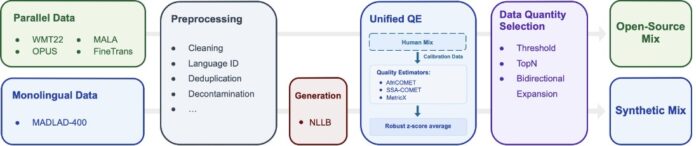
African language training data has a quality problem. The large public repositories researchers rely on are noisy, heavily duplicated, and inconsistently aligned. The team pulled together roughly 427 million raw sentence pairs from open sources, but raw volume did not translate into quality.
To fix this, the researchers built what they call unified quality estimation. Instead of trusting a single automated quality score, they combined three existing scoring tools (AfriCOMET, SSA-COMET and MetricX) into one normalized score.
They calibrated each against a benchmark of around 352,000 human-translated sentence pairs. Researchers then graded each candidate sentence pair against that human standard and discarded anything that fell short.
The results were striking. A model trained on the full, unfiltered open-source pool used nearly 45 billion training tokens. A model trained on the filtered version used just 1.76 billion tokens and achieved a comparable score. That is a 96% cut in training data with no loss in quality.
The team also found that the direction of filtering matters. A sentence pair that looks good when scored from English to Hausa may score differently from Hausa to English. Scoring pairs in the same direction the model was trained on produced consistently better results, while scoring in the reverse direction noticeably degraded quality.
Why Synthetic Data Won
Here is where the story gets more interesting. The final TranslatePsy-AfriSLM models were not trained mainly on filtered open-source data. They were trained on filtered synthetic data.
The researchers took large amounts of monolingual text in each language and translated it using Meta’s NLLB-3.3B as a “teacher” model. They then applied the same strict quality filter to those machine translations.
Because synthetic data can be generated in huge volumes, the team could afford to set a much higher quality bar and still keep enough data to train on. The final training set came to about 32 billion tokens.
Two ironies stand out. First, the student now matches or beats its teacher. The 800M model trained on NLLB’s filtered output ties or edges out NLLB-3.3B itself.
Second, the TranslatePsy models are built by fine-tuning Alibaba’s own small Qwen3.5 models, which means a fine-tuned 0.8B Qwen model ended up beating the 122B flagship from the same family.
The lesson is clear. The researchers conclude that, given the current shortage of high-quality human-translated data for African languages, carefully filtered synthetic generation appears to be the most practical way forward. Human-translated data proved most valuable per sentence, but there simply isn’t enough of it.
Why Small Matters for Africa
A leaner model is not just an academic achievement. For African users, size is the difference between AI that works and AI that doesn’t.
Cloud-based translation depends on steady, affordable internet access, which remains patchy across much of the continent. A model with 800 million parameters can run entirely on the device, with no connection and no data sent to outside servers.
Tether says the models are designed for smartphones, laptops, and other edge devices, and it has published quantized (compressed) versions alongside the full-precision ones to make them lighter still. A separate, even smaller TranslatePsy-AfriNano model covers eight African languages.
For Nigeria in particular, the release is notable because it covers all three of the country’s major languages: Igbo, Hausa, and Yoruba. The paper’s data tables also show why this is hard.
In the open-source pool, millions of raw Igbo sentence pairs shrank to a small fraction once low-quality pairs were filtered out, reminding us how thin clean training data is for even widely spoken African languages.
The researchers also tested whether the model’s training transfers to languages it was never trained on. On eight held-out languages, including Akan, Bambara, Sepedi and Mooré, the 2B model improved on its base Qwen model in every case, with some of the biggest gains in the lowest-resourced languages. The improvement was less uniform than on the core 19, but it suggests the approach can stretch beyond its original list.
What the Research Doesn’t Claim, Yet
To their credit, the researchers are open about the limits.
Their evaluation relies on automated metrics, and they acknowledge that measuring absolute translation quality for African languages remains an open problem.
They say performance still has not reached the level of translation for European and Asian languages, and that expert human evaluation is needed to find errors that automated tools may miss.
They also flag a dialect issue. Because the training data comes largely from web text, the models may favor standardized written forms and under-represent regional dialects and oral traditions.
For languages like Yoruba or Hausa, which vary significantly from region to region, that matters. The team advises anyone deploying the models to audit them for local sensitivity first.
That caution is worth repeating for real-world use. Tether is pitching the models for education and health information, and a benchmark score is not the same as a translation a patient can safely rely on.
What This Means for the “Bigger Is Better” AI Race
TranslatePsy-AfriSLM joins a growing body of evidence that, for specialized tasks, curated data beats brute-force scale. The implications reach well beyond Africa.
For researchers working on any low-resource language, the paper offers a reusable recipe. Combine multiple quality scores, calibrate them against human translations, filter in the training direction, and lean on high-quality synthetic data.
For developers, it means capable translation can ship inside an app rather than behind a cloud API. For the continent, it challenges the idea that African users must wait for global AI labs, or for better networks, before they can benefit.
Tether CEO Paolo Ardoino framed the release in those terms, saying that
“language should not determine who can benefit from artificial intelligence.”
The models and the research data are available on Hugging Face, and because the weights are public, independent researchers can now test the claims for themselves. That scrutiny, especially from native speakers, will be the real benchmark.
TranslatePsy-AfriSLM is available for download on Hugging Face in three sizes (full-precision and smaller quantized versions):
- qvac/TranslatePsy-AfriSLM-0.8B
- qvac/TranslatePsy-AfriSLM-2B
- qvac/TranslatePsy-AfriSLM-4B
TranslatePsy-Nano is also available for download on Hugging Face. It supports both European and African language translation, with models offered in full-precision and quantized versions:
- qvac/TranslatePsy-EuroNano
- qvac/TranslatePsy-AfriNano
Frequently Asked Questions about TranslatePsy-AfriSLM
What is TranslatePsy-AfriSLM? TranslatePsy-AfriSLM is a family of open-source AI translation models from Tether AI Research, covering 19 Sub-Saharan African languages. It comes in 0.8B, 2B, and 4B parameter sizes and is designed to run offline on phones and laptops.
Which African languages does TranslatePsy-AfriSLM support? It supports Hausa, Amharic, Yoruba, Lingala, Swahili, Igbo, Zulu, Somali, Oromo, Malagasy, Kinyarwanda, Xhosa, Afrikaans, Wolof, Luganda, Nyanja, Shona, Tswana, and Southern Sotho.
Did the 800M model really beat Qwen3.5-122B? Yes, on the SSA-COMET metric, the 0.8B model scored higher than Qwen3.5-122B-A10B on FLORES-200, BOUQuET, and SMOL. Note that Qwen3.5-122B-A10B is a mixture-of-experts model with about 10 billion active parameters.
Is TranslatePsy-AfriSLM better than Meta’s NLLB? The 0.8B model ties NLLB-3.3B on FLORES-200 and edges ahead on BOUQuET and SMOL. The larger 2B and 4B versions beat NLLB more clearly.
Does TranslatePsy-AfriSLM need internet access? No. The models run locally on the device, so translations work offline, and user data stays on the phone or laptop.
Where can I download TranslatePsy-AfriSLM? The models are available for free on Hugging Face under the qvac/translatepsy-afrislm collection.